


Safety of tPA in stroke mimics and neuroimaging-negative cerebral ischemia
- PMID: 20335564
- PMCID: PMC2875935
- DOI: 10.1212/WNL.0b013e3181dad5a6
Safety of tPA in stroke mimics and neuroimaging-negative cerebral ischemia
Abstract
Background: Patients with acute neurologic symptoms may have other causes simulating ischemic stroke, called stroke mimics (SM), but they may also have averted strokes that do not appear as infarcts on neuroimaging, which we call neuroimaging-negative cerebral ischemia (NNCI). We determined the safety and outcome of IV thrombolysis within 3 hours of symptom onset in patients with SM and NNCI.
Methods: Patients treated with IV tissue plasminogen activator (tPA) within 3 hours of symptom onset were identified from our stroke registry from June 2004 to October 2008. We collected admission NIH Stroke Scale (NIHSS) score, modified Rankin score (mRS), length of stay (LOS), symptomatic intracerebral hemorrhage (sICH), and discharge diagnosis.
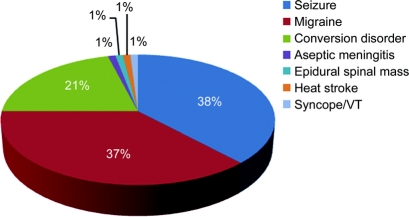
Results: Among 512 treated patients, 21% were found not to have an infarct on follow-up imaging. In the SM group (14%), average age was 55 years, median admission NIHSS was 7, median discharge NIHSS was 0, median LOS was 3 days, and there were no instances of sICH. The most common etiologies were seizure, complicated migraine, and conversion disorder. In the NNCI group (7%), average age was 61 years, median admission NIHSS was 7, median discharge NIHSS was 0, median LOS was 3 days, and there were no instances of sICH. Nearly all SM (87%) and NNCI (91%) patients were functionally independent on discharge (mRS 0-1).
Conclusions: Our data support the safety of administering IV tissue plasminogen activator to patients with suspected acute cerebral ischemia within 3 hours of symptom onset, even when the diagnosis ultimately is found not to be stroke or imaging does not show an infarct.
Comment in
-
Swift or sure?: The acceptable rate of neurovascular mimics among IV tPA-treated patients.Neurology. 2010 Apr 27;74(17):1336-7. doi: 10.1212/WNL.0b013e3181dbe0ad. Epub 2010 Mar 24. Neurology. 2010. PMID: 20335563 No abstract available.
-
Stroke: validation of the ABCD2 score, safety of tPA in stroke mimics and effects of robot-assisted therapy.J Neurol. 2010 Jun;257(6):1049-51. doi: 10.1007/s00415-010-5595-3. J Neurol. 2010. PMID: 20490820 No abstract available.
-
Safety of tPA in stroke mimics and neuroimaging-negative cerebral ischemia: swift or sure? The acceptable rate of neurovascular mimics among IV tPA-treated patients.Neurology. 2010 Nov 16;75(20):1853; author reply 1854. doi: 10.1212/WNL.0b013e3181fac7da. Neurology. 2010. PMID: 21079190 No abstract available.
-
Safety of tPA in stroke mimics and neuroimaging-negative cerebral ischemia: swift or sure? The acceptable rate of neurovascular mimics among IV tPA-treated patients.Neurology. 2010 Nov 16;75(20):1853-4; author reply 1854. Neurology. 2010. PMID: 21121100 No abstract available.
References
-
- D'Addesio JP. Should thrombolytic therapy be the first-line treatment for acute ischemic stroke? N Engl J Med 1998;338:762; author reply 762–763. - PubMed
-
- Hemmen TM, Meyer BC, McClean TL, Lyden PD. Identification of nonischemic stroke mimics among 411 code strokes at the University of California, San Diego, Stroke Center. J Stroke Cerebrovasc Dis 2008;17:23–25. - PubMed
-
- Saver JL. Time is brain: quantified. Stroke 2006;37:263–266. - PubMed
-
- Caplan LR, Mohr JP, Kistler JP, Koroshetz W. Should thrombolytic therapy be the first-line treatment for acute ischemic stroke? Thrombolysis: not a panacea for ischemic stroke. N Engl J Med 1997;337:1309–1310; discussion 1313. - PubMed
-
- Winkler DT, Fluri F, Fuhr P, et al. Thrombolysis in stroke mimics: frequency, clinical characteristics, and outcome. Stroke 2009;40:1522–1525. - PubMed
Publication types
MeSH terms
Substances
Grants and funding
LinkOut - more resources
Full Text Sources
Medical
Miscellaneous
