


Effect of virtual reality on time perception in patients receiving chemotherapy
- PMID: 20336327
- PMCID: PMC3673561
- DOI: 10.1007/s00520-010-0852-7
Effect of virtual reality on time perception in patients receiving chemotherapy
Abstract
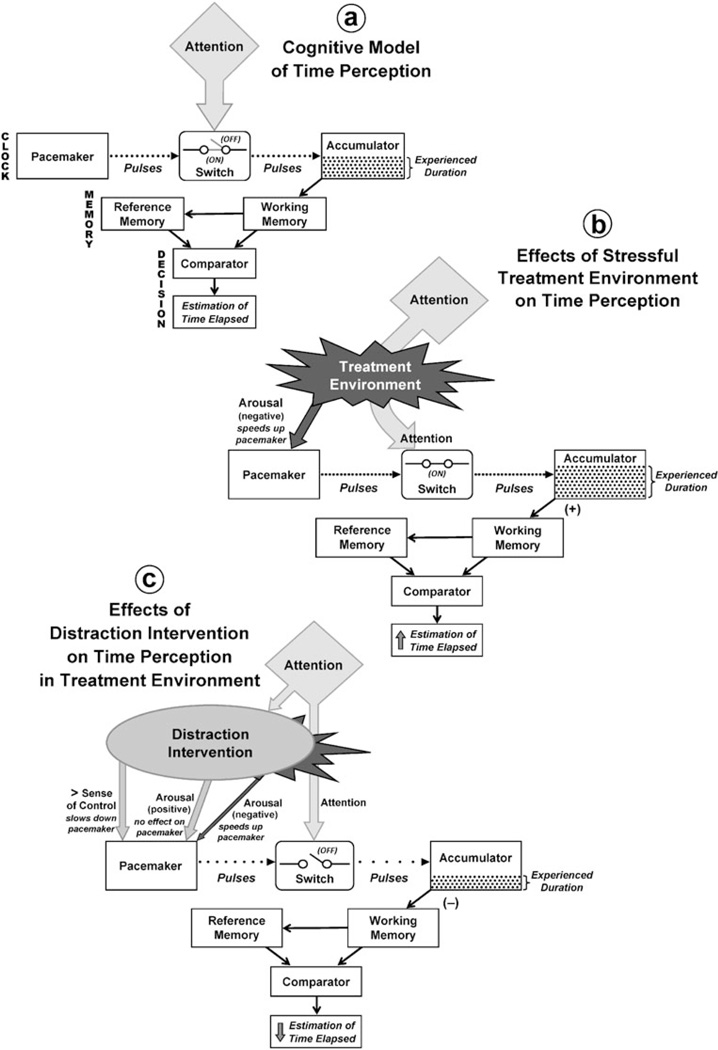
Purpose: Virtual reality (VR) during chemotherapy has resulted in an elapsed time compression effect, validating the attention diversion capabilities of VR. Using the framework of the pacemaker-accumulator cognitive model of time perception, this study explored the influence of age, gender, state anxiety, fatigue, and cancer diagnosis in predicting the difference between actual time elapsed during receipt of intravenous chemotherapy while immersed in a VR environment versus patient's retrospective estimates of time elapsed during this treatment.
Materials and methods: This secondary analysis from three studies yielded a pooled sample of N = 137 participants with breast, lung, or colon cancer. Each study employed a crossover design requiring two matched intravenous chemotherapy treatments, with participants randomly assigned to receive VR during one treatment. Regressions modeled the effect of demographic variables, diagnosis, and Piper Fatigue Scale and State Anxiety Inventory scores on the difference between actual and estimated time elapsed during chemotherapy with VR.
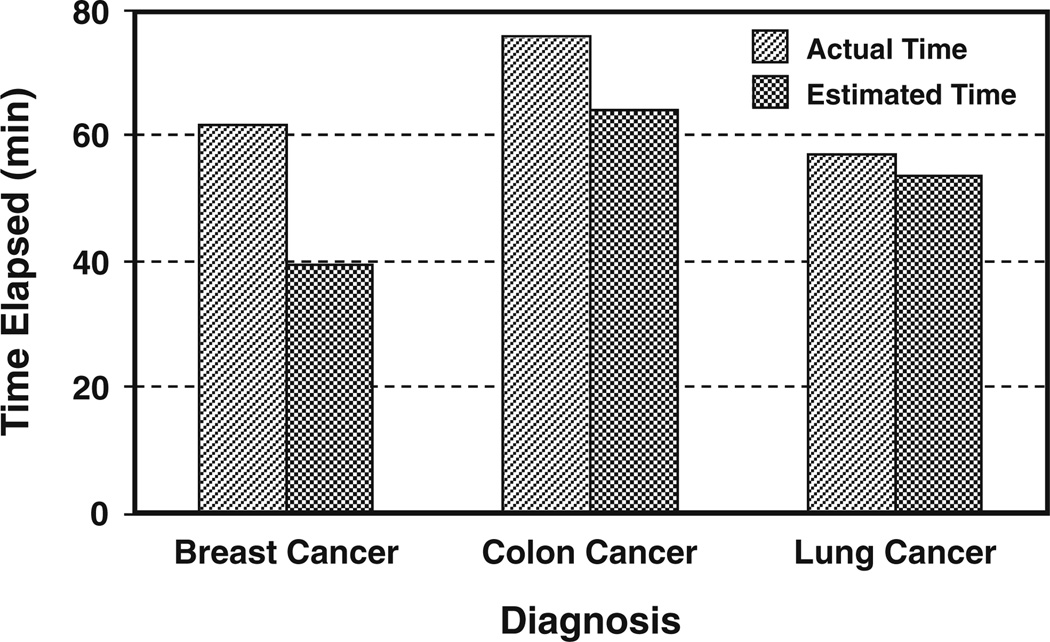
Results: In a forward regression model, three predictors (diagnosis, gender, and anxiety) explained a significant portion of the variability for altered time perception (F=5.06, p = 0.0008). Diagnosis was the strongest predictor; individuals with breast and colon cancer perceived time passed more quickly.
Conclusions: VR is a noninvasive intervention that can make chemotherapy treatments more tolerable. Women with breast cancer are more likely and lung cancer patients less likely to experience altered time perception during VR (a possible indicator of effectiveness for this distraction intervention). Understanding factors that predict responses to interventions can help clinicians tailor coping strategies to meet each patient's needs.
Conflict of interest statement
Figures
References
-
- Abetz L, Coombs JH, Keininger DL, Earle CC, Wade C, Bury-Maynard D, Copley-Merriman K, Hsu M-A. Development of the cancer therapy satisfaction questionnaire: item generation and content validity testing. Value Health. 2005;8(Suppl 1):S41–S53. - PubMed
-
- Bell K. ‘If it almost kills you that means it’s working!’ Cultural models of chemotherapy expressed in a cancer support group. Soc Sci Med. 2009;68(1):169–176. - PubMed
-
- Brañas-Garza P, Espinosa-Fernández L, Serrano-del-Rosal R. Effects of gender and age on retrospective time judgements. Time Soc. 2007;16(1):99–118.
-
- Buhusi CV, Meck WH. What makes us tick? Functional and neural mechanisms of interval timing. Nat Rev Neurosci. 2005;6(10):755–765. - PubMed
-
- Burle B, Casini L. Dissociation between activation and attention effects in time estimation: implications for internal clock models. J Exp Psychol Hum Percept Perform. 2001;27(1):195–205. - PubMed
Publication types
MeSH terms
Substances
Grants and funding
LinkOut - more resources
Full Text Sources
Medical
