


Structural integrity of callosal midbody influences intermanual transfer in a motor reaction-time task
- PMID: 20336657
- PMCID: PMC6870465
- DOI: 10.1002/hbm.21011
Structural integrity of callosal midbody influences intermanual transfer in a motor reaction-time task
Abstract
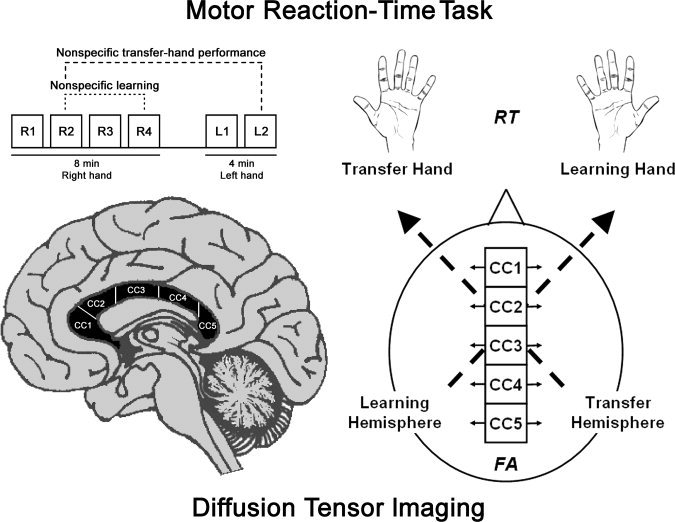
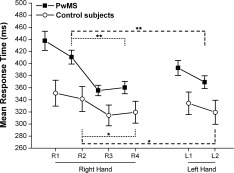
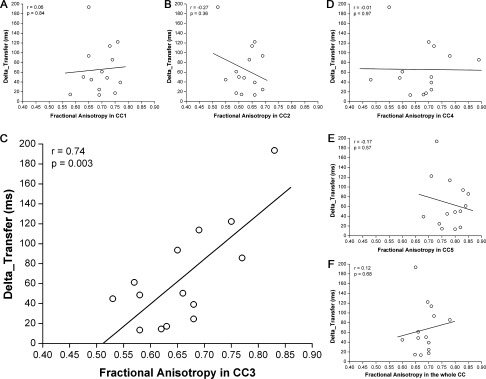
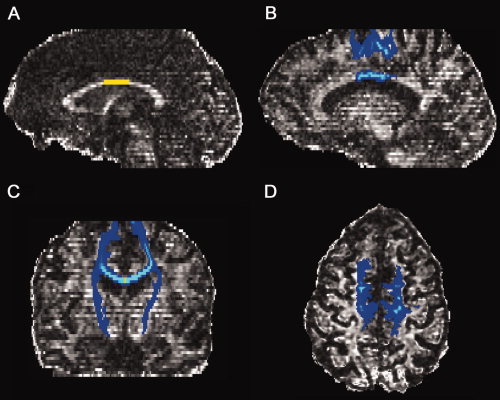
Training one hand on a motor task results in performance improvements in the other hand, also when stimuli are randomly presented (nonspecific transfer). Corpus callosum (CC) is the main structure involved in interhemispheric information transfer; CC pathology occurs in patients with multiple sclerosis (PwMS) and is related to altered performance of tasks requiring interhemispheric transfer of sensorimotor information. To investigate the role of CC in nonspecific transfer during a pure motor reaction-time task, we combined motor behavior with diffusion tensor imaging analysis in PwMS. Twenty-two PwMS and 10 controls, all right-handed, were asked to respond to random stimuli with appropriate finger opposition movements with the right (learning) and then the left (transfer) hand. PwMS were able to improve motor performance reducing response times with practice with a trend similar to controls and preserved the ability to transfer the acquired motor information from the learning to the transfer hand. A higher variability in the transfer process, indicated by a significantly larger standard deviation of mean nonspecific transfer, was found in the PwMS group with respect to the control group, suggesting the presence of subtle impairments in interhemispheric communication in some patients. Then, we correlated the amount of nonspecific transfer with mean fractional anisotropy (FA) values, indicative of microstructural damage, obtained in five CC subregions identified on PwMS's FA maps. A significant correlation was found only in the subregion including posterior midbody (Pearson's r = 0.74, P = 0.003), which thus seems to be essential for the interhemispheric transfer of information related to pure sensorimotor tasks.
Copyright © 2010 Wiley-Liss, Inc.
Figures
References
-
- Anderson V, Fisniku L, Altmann D, Thompson A, Miller D ( 2009): MRI measures show significant cerebellar gray matter volume loss in multiple sclerosis and are associated with cerebellar dysfunction. Mult Scler 15: 811–817. - PubMed
-
- Birbaumer N ( 2007): Motor learning: Passing a skill from one hand to the other. Curr Biol 17: R1024–R1026. - PubMed
-
- Bove M, Tacchino A, Novellino A, Trompetto C, Abbruzzese G, Ghilardi MF ( 2007): The effects of rate and sequence complexity on repetitive finger movements. Brain Res 1153: 84–91. - PubMed
-
- Casadio M, Sanguineti V, Morasso P, Solaro C ( 2008): Abnormal sensorimotor control, but intact force field adaptation, in multiple sclerosis subjects with no clinical disability. Mult Scler 14: 330–342. - PubMed
Publication types
MeSH terms
LinkOut - more resources
Full Text Sources
