


Sleep duration and five-year abdominal fat accumulation in a minority cohort: the IRAS family study
- PMID: 20337186
- PMCID: PMC2831422
- DOI: 10.1093/sleep/33.3.289
Sleep duration and five-year abdominal fat accumulation in a minority cohort: the IRAS family study
Abstract
Study objectives: To study 5-year change in computed tomography (CT)-derived visceral adipose tissue (VAT) and subcutaneous adipose tissue (SAT) associated with sleep duration in 2 minority groups.
Design: Longitudinal epidemiologic study.
Setting: Three US communities.
Participants: African Americans (N = 332) and Hispanic Americans (N = 775), aged 18-81 years, participating in the IRAS Family Study.
Interventions: none
Measurements and results: Abdominal CT scans and BMI obtained at a 5-year interval. Sleep duration was assessed by questionnaire at baseline and categorized as < or = 5 h, 6-7 h, and > or = 8 h. Generalized estimating equations assessed the association between sleep duration and 5-year fat accumulation with adjustment for age, race, gender, study site, baseline fat measure, physical activity, total calories, smoking status, and education. Age interacted with sleep duration to predict change in fat measures (P < 0.01). In those younger than 40 years, < or = 5 h of sleep was related to a greater accumulation of BMI (1.8 kg/m2, P < 0.001), SAT (42 cm2, P < 0.0001), and VAT (13 cm2, P > 0.01), compared to sleep duration between 6 and 7 h. Eight hours or more of sleep was also significantly related to a greater accumulation of BMI (0.8 kg/m2, P < 0.001), SAT (20 cm2, P < 0.01) and VAT (6 cm2, P < 0.05) compared to sleep duration between 6 and 7 h. No significant relationship existed between sleep duration and fat depot change in participants older than 40 years old.
Conclusions: In this minority cohort, extremes of sleep duration are related to increases in BMI, SAT, and VAT in persons younger than 40 years old.
Figures
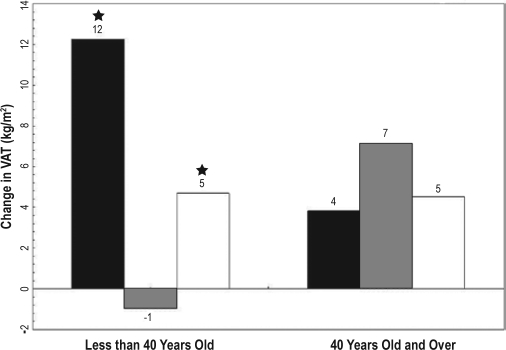
 6 to 7 h, □ ≤ 8 h; VAT (visceral adipose tissue); (★) Indicates significant difference from 6 to 7 h (P > 0.01). Model adjusted for age, gender, center/race, baseline fat, and age.
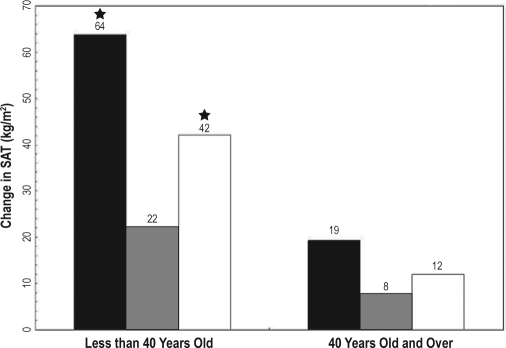 6 to 7 h, □ ≥ 8 h; SAT (subcutaneous adipose tissue); (★) Indicates significant difference from 6 to 7 h (P > 0.01). Model adjusted for age, gender, center/race, baseline fat, and age.
References
-
- Lovejoy JC, Smith SR, Rood JC. Comparison of regional fat distribution and health risk factors in middle-aged white and African American women: the healthy transitions study. Obesity. 2001;9:10–6. - PubMed
-
- Foundation NS. Washington, DC: 2009 Sleep in America Poll; 2009.
-
- Dinges DF Pack F, Williams K, et al. Cumulative sleepiness, mood disturbance, and psychomotor vigilance performance decrements during a week of sleep restricted to 4-5 hours per night. Sleep. 1997;20:267–77. - PubMed
-
- Spiegel K, Tasali E, Penev P, Van Cauter E. Brief Communication: sleep curtailment in healthy young men is associated with decreased leptin levels, elevated ghrelin levels, and increased hunger and appetite. Ann Intern Med. 2004;141:846–50. - PubMed
-
- Herva A, Laitinen J, Miettunen J, et al. Obesity and depression: results from the longitudinal Northern Finland 1966 Birth Cohort Study. Int J Obes. 2005;30:520–7. - PubMed
Publication types
MeSH terms
Grants and funding
LinkOut - more resources
Full Text Sources
Medical
Research Materials
