


Sleep measures and morning plasma TNF-alpha levels in children with sleep-disordered breathing
- PMID: 20337189
- PMCID: PMC2831425
- DOI: 10.1093/sleep/33.3.319
Sleep measures and morning plasma TNF-alpha levels in children with sleep-disordered breathing
Abstract
Background: Sleep disordered breathing in children is associated with severity-dependent increases in excessive daytime sleepiness (EDS). TNF-alpha is an inflammatory cytokine that has been implicated in EDS. Since, at any given level of apnea-hypopnea index, there is significant variability in EDS, we hypothesized that morning tumor necrosis factor (TNF)-alpha plasma levels may provide a biologic correlate of EDS.
Methods: Children being evaluated for sleep disordered breathing underwent a blood draw after nocturnal polysomnography, and TNF-alpha plasma concentrations were assayed using ELISA. In a subset of 15 children with sleep disordered breathing and in 15 matched control subjects, whole blood cultures in the presence of lipopolysaccharide and Multiple Sleep Latency Test were conducted. Furthermore, 22 children with obstructive sleep apnea had TNF-alpha levels assayed and underwent nocturnal polysomnography and Multiple Sleep Latency Test before and after adenotonsillectomy.
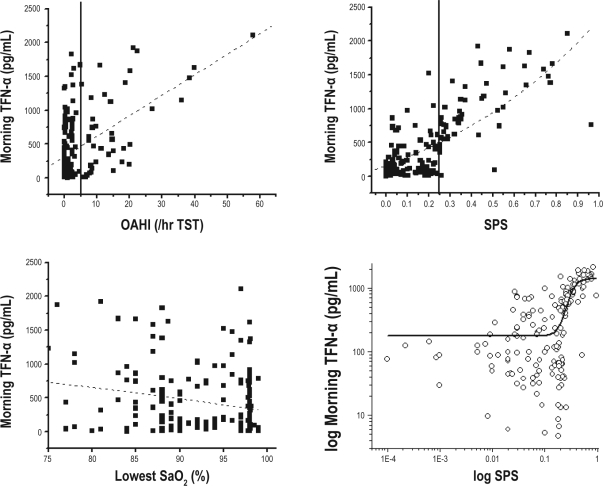
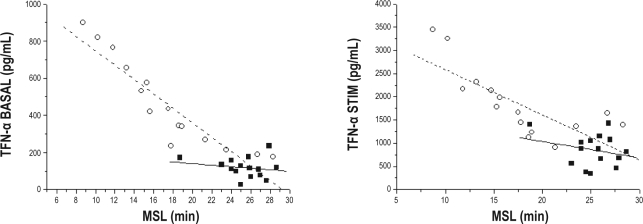
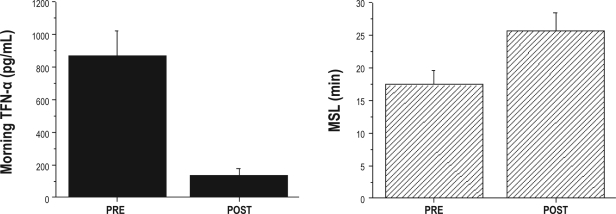
Results: In 298 children, morning TNF-alpha levels were globally increased in the presence of obstructive sleep apnea, particularly in more severe cases, and correlated with obstructive apnea-hypopnea index and sleep pressure score, a measure of respiratory-induced sleep fragmentation, but not with nadir Sa02. A stepwise logistic regression analysis revealed that sleep pressure score and body mass index accounted for 36.2% of the adjusted variance in TNF-alpha levels (P < 0.0001). Furthermore, multiple sleep latencies were correlated with whole blood culture-derived TNF-alpha levels (n = 15), and morning TNF-alpha levels decreased after adenotonsillectomy in 22 children.
Conclusions: TNF-alpha levels are increased in pediatric obstructive sleep apnea, are primarily driven by sleep fragmentation and body mass index, and are closely associated with the degree of sleepiness, as measured by Multiple Sleep Latency Test. Furthermore, surgical treatment of obstructive sleep apnea results in significant reductions in TNF-alpha levels with reciprocal prolongations in sleep latency.
Figures
References
-
- Carroll JL, McColley SA, Marcus CL, Curtis S, Loughlin GM. Inability of clinical history to distinguish primary snoring from obstructive sleep apnea syndrome in children. Chest. 1995;108:610–8. - PubMed
-
- Gozal D, Wang M, Pope DW., Jr. Objective sleepiness measures in pediat-Objective sleepiness measures in pediatric obstructive sleep apnea. Pediatrics. 2001;108:693–7. - PubMed
-
- Melendres MC, Lutz JM, Rubin ED, Marcus CL. Daytime sleepiness and hyperactivity in children with suspected sleep-disordered breathing. Pediatrics. 2004;114:768–75. - PubMed
-
- Gozal D, Kheirandish-Gozal L. Obesity and excessive daytime sleepiness in pre-pubertal children with obstructive sleep apnea. Pediatrics. 2009;123:13–8. - PubMed
Publication types
MeSH terms
Substances
Grants and funding
LinkOut - more resources
Full Text Sources
