The natural tumor suppressor protein maspin and potential application in non small cell lung cancer
- PMID: 20337574
- PMCID: PMC2908495
- DOI: 10.2174/138161210791208974
The natural tumor suppressor protein maspin and potential application in non small cell lung cancer
Abstract
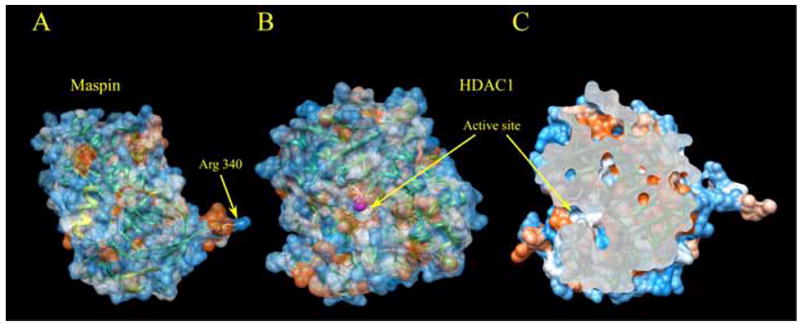
The grim prognosis of lung cancer, that has an overall 10-15% survival at 5 years, remains in the US the leading cause of cancer mortality, provides a compelling rationale for studying the molecular basis of this malignancy. Surmising the common, general association with smoking, lung cancers differ at the microscopic, anatomical, epidemiological and clinical level and harbor complex genetic and epigenetic alterations. Currently, lung cancer is divided into small cell lung carcinoma (SCLC) and non small cell lung carcinoma (NSCLC) for the purpose of clinical management. (NSCLC) constitutes 80-85% of lung cancers and is further divided into histological subtypes such as adenocarcinoma, squamous cell carcinoma, and large cell carcinoma, etc. The ultimate goal for lung cancer research is to develop a strategy to block the tumor progression and improve the prognosis of lung cancer. This goal can realistically be achieved only when the biological complexity of this disease is taken into account. To this end, identification and understanding of molecular markers that are mechanistically involved in tumor progression is needed. Our recent studies suggest histological subtype-dependent distinct correlations between the expression and/or subcellular localization of tumor suppressive maspin with the progression and prognosis of NSCLC. Maspin is an epithelial specific member of the serine protease inhibitor (serpin) superfamily but recently identified as an endogenous inhibitor of histone deacetylase 1 (HDAC1). This novel biochemical activity coincides with a consensus emerged recently from the evidence that nuclear maspin confers better differentiated epithelial phenotypes, decreased tumor angiogenesis, increased tumor sensitivity to drug-induced apoptosis, and a more favorable prognosis. In the current review, we discuss the evidence that maspin may be a marker that stratifies the progression and prognosis of different subtypes of NSCLC.
Figures
References
-
- Scagliotti GV, De Marinis F, Rinaldi M, Crino L, Gridelli C, Ricci S, et al. The role of histology with common first-line regimens for advanced non-small cell lung cancer: a brief report of the retrospective analysis of a three-arm randomized trial. J Thorac Oncol. 2009;4:1568–71. - PubMed
-
- Panani AD, Roussos C. Cytogenetic and molecular aspects of lung cancer. Cancer Lett. 2006;239:1–9. - PubMed
-
- Sy SM, Wong N, Lee TW, Tse G, Mok TS, Fan B, et al. Distinct patterns of genetic alterations in adenocarcinoma and squamous cell carcinoma of the lung. Eur J Cancer. 2004;40:1082–94. - PubMed
-
- Blankenburg F, Hatz R, Nagel D, Ankerst D, Reinmiedl J, Gruber C, et al. Preoperative CYFRA 21–1 and CEA as prognostic factors in patients with stage I non-small cell lung cancer: external validation of a prognostic score. Tumour Biol. 2008;29:272–7. - PubMed
Publication types
MeSH terms
Substances
Grants and funding
LinkOut - more resources
Full Text Sources
Other Literature Sources
Medical
Miscellaneous