


B cell depletion in diffuse progressive systemic sclerosis: safety, skin score modification and IL-6 modulation in an up to thirty-six months follow-up open-label trial
- PMID: 20338043
- PMCID: PMC2888203
- DOI: 10.1186/ar2965
B cell depletion in diffuse progressive systemic sclerosis: safety, skin score modification and IL-6 modulation in an up to thirty-six months follow-up open-label trial
Abstract
Introduction: An over-expression of CD19 has been shown in B cells of systemic sclerosis (SSc) and B cells are thought to contribute to the induction of skin fibrosis in the tight skin mouse model. The aim was to define the outcome on safety and the change in skin score after rituximab therapy in SSc patients and to correlate the clinical characteristics with the levels of interleukin (IL)-6 and with the immune cell infiltrate detected by immunohistochemistry.
Methods: Nine patients with SSc with mean age 40.9 +/- 11.1 years were treated with anti-CD20, 1 g at time 0 and after 14 days. Skin biopsy was performed at baseline and during the follow-up. B-cell activating factor (BAFF) and IL-6 levels were also determined at the follow-up times.
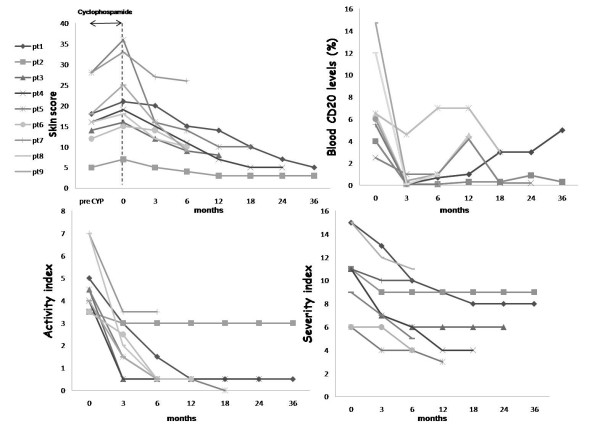
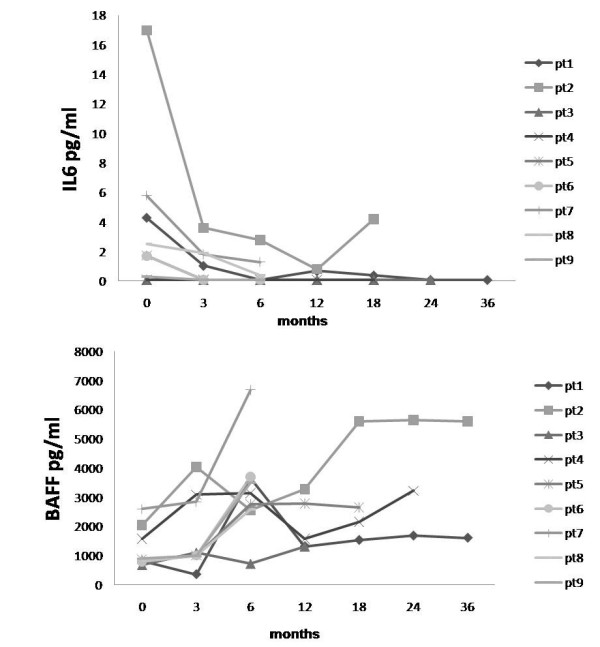
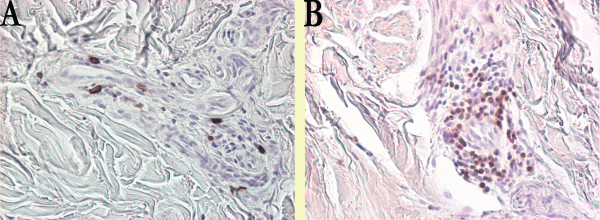
Results: After 6 months patients presented a median decrease of the skin score of 43.3% (range 21.1-64.0%), and a decrease in disease activity index and disease severity index. IL-6 levels decreased permanently during the follow up. After treatment, a complete depletion of peripheral blood B cells was observed in all but 2 patients. Only 3 patients presented CD20 positive cells in the biopsy of the involved skin at baseline.
Conclusions: Anti-CD20 treatment has been well tolerated and SSc patients experienced an improvement of the skin score and of clinical symptoms. The clear fall in IL-6 levels could contribute to the skin fibrosis improvement, while the presence of B cells in the skin seems to be irrelevant with respect to the outcome after B cell depletion.
Trial registration: ISRCTN77554566.
Figures
Comment in
-
B-cell depletion with rituximab: a promising treatment for diffuse cutaneous systemic sclerosis.Arthritis Res Ther. 2010;12(2):112. doi: 10.1186/ar2977. Epub 2010 Apr 22. Arthritis Res Ther. 2010. PMID: 20441607 Free PMC article.
References
-
- Famularo G, Giacomelli R, Alesse E, Cifone MG, Morrone S, Boirivant M, Danese C, Perego MA, Santoni A, Tonietti G. Polyclonal B lymphocyte activation in progressive systemic sclerosis. J Clin Lab Immunol. 1989;29:59–63. - PubMed
-
- Sato S, Hasegawa M, Fujimoto M, Tedder TF, Takehara K. Quantitative genetic variation in CD19 expression correlates with autoimmunity. J Immunol. 2000;165:6635–6643. - PubMed
-
- Whitfield ML, Finlay DR, Murray JI, Troyanskaya OG, Chi JT, Pergamenschikov A, McCalmont TH, Brown PO, Botstein D, Connolly MK. Systemic and cell type-specific gene expression patterns in scleroderma skin. Proc Natl Acad Sci USA. 2003;100:12319–12324. doi: 10.1073/pnas.1635114100. - DOI - PMC - PubMed
Publication types
MeSH terms
Substances
LinkOut - more resources
Full Text Sources
Other Literature Sources
Medical
