


Human PON1, a biomarker of risk of disease and exposure
- PMID: 20338154
- PMCID: PMC3035622
- DOI: 10.1016/j.cbi.2010.03.033
Human PON1, a biomarker of risk of disease and exposure
Abstract
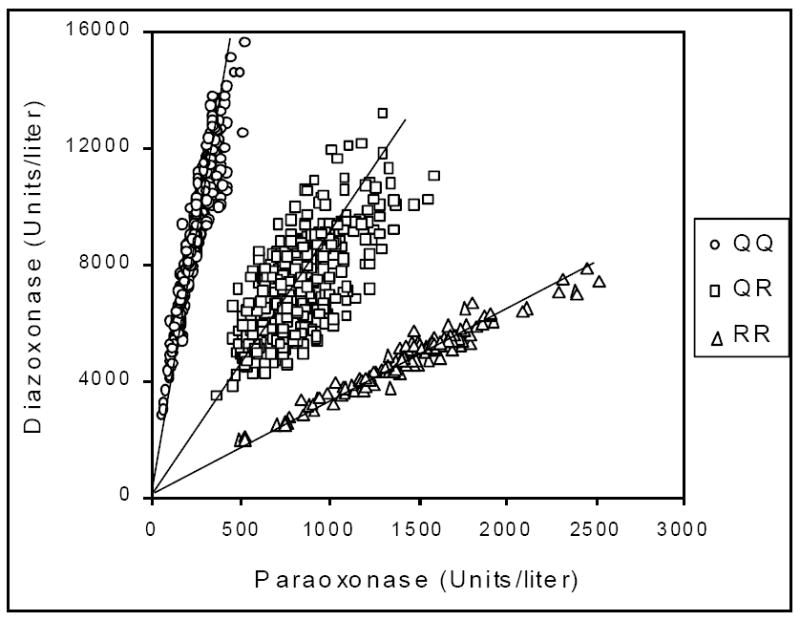
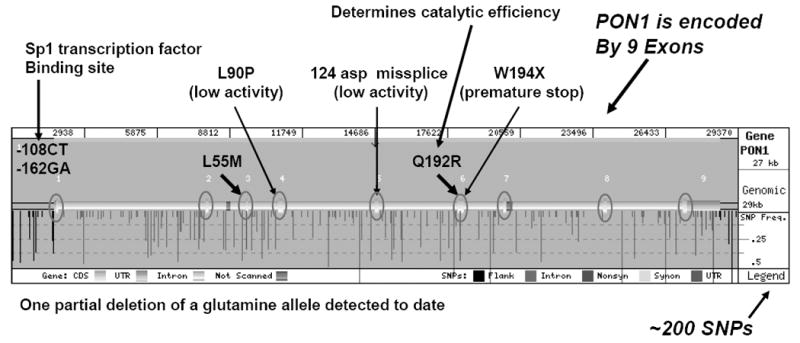
Human paraoxonase 1 (PON1) is a high-density lipoprotein (HDL)-associated serum enzyme that exhibits a broad substrate specificity. In addition to protecting against exposure to some organophosphorus (OP) pesticides by hydrolyzing their toxic oxon metabolites, PON1 is important in protecting against vascular disease by metabolizing oxidized lipids. Recently, PON1 has also been shown to play a role in inactivating the quorum sensing factor N-(3-oxododecanoyl)-l-homoserine lactone (3OC12-HSL) of Pseudomonas aeruginosa. Native, untagged engineered recombinant human PON1 (rHuPON1) expressed in Escherichia coli and purified by conventional column chromatographic purification is stable, active, and capable of protecting PON1 knockout mice (PON1(-/-)) from exposure to high levels of the OP compound diazoxon. The bacterially derived rHuPON1 can be produced in large quantities and lacks the glycosylation of eukaryotic systems that can produce immunogenic complications when inappropriately glycosylated recombinant proteins are used as therapeutics. Previous studies have shown that the determination of PON1 status, which reveals both PON1(192) functional genotype and serum enzyme activity level, is required for a meaningful evaluation of PON1's role in risk of disease or exposure. We have developed a new two-substrate assay/analysis protocol that provides PON1 status without use of toxic OP substrates, allowing for use of this protocol in non-specialized laboratories. Factors were also determined for inter-converting rates of hydrolysis of different substrates. PON1 status also plays an important role in revealing changes in HDL-associated PON1 activities in male patients with Parkinson disease (PD). Immunolocalization studies of PONs 1, 2 and 3 in nearly all mouse tissues suggest that the functions of PONs 1 and 3 extend beyond the plasma and the HDL particle.
Copyright (c) 2010. Published by Elsevier Ireland Ltd.
Conflict of interest statement
The authors declare that there are no conflicts of interest.
Figures
References
-
- Geldmacher-von Mallinckrodt M, D TL. The Human Serum Paraoxonase-Polymorphism and Specificity. Toxicological and Environmental Chemistry. 1988;18:79–196.
-
- Richter RJ, Furlong CE. Determination of paraoxonase (PON1) status requires more than genotyping. Pharmacogenetics. 1999;9:745–53. - PubMed
Publication types
MeSH terms
Substances
Grants and funding
- HL67406/HL/NHLBI NIH HHS/United States
- ES09601/ES/NIEHS NIH HHS/United States
- ES09883/ES/NIEHS NIH HHS/United States
- R01 NS065070/NS/NINDS NIH HHS/United States
- ES07033/ES/NIEHS NIH HHS/United States
- P30 ES007033/ES/NIEHS NIH HHS/United States
- R01 HL067406/HL/NHLBI NIH HHS/United States
- P50 NS062684/NS/NINDS NIH HHS/United States
- ES04696/ES/NIEHS NIH HHS/United States
- P01 ES009601/ES/NIEHS NIH HHS/United States
- R01 ES009883/ES/NIEHS NIH HHS/United States
- P42 ES004696/ES/NIEHS NIH HHS/United States
LinkOut - more resources
Full Text Sources
Other Literature Sources
Miscellaneous
