Review
. 2010 Jul 14;100(5):419-28.
doi: 10.1016/j.physbeh.2010.03.009. Epub 2010 Mar 23.

Role of orexin/hypocretin in reward-seeking and addiction: implications for obesity

Affiliations
Review

Role of orexin/hypocretin in reward-seeking and addiction: implications for obesity

Angie M Cason et al. Physiol Behav. .

Abstract

Orexins (also named hypocretins) are recently discovered neuropeptides made exclusively in the hypothalamus. Recent studies have shown that orexin cells located specifically in lateral hypothalamus (LH) are involved in motivated behavior for drugs of abuse as well as natural rewards. Administration of orexin has been shown to stimulate food consumption, and orexin signaling in VTA has been implicated in intake of high-fat food. In self-administration studies, the orexin 1 receptor antagonist SB-334867 (SB) attenuated operant responding for high-fat pellets, sucrose pellets and ethanol, but not cocaine, demonstrating that signaling at orexin receptors is necessary for reinforcement of specific rewards. The orexin system is also implicated in associations between rewards and relevant stimuli. For example, Fos expression in LH orexin neurons varied in proportion to conditioned place preference (CPP) for food, morphine, or cocaine. This Fos expression was altered accordingly for CPP administered during protracted abstinence from morphine or cocaine, when preference for natural rewards was decreased and drug preference was increased. Additionally, orexin has been shown to be involved in reward-stimulus associations in the self-administration paradigm, where SB attenuated cue-induced reinstatement of extinguished sucrose- or cocaine-seeking. Although the specific circuitry mediating the effects of orexin on food reward remains unknown, VTA seems likely to be a critical target for at least some of these orexin actions. Thus, recent studies have established a role for orexin in reward-based feeding, and further investigation is warranted for determining whether function/dysfunction of the orexin system may contribute to the overeating associated with obesity. The paper represents an invited review by a symposium, award winner or keynote speaker at the Society for the Study of Ingestive Behavior [SSIB] Annual Meeting in Portland, July 2009.


Figures

Figure 1
Figure 1
Attenuation of DAMGO-induced high-fat diet intake following pretreatment with the OxR1 antagonist, SB-334867, in the VTA. Rats were given SB (15 nmol/side) or vehicle in VTA, and DAMGO (250 ng) in NAc, following overnight presentation of high-fat. Bars that do not share the same letter are significantly different from each other (p<0.05), based on ANOVA for high-fat diet. Effects on DAMGO-induced high-fat intake are shown. Adapted from [37].
Figure 2
Figure 2
Attenuation of sucrose self-administration following pretreatment with the OxR1 antagonist SB-334867. Ad libitum fed (A) and food-restricted (B) rats were given SB (10, 20, 30 mg/kg, i.p.) or vehicle prior to self-administration sessions following at least 10 days of previous self-administration sessions. Effects on the number of earned reinforcers are shown (*p<0.05). SB doses were compared to vehicle treatment using a between-subjects design.
Figure 3
Figure 3
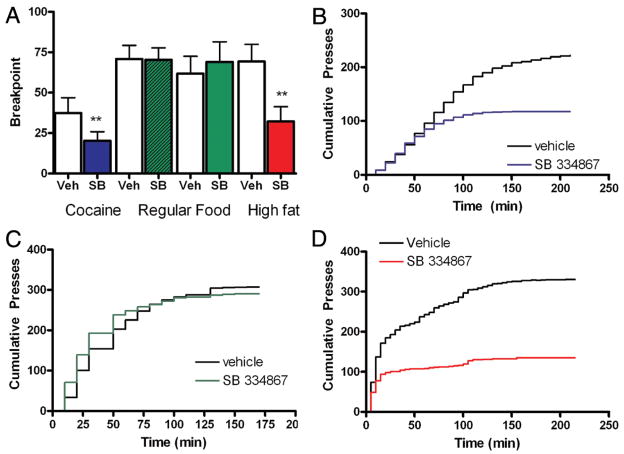
Attenuation of progressive ratio (PR) responding for high-fat chocolate (red bars) or cocaine (blue bars) following pretreatment with the OrxR1 antagonist SB-3348667 (10 mg/kg). There was no effect on PR responding for regular chow (SB 10 mg/kg, green hatched bars; SB 20 mg/kg, green bars). Effects on breakpoint (A) and cumulative presses (B–D) are shown (**p<0.001). Taken from [45].
Figure 4
Figure 4
Photomicrograph of divisions of hypothalamic neurons expressing orexin (brown cytoplasm) as described in [46]. All orexin labelled neurons lateral to the fornix (f) are considered lateral hypothalamus (LH). Orexin labelled neurons dorsal and 0.4mm medial to the fornix are considered perifornical hypothalamus (PFA). All remaining orexin labelled neurons from the medial edge of the PFA region to the third ventricle (3V) are considered dorsomedial hypothalamus (DMH). Opt = optic tract
Figure 5
Figure 5
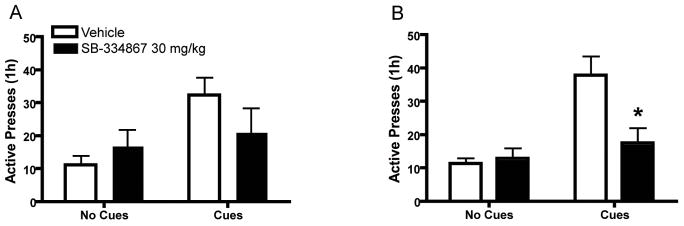
Attenuation of sucrose-seeking behavior elicited by conditioned cues following pretreatment with the OxR1 antagonist SB-334867. Ad libitum fed (A) and food restricted (B) rats were given SB (30 mg/kg, i.p.) or vehicle prior to reinstatement of extinguished sucrose-seeking by discrete tone + light cues. Effects on active lever presses are shown (*p<0.05). SB was compared to vehicle treatment in the same animals using a within-subjects design. Note that SB significantly decreased presses in food-restricted, but not in ad lib-fed, rats.
Figure 6
Figure 6
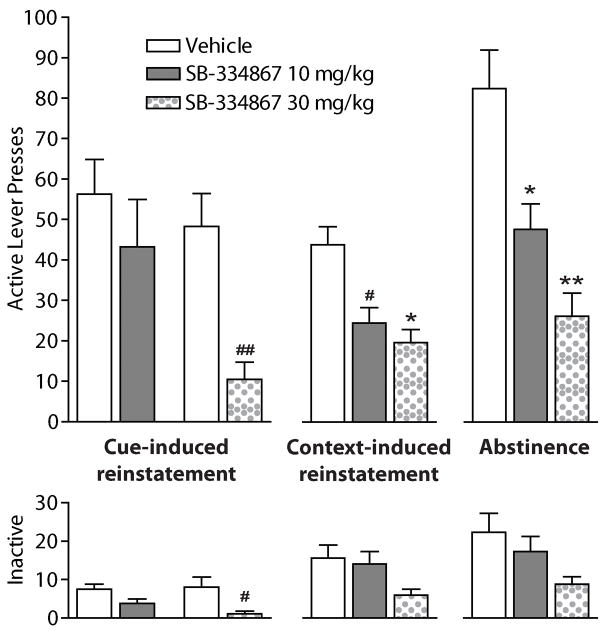
Attenuation of cocaine-seeking behavior elicited by conditioned cues following pretreatment with the OxR1 antagonist SB-334867. Rats were given SB (10 or 30 mg/kg, i.p., shown here) or vehicle prior to: reinstatement of extinguished cocaine-seeking by discrete tone + light cues (left panels), reinstatement of extinguished cocaine-seeking by contextual cues (center panels), or cocaine-seeking following 2 weeks of abstinence in the home cage (right panels). Effects on active and inactive lever pressing are shown (#p < 0.05, *p < 0.01, ##p < 0.001, **p < 0.0005). For cue-induced reinstatement, SB was compared to vehicle treatment in the same animals using a within-subjects design. For context-induced reinstatement and abstinence, SB was compared to vehicle and other doses of SB in a between-subjects design. Modified from [43,63].
Figure 7
Figure 7
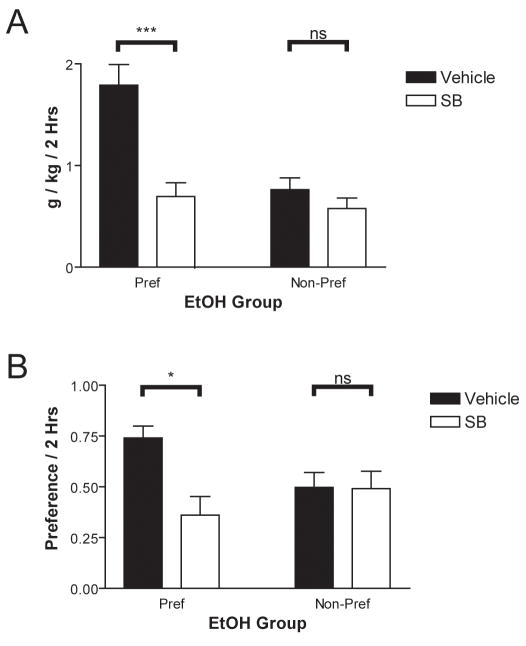
Attenuation of ethanol intake and ethanol preference in ethanol-preferring rats following pretreatment with the Orx1 antagonist SB 33-4867. Effects on A) ethanol intake and B) ethanol preference are shown (*p < 0.05, ***p < 0.001). SB was compared to vehicle treatment in the same animals using a within-subjects design.
Figure 8
Figure 8
Percentage of LH orexin neurons expressing Fos following preference testing for food, morphine, or cocaine in a CPP paradigm. Some animals were implanted with morphine or placebo pellets for 2 weeks, remained in their home cages for 5 weeks, and then underwent CPP conditioning for morphine or food [73,76]. Naïve animals underwent CPP conditioning for cocaine, or had no conditioning at all. Note that a higher percentage of LH orexin neurons exhibited Fos in withdrawn animals than in placebo-pelleted animals following morphine CPP testing. Conversely, a lower percentage of LH orexin neurons exhibited Fos in withdrawn animals than in placebo-pelleted animals following food CPP testing. Cocaine, morphine, or food CPP testing increased Fos expression in LH orexin neurons, as compared to non-conditioned controls. Taken from [31].

References

    1. de Lecea L, Kilduff TS, Peyron C, Gao X, Foye PE, Danielson PE, Fukuhara C, Battenberg EL, Gautvik VT, Bartlett FS, 2nd, Frankel WN, van den Pol AN, Bloom FE, Gautvik KM, Sutcliffe JG. The hypocretins: hypothalamus-specific peptides with neuroexcitatory activity. Proc Natl Acad Sci U S A. 1998;95:322–327. - PMC - PubMed
    1. Sakurai T, Amemiya A, Ishii M, Matsuzaki I, Chemelli RM, Tanaka H, Williams SC, Richardson JA, Kozlowski GP, Wilson S, Arch JR, Buckingham RE, Haynes AC, Carr SA, Annan RS, McNulty DE, Liu WS, Terrett JA, Elshourbagy NA, Bergsma DJ, Yanagisawa M. Orexins and orexin receptors: a family of hypothalamic neuropeptides and G protein-coupled receptors that regulate feeding behavior. Cell. 1998;92:573–585. - PubMed
    1. Zhu Y, Miwa Y, Yamanaka A, Yada T, Shibahara M, Abe Y, Sakurai T, Goto K. Orexin receptor type-1 couples exclusively to pertussis toxin-insensitive G-proteins, while orexin receptor type-2 couples to both pertussis toxin-sensitive and -insensitive G-proteins. J Pharmacol Sci. 2003;92:259–266. - PubMed
    1. Peyron C, Tighe DK, van den Pol AN, de Lecea L, Heller HC, Sutcliffe JG, Kilduff TS. Neurons containing hypocretin (orexin) project to multiple neuronal systems. J Neurosci. 1998;18:9996–10015. - PMC - PubMed
    1. Sutcliffe JG, de Lecea L. The hypocretins: setting the arousal threshold. Nat Rev Neurosci. 2002;3:339–349. - PubMed

MeSH terms