. 2010 Jul;38(13):4487-502.
doi: 10.1093/nar/gkq172. Epub 2010 Mar 24.

Arabidopsis thaliana XRN2 is required for primary cleavage in the pre-ribosomal RNA

Affiliations

Arabidopsis thaliana XRN2 is required for primary cleavage in the pre-ribosomal RNA

Monika Zakrzewska-Placzek et al. Nucleic Acids Res. 2010 Jul.

Abstract

Three Rat1/Xrn2 homologues exist in Arabidopsis thaliana: nuclear AtXRN2 and AtXRN3, and cytoplasmic AtXRN4. The latter has a role in degrading 3' products of miRNA-mediated mRNA cleavage, whereas all three proteins act as endogenous post-transcriptional gene silencing suppressors. Here we show that, similar to yeast nuclear Rat1, AtXRN2 has a role in ribosomal RNA processing. The lack of AtXRN2, however, does not result in defective formation of rRNA 5'-ends but inhibits endonucleolytic cleavage at the primary site P in the pre-rRNA resulting in the accumulation of the 35S* precursor. This does not lead to a decrease in mature rRNAs, as additional cleavages occur downstream of site P. Supplementing a P-site cleavage-deficient xrn2 plant extract with the recombinant protein restores processing activity, indicating direct participation of AtXRN2 in this process. Our data suggest that the 5' external transcribed spacer is shortened by AtXRN2 prior to cleavage at site P and that this initial exonucleolytic trimming is required to expose site P for subsequent endonucleolytic processing by the U3 snoRNP complex. We also show that some rRNA precursors and excised spacer fragments that accumulate in the absence of AtXRN2 and AtXRN3 are polyadenylated, indicating that these nucleases contribute to polyadenylation-dependent nuclear RNA surveillance.


Figures
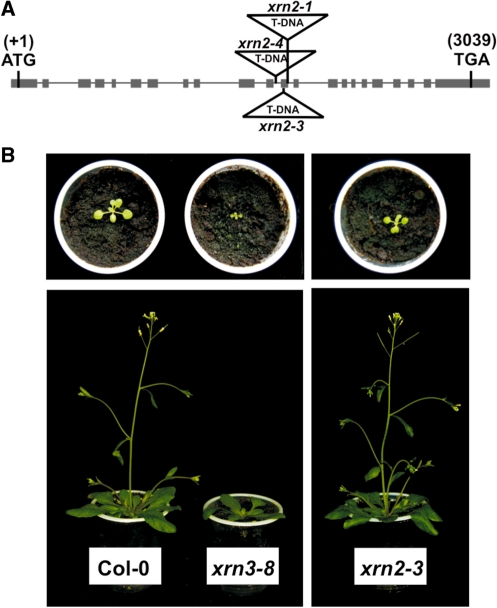
Figure 1.
Figure 1.
Characterization of xrn2 and xrn3 mutant lines. (A) Structure of the AtXRN2 (At5g42540) gene. Exons are represented by grey bars, the location of T-DNA insertions are indicated. (B) 14-day-old (top) and 30-day-old (bottom) wild-type, xrn2 and xrn3 plants.
Figure 2.
Figure 2.
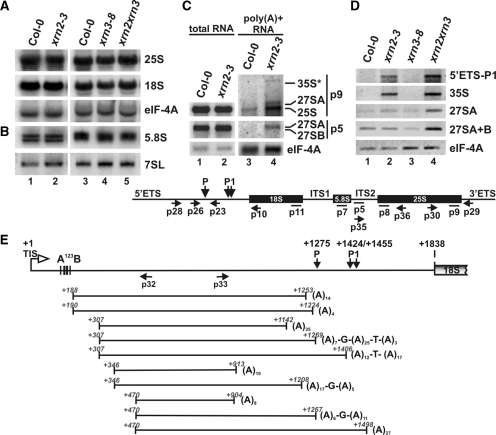
Polyadenylated mature, precursor and intermediate rRNAs accumulate in the absence of AtXRN2. (A and B) Northern analysis of mature rRNAs in xrn2 and xrn3 mutants. Total RNA was extracted from wild-type, xrn2-3, xrn3-8 and xrn2-1 xrn3-3 seedlings and separated on 1.1% agarose (A) or 6% polyacrylamide (B) gels and hybridized with probes specific for 5′ regions of 25S (p8) and 18S rRNAs (p10) as well as 5.8S (p7). Hybridizations for eIF-4A mRNA and 7SL RNA (p13) were used as loading controls. (C) Northern analysis of total and poly(A)+ RNA extracted from wild-type and xrn2-3 inflorescences, using probes p9 (25S rRNA) and p5 (27S pre-rRNA). rRNA, pre-RNA and intermediates detected in (A–C) are indicated on the right. (D) RT-PCR on total RNA from wild-type, xrn2-3, xrn3-8 and xrn2-1 xrn3-3 lines. Reverse transcription was performed using oligo(dT)20 and PCR using primers p28 and p23 for detection of the 5′ETS fragment, p10 and p26 for 35S, p29 and p30 for 27SA, and p35 and p36 for both 27SA/27SB pre-rRNAs. RT-PCR for eIF-4A was used as a control. The structure of the pre-rRNA with location of probes (solid lines) and PCR primers (arrows) used is shown below. (E) CRT-PCR on poly(A)+ RNA extracted from xrn2-3 inflorescences. Top diagram represents the structure of 5′ETS with primers used for PCR. Indicated are: transcription initiation site TIS (+1); conserved cluster A123B; cleavage sites P (+1275) and P1 (+1423/+1454); 5′-end of 18S rRNA (+1836). RNA fragments identified as sequenced clones are represented below as horizontal lines, their 5′ -and 3′-ends are shown in italics and the number of adenine residues is indicated at the 3′-end of each molecule.
Figure 3.
Figure 3.
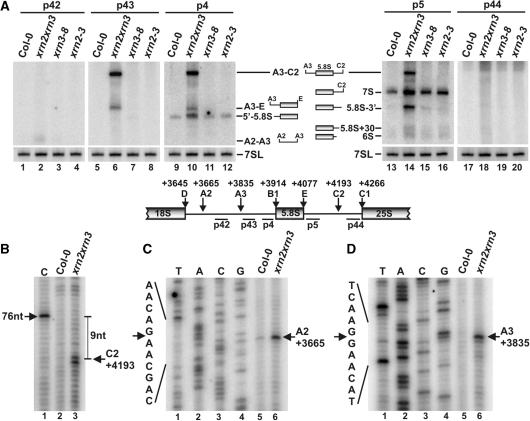
5′ processing of 5.8S and 25S rRNAs involves AtXRN2/3. (A) Northern analysis of 5.8S processing in wild-type (Col-0) and xrn2-3, xrn3-8 and xrn2-1 xrn3-3 mutants. Total RNA isolated from seedlings was separated on 6% polyacrylamide gels and hybridized with probes located along ITS1 (probes p42, p43 and p4; lanes 1–12) and ITS2 (probes p5 and p44; lanes 13–20). Names and schematic representations of rRNA precursors and intermediates are shown between the two sections. 7SL RNA (p13) was used as a loading control. (B–D) Mapping cleavages at sites C2 in ITS2 (B) and A2 and A3 in ITS1 (C and D) by primer extension in wild-type (Col-0) and xrn2-1 xrn3-3 plants. Primers p44, p4 and p42 were used to detect cleavage at C2, A3 and A2, respectively. Primer extension reactions were separated on 6% sequencing polyacrylamide gels alongside DNA sequencing (shown on the left) using the same primers on a PCR product encompassing ITS1 (lanes 1–4, C and D). Cleavage at site C2 was mapped relative to RNA ladder of a product 76 nt in length (B). Positions of cleavages relative to the TIS are shown on the right. The structure of the relevant region of the pre-rRNA with location of cleavage sites, probes and primers used is shown between (A) and (B).
Figure 4.
Figure 4.
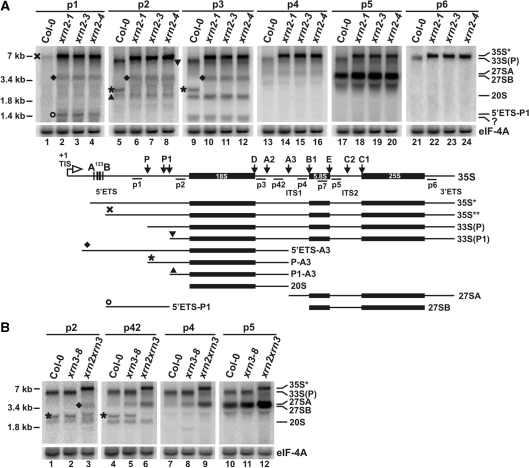
AtXRN2 participates in pre-rRNA processing. Northern analysis of rRNA precursors and intermediates in xrn2 (A) and xrn3 (B) mutants. Total RNA isolated from wild-type (Col-0), xrn2-1, xrn2-2, xrn2-3, xrn3-8 and xrn2-1 xrn3-3 seedlings were separated on 1.1% agarose gels and hybridized with probes indicated above each panel. rRNA precursors and intermediates are described on the right; molecular weight of 35S, 25S and 18S (7, 3.4 and 1.8 kb) are on the left. Intermediates designated with symbols together with the structure of all detected rRNA species and location of probes along the 35S precursor are shown between (A) and (B). A band detected with probe p3 designated with a question mark probably does not correspond to a nuclear pre-RNA but results from cross-hybridization to organellar rRNA. eIF-4A mRNA was used as a loading control.
Figure 5.
Figure 5.
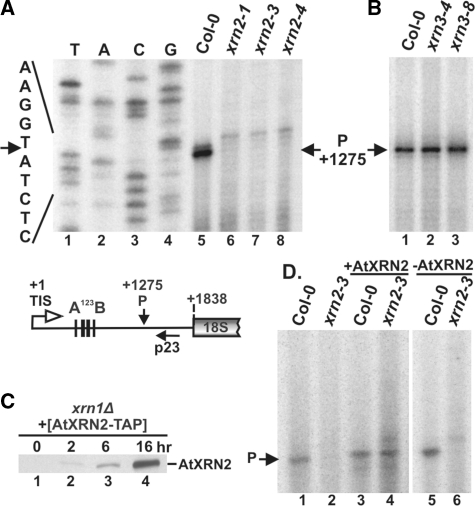
Cleavage at site P is inhibited in xrn2 mutants and is restored in plant extracts by the purified AtXRN2. (A and B) Mapping the cleavage at site P by primer extension in wild-type, xrn2 and xrn3 plants. The location of p23 primer used to detect the cleavage is shown on the schematic below. Primer extension reactions were separated on 6% sequencing polyacrylamide gels alongside DNA sequencing using the same primers on a PCR product encompassing 5′ETS (A, lanes 1–4). The sequence with primer extension stops is shown on the left and the position of cleavage relative to the TIS on the right. (C) Western blot of AtXRN2-TAP expressed under the control of the GAL1/10 promoter in the xrn1Δ yeast strain carrying a pYES2-GAL1/10::AtXRN2-TAP plasmid. Cells were pre-grown in medium containing 2% raffinose and 0.8% glucose and shifted to medium containing 2% galactose for times indicated when samples were harvested and analysed by western blot using peroxidase-anti-peroxidase antibody. (D) Analysis of cleavage at site P by primer extension using primer p23 on RNA isolated from wild-type and xrn2-3 plant cell extracts incubated alone (lanes 1 and 2) or supplemented with IgG-purified fraction from yeast expressing (lanes 3 and 4) or not expressing (lanes 5 and 6, mock controls) AtXRN2-TAP.
Figure 6.
Figure 6.
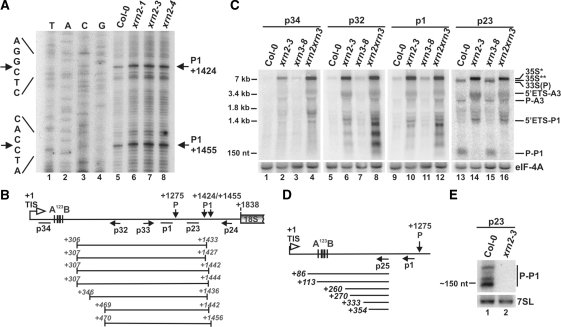
AtXRN2 is not required for processing at site P1 but is involved in the 5′ETS trimming that precedes cleavage at site P. (A) Mapping cleavages at sites P1 by primer extension in wild-type and xrn2 plants using primer p24. Description is as for Figure 5A. (B) Mapping the 5′ and 3′ ends of 5′ETS-P1 fragment by CRT-PCR on total RNA from the xrn2-3 mutant. Description is as for Figure 2E. Identified termini are shown in italics. (C) Northern analysis of the 5′ETS-containing pre-rRNAs in wild-type, xrn2-3, xrn3-8 and xrn2-1 xrn3-3 plants. Total RNA was separated on a 1.1% agarose gel and hybridized with probes distributed along 5’ETS, shown in the panel below. Pre-rRNA and intermediate species are designated as in Figure 4. eIF-4A mRNA was used as a loading control. (D) Mapping 5′ ends of 35S* pre-rRNA in the xrn2-3 mutant by 5′ RACE. cDNA synthesis was performed with primer p1 and PCR with p25 and a primer complementary to an adaptor ligated to cDNA. Identified 5′ ends are shown in italics. (E) Excised P-P1 fragment in wild-type and xrn2-3 plants detected by northern analysis. Total RNA was separated on a 6% polyacrylamide gel and hybridized with probe p23. 7SL RNA was used as a control. Location of primers used for primer extension, northern blots and CRT-PCR are shown in the schematics below panel A.
Figure 7.
Figure 7.
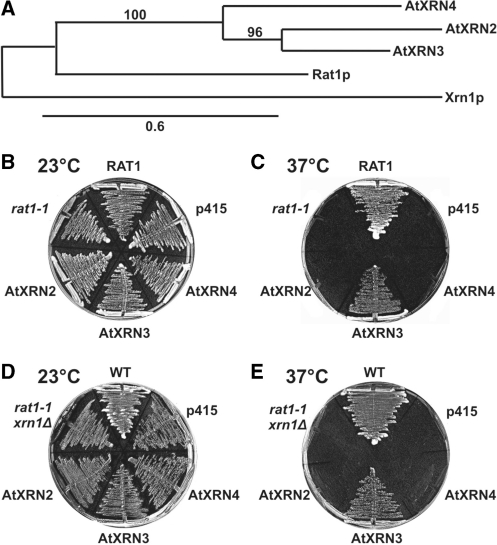
(A) Bootstrapped neighbour-joining phylogram representing evolutionary relationships between yeast Rat1 and Xrn1, and Arabidopsis AtXRN2, AtXRN3 and AtXRN4 nucleases. Bootstraps values are indicated along the branches. The scale bar shows the evolutionary distance (amino acid substitutions per site). (B–E) Complementation tests of the temperature sensitive phenotypes of rat1-1 (B and C) and rat1-1, xrn1Δ (D and E) yeast strains by AtXRN2, AtXRN3 or AtXRN4 expressed from a low copy p415TEF plasmid. RAT1, control strain containing the wild-type RAT1 allele; p415, strain containing an empty p415TEF vector; WT, wild-type strain. Plates were incubated at 23°C (B and D) or 37°C (C and E).
Figure 8.
Figure 8.
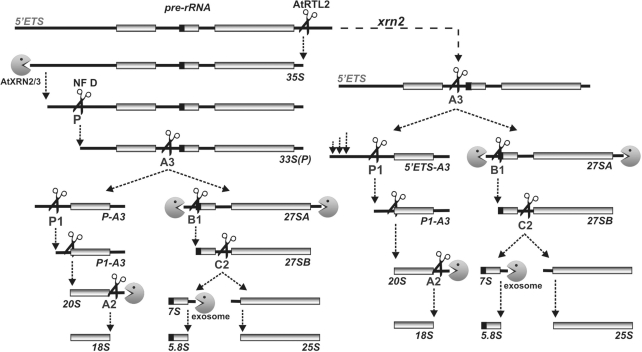
Model of early pre-rRNA processing steps in Arabidopsis thaliana. Alternative pathway in the xrn2 mutant is shown on the right.

References

    1. Garneau NL, Wilusz J, Wilusz CJ. The highways and byways of mRNA decay. Nat. Rev. Mol. Cell. Biol. 2007;8:113–126. - PubMed
    1. Houseley J, Tollervey D. The many pathways of RNA degradation. Cell. 2009;136:763–776. - PubMed
    1. Souret FF, Kastenmayer JP, Green PJ. AtXRN4 degrades mRNA in Arabidopsis and its substrates include selected miRNA targets. Mol. Cell. 2004;15:173–183. - PubMed
    1. Orban TI, Izaurralde E. Decay of mRNAs targeted by RISC requires XRN1, the Ski complex, and the exosome. RNA. 2005;11:459–469. - PMC - PubMed
    1. Sheth U, Parker R. Targeting of aberrant mRNAs to cytoplasmic processing bodies. Cell. 2006;125:1095–1109. - PMC - PubMed

Publication types

MeSH terms