Review
. 2010 Jul;106(1):1-16.
doi: 10.1093/aob/mcq059. Epub 2010 Mar 25.

Recent advances in understanding the assembly and repair of photosystem II

Affiliations
Review

Recent advances in understanding the assembly and repair of photosystem II

Peter J Nixon et al. Ann Bot. 2010 Jul.

Abstract

Background: Photosystem II (PSII) is the light-driven water:plastoquinone oxidoreductase of oxygenic photosynthesis and is found in the thylakoid membrane of chloroplasts and cyanobacteria. Considerable attention is focused on how PSII is assembled in vivo and how it is repaired following irreversible damage by visible light (so-called photoinhibition). Understanding these processes might lead to the development of plants with improved growth characteristics especially under conditions of abiotic stress.

Scope: Here we summarize recent results on the assembly and repair of PSII in cyanobacteria, which are excellent model organisms to study higher plant photosynthesis.

Conclusions: Assembly of PSII is highly co-ordinated and proceeds through a number of distinct assembly intermediates. Associated with these assembly complexes are proteins that are not found in the final functional PSII complex. Structural information and possible functions are beginning to emerge for several of these 'assembly' factors, notably Ycf48/Hcf136, Psb27 and Psb28. A number of other auxiliary proteins have been identified that appear to have evolved since the divergence of chloroplasts and cyanobacteria. The repair of PSII involves partial disassembly of the damaged complex, the selective replacement of the damaged sub-unit (predominantly the D1 sub-unit) by a newly synthesized copy, and reassembly. It is likely that chlorophyll released during the repair process is temporarily stored by small CAB-like proteins (SCPs). A model is proposed in which damaged D1 is removed in Synechocystis sp. PCC 6803 by a hetero-oligomeric complex composed of two different types of FtsH sub-unit (FtsH2 and FtsH3), with degradation proceeding from the N-terminus of D1 in a highly processive reaction. It is postulated that a similar mechanism of D1 degradation also operates in chloroplasts. Deg proteases are not required for D1 degradation in Synechocystis 6803 but members of this protease family might play a supplementary role in D1 degradation in chloroplasts under extreme conditions.


Figures
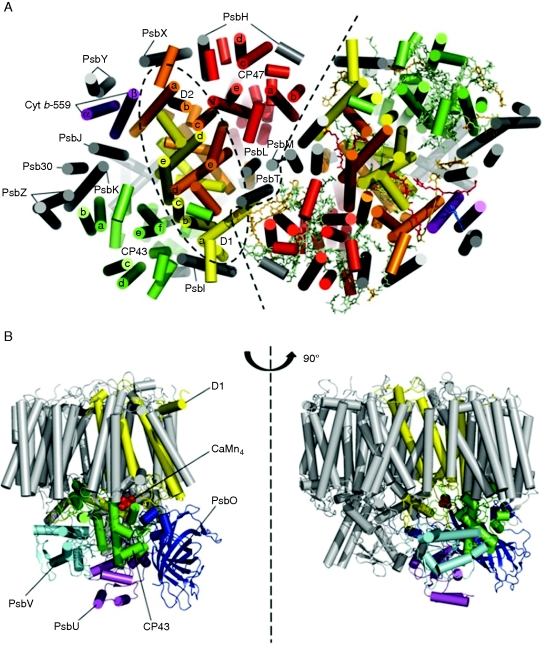
Fig. 1.
Fig. 1.
Sub-unit organization of the isolated homodimeric PSII complex from Thermosynechococcus elongatus. (A) View from the cytoplasmic side of the membrane. The two monomers are separated by a black dashed line and the α-helical elements of each subunit are represented as cylinders. D1 (yellow), D2 (orange), CP43 (green), CP47 (red), cytochrome b-559 (purple) and the remaining 11 small sub-units (grey) are indicated in the monomer on the left side as well as the D1–D2–Cyt b-559 sub-complex (elliptical black dashed circle). The same colour coding system applies to the monomer on the right side where are also represented the co-factors of PSII: chlorophylls (green), carotenoids (orange), pheophytins (yellow), plastoquinones (red) and haem (blue). The co-factors are shown in stick form. (B) Two side views, differing by a rotation of 90 °, showing the lumenal subunits PsbO (dark blue), PsbV (light blue), PsbU (purple) and the large lumenal loop of CP43 interconnecting transmembrane helices e and f (green) that lies close to the CaMn4 cluster. The figure was created with the software Pymol (http://pymol.sourceforge.net, version 0·99) and the PDB files 3BZ1 and 3BZ2 (Guskov et al., 2009).
Fig. 2.
Fig. 2.
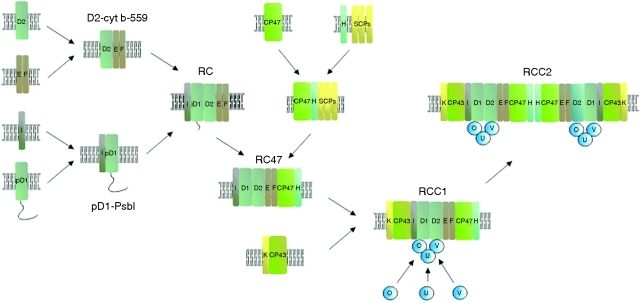
Assembly of the PSII complex in Synechocystis sp. PCC 6803. Proposed scheme for the assembly of PSII based on the analysis of PSII assembly complexes in defined mutants and radioactive pulse–chase experiments. For clarity, assembly factors and many of the low molecular mass (LMM) sub-units are not included. The LMM PsbE, PsbF, PsbH, PsbI and PsbK sub-units and the extrinsic PsbO, PsbU and PsbV sub-units are designated by the appropriate upper case letter, and the small CAB-like proteins by SCPs. Cytochome b-559 (cyt b-559) is composed of a heterodimer of the PsbE and PsbF subunits. Types of PSII complex: RC, PSII reaction centre-like complexes containing either mature D1, intermediate D1 (iD1) or precursor D1 (pD1) but lacking CP47 and CP43; RC47, PSII core complexes lacking CP43; RCC1, monomeric PSII core complex; RCC2, dimeric PSII core complex. The site of attachment of the extrinsic proteins to PSII is purely illustrative.
Fig. 3.
Fig. 3.
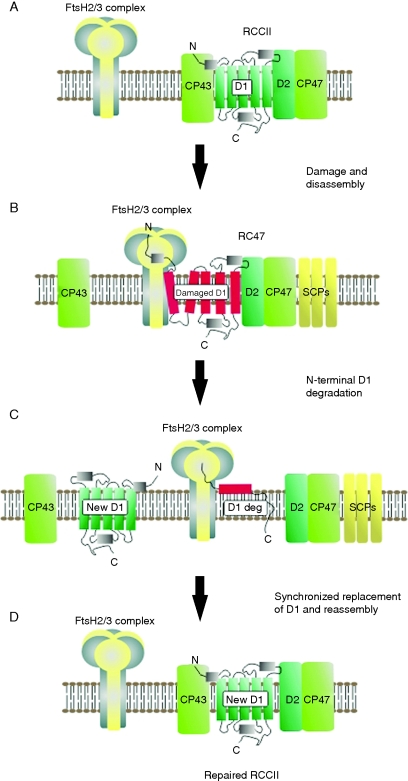
Selective synchronized replacement of damaged D1 during PSII repair according to the FtsH-only model (Nixon et al., 2005). (A and B) Light-induced irreversible damage to D1 triggers partial disassembly of the dimeric PSII complex (RCCII) to form the monomeric RC47 complex containing damaged D1. For clarity the extrinsic proteins have been omitted. The hexameric FtsH2/FtsH3 hetero-oligomeric complex engages with the N-terminal tail of the damaged D1 sub-unit. SCPs might store chlorophyll during repair. (C) Damaged D1 is removed from the membrane by the FtsH complex in a process driven by ATP hydrolysis and is degraded in a highly processive reaction at the Zn2+ protease domain. Degradation of damaged D1 is synchronized at the transmembrane helix level with insertion of the ‘new’ D1 subunit into the RC47 complex to minimize destabilization of the RC47 complex. (D) CP43 reattaches to form a non-oxygen-evolving complex which then reassembles the CaMn4 cluster, binds the extrinsic subunits and dimerizes to form the fully functional RCCII complex. For clarity, assembly factors are not included.

References

    1. Adam Z, Clarke AK. Cutting edge of chloroplast proteolysis. Trends in Plant Science. 2002;7:451–456. - PubMed
    1. Adam Z, Zaltsman A, Sinvany-Villalobo G, Sakamoto W. FtsH proteases in chloroplasts and cyanobacteria. Physiologia Plantarum. 2005;123:386–390.
    1. Adir N, Zer H, Shochat S, Ohad I. Photoinhibition – a historical perspective. Photosynthesis Research. 2003;76:343–370. - PubMed
    1. Akiyama Y, Ito K. Reconstitution of membrane proteolysis by FtsH. Journal of Biological Chemistry. 2003;278:18146–18153. - PubMed
    1. Anbudurai PR, Mor TS, Ohad I, Shestakov SV, Pakrasi HB. The ctpA gene encodes the C-terminal processing protease for the D1 protein of the photosystem-II reaction-center complex. Proceedings of the National Academy of Sciences, USA. 1994;91:8082–8086. - PMC - PubMed

Publication types

MeSH terms

Substances