


Volume density, distribution, and ultrastructure of secretory and basolateral membranes and mitochondria predict parietal cell secretory (dys)function
- PMID: 20339514
- PMCID: PMC2842899
- DOI: 10.1155/2010/394198
Volume density, distribution, and ultrastructure of secretory and basolateral membranes and mitochondria predict parietal cell secretory (dys)function
Abstract
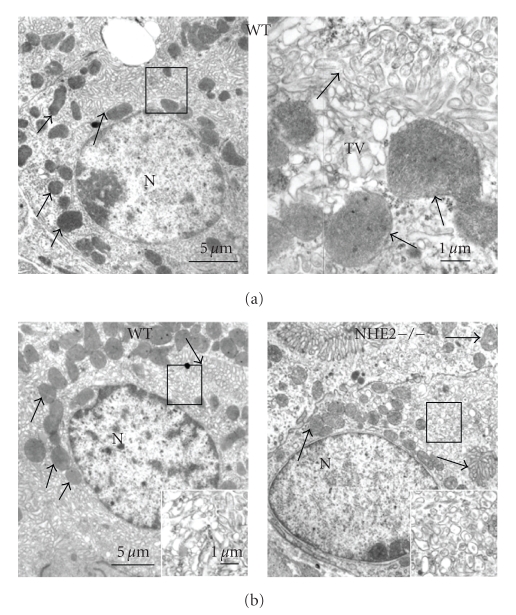
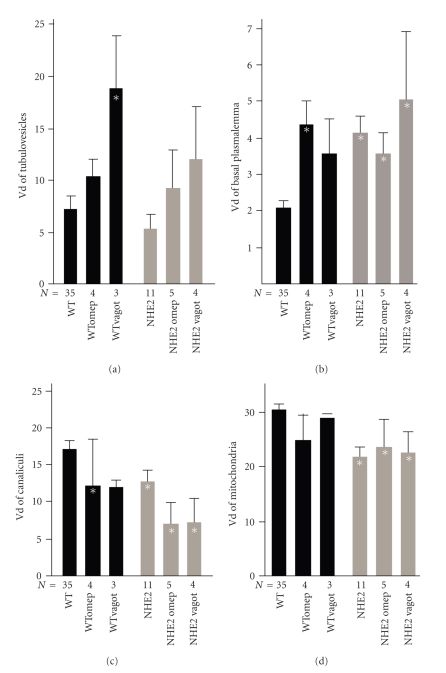
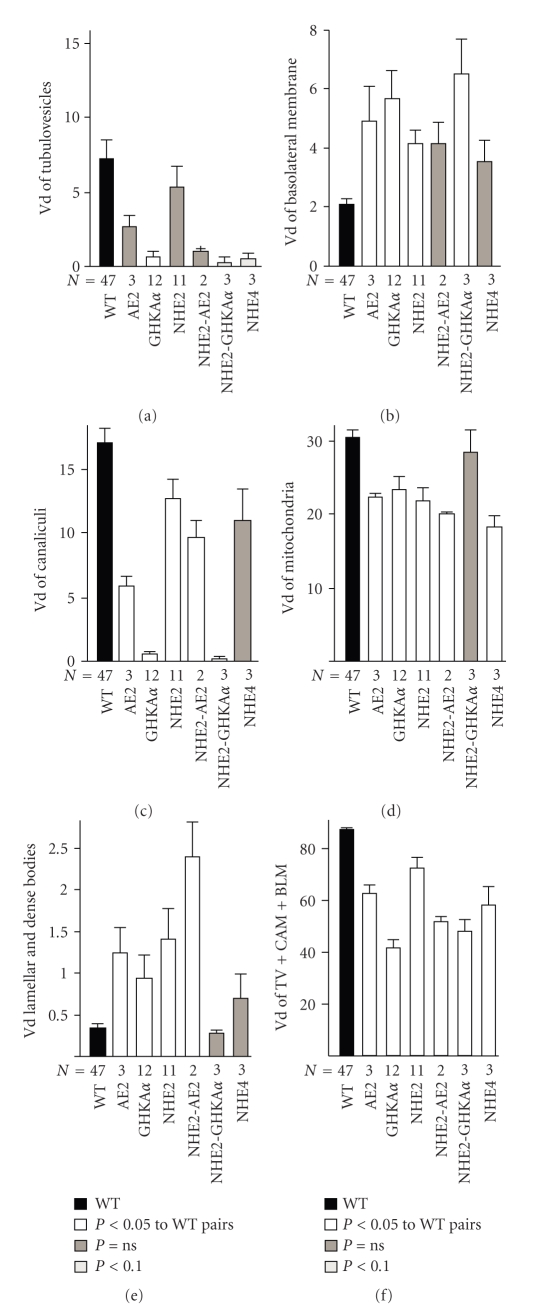
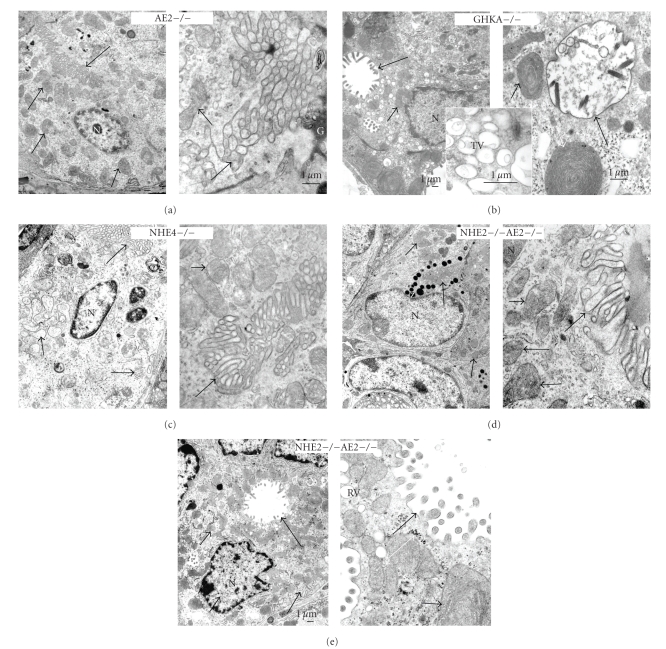
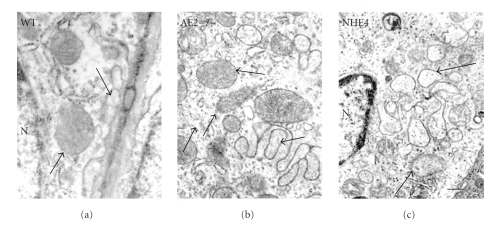
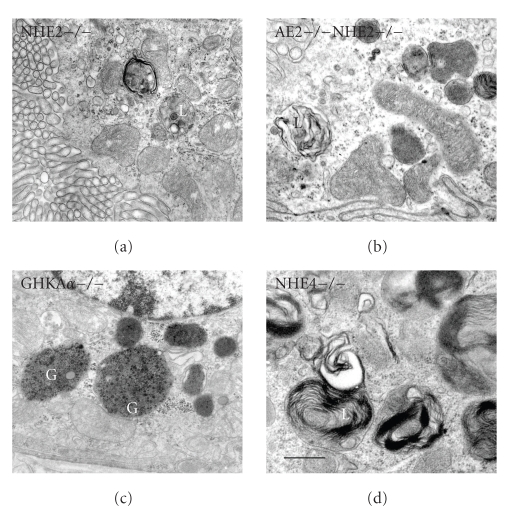
Acid secretion in gastric parietal cells requires highly coordinated membrane transport and vesicle trafficking. Histologically, consensus defines acid secretion as the ratio of the volume density (Vd) of canalicular and apical membranes (CAMs) to tubulovesicular (TV) membranes, a value which varies widely under normal conditions. Examination of numerous achlorhydric mice made it clear that this paradigm is discrepant when used to assess most mice with genetic mutations affecting acid secretion. Vd of organelles in parietal cells of 6 genetically engineered mouse strains was obtained to identify a stable histological phenotype of acid secretion. We confirmed that CAM to TV ratio fairly represented secretory activity in untreated and secretion-inhibited wild-type (WT) mice and in NHE2-/- mice as well, though the response was significantly attenuated in the latter. However, high CAM to TV ratios wrongly posed as active acid secretion in AE2-/-, GHKAalpha-/-, and NHE4-/- mice. Achlorhydric genotypes also had a significantly higher Vd of basolateral membrane than WT mice, and reduced Vd of mitochondria and canaliculi. The Vd of mitochondria, and ratio of the Vd of basolateral membranes/Vd of mitochondria were preferred predictors of the level of acid secretion. Alterations in acid secretion, then, cause significant changes not only in the Vd of secretory membranes but also in mitochondria and basolateral membranes.
Figures
References
-
- Urushidani T, Forte JG. Signal transduction and activation of acid secretion in the parietal cell. Journal of Membrane Biology. 1997;159(2):99–111. - PubMed
-
- Yao X, Karam SM, Ramilo M, et al. Stimulation of gastric acid secretion by cAMP in a novel alpha-toxin-permeabilized gland model. American Journal of Physiology. 1996;271(1, part 1):C61–C73. - PubMed
-
- Kato Y, Fukamachi H, Takano-Maruyama M, et al. Reduction of SNAP25 in acid secretion defect of Foxl1-/- gastric parietal cells. Biochemical and Biophysical Research Communications. 2004;320(3):766–772. - PubMed
Publication types
MeSH terms
Substances
Grants and funding
LinkOut - more resources
Full Text Sources
