Review
. 2010 Jan-Feb;76(1):129-35.
doi: 10.1590/S1808-86942010000100021.

Real models and virtual simulators in otolaryngology: review of literature

Affiliations
Review

Real models and virtual simulators in otolaryngology: review of literature

João Flávio Nogueira Júnior et al. Braz J Otorhinolaryngol. 2010 Jan-Feb.

Abstract

Introduction and aims: Real models and virtual simulators have been used with positive results in several fields of medicine. These new devices can enhance teaching, learning and also training in Otolaryngology, reducing associated costs and potentially reducing medical errors. We reviewed the literature on the real and virtual models and simulators used for education and training in our medical specialty, discussing some of them and the results achieved with such instruments. Moreover, we also discuss the future perspectives in education and training in our medical specialty.

Methods: Literature review.

Conclusions: Otolaryngology, a clinical and surgical field of medicine, should be at the forefront of this technological revolution. In our specialty, real models and virtual simulators and environments have a great teaching and learning potential. With equipment costs dropping, thanks to technological development, these tools tend to become increasingly more popular.


Figures

Figure 1
Figure 1
Otoscopy teaching and training model. A: model with head and several mobile parts for many disease types and otoscopies. B: practicing otoscopy in a model. C: example of a normal otoscopy of a left tympanic membrane in a model. D: example of a normal otoscopy of a right tympanic membrane in a model. Note the light triangle, the membrane with a slightly pearly sheen, and a view of part of the ossicular chain and auditory tube by transparency.
Figure 2
Figure 2
Virtual simulator of a temporal bone dissection. Virtual Temporal Bone Project. Note the controls that provide touch and force feedback.
Figure 3
Figure 3
Computer screen image of virtual temporal bone dissection software. This German software may be downloaded free. Note well-defined textures and important anatomical structures, such as the facial nerve.
Figure 4
Figure 4
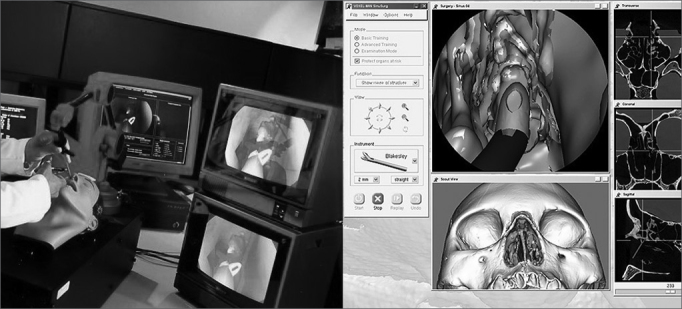
Virtual simulator of nasosinusal endoscopic surgery (ES3). Computer screen image of this software to the side. Note the possibility of changing virtually the tweezers, other tools, and dissection images.
Figure 5
Figure 5
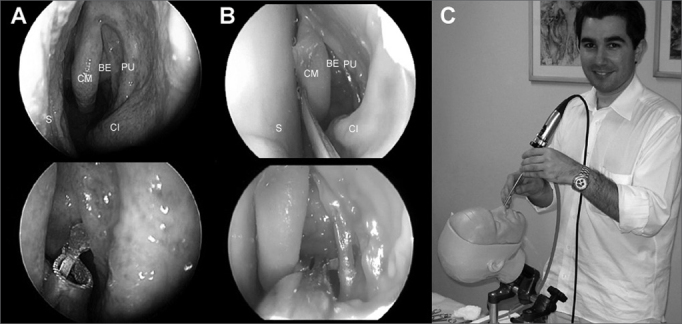
Images of the S.I.M.O.N.T. model. A: endoscopic image (0-degrees, 4mm) of an anatomical dissection of a recent cadaver. B: endoscopic image (0-degrees, 4mm) of an anatomical dissection in a S.I.M.O.N.T. model. Note the similarity between the structures and the use of real surgical tools also used in traditional surgery. (CM) middle turbinate; (BE) ethmoidal bulla; (PU) uncinate process; (CI) lower turbinate; (S) nasal septum. C: Physicians carrying out dissection of tasks required in the S.I.M.O.N.T. model. Note that the surgical instruments are the same as those in nasosinusal surgery.
Figure 6
Figure 6
Rhinoplasty training model. A: model with exposed cartilage. B: model with synthetic skin covering cartilage. The white portion is a model of a fixed head. The skin-colored part is a module with synthetic skin and cartilage that may be dissected and touched.

References

    1. Arora H, Uribe J, Ralph W, et al. Assessment of Construct Validity of the Endoscopic Sinus Surgery Simulator. Arch Otolaryngol Head Neck Surg. 2005:217–221. - PubMed
    1. Champion H, Gallagher A. Simulation in surgery: a good idea whose time has come. Br J Surg. 2003;90:767–768. - PubMed
    1. Kohn LT, Corrigan JM, Donaldson MS. To Err Is Human: Building a Safer Health System. National Academy Press; Washington, DC: 1999. - PubMed
    1. Dawson SL. A critical approach to medical simulation. Bull Am Coll Surg. 2002;87:12–18. - PubMed
    1. Satava RM. Advanced simulation technologies for surgical education. Bull Am Coll Surg. 1996;81:77–81.

LinkOut - more resources