Review
. 2010 Sep;14(9):2240-9.
doi: 10.1111/j.1582-4934.2010.01058.x.

The role of microRNAs in ovarian cancer initiation and progression

Affiliations
Review

The role of microRNAs in ovarian cancer initiation and progression

Shuang-Di Li et al. J Cell Mol Med. 2010 Sep.

Abstract

Epithelial ovarian cancer (EOC) has the highest mortality rate of all gynaecological cancers. One of the greatest impediments to improving outcome is an incomplete understanding of the molecular underpinnings of EOC pathogenesis and progression. Recent studies suggest that microRNAs (miRNAs) are involved in ovarian tumorigenesis and cancer development. Several miRNA profiling studies have identified some consensus aberrantly expressed miRNAs in EOC tissues, and these EOC-related miRNAs may play critical roles in the pathogenesis and progression of EOC. Moreover, some of the miRNAs may have diagnostic or prognostic significance. In this review, recent progress to reveal the role of miRNAs in EOC will be addressed, and a model for miRNA functions in ovarian cancer initiation and progression will be proposed.


Figures

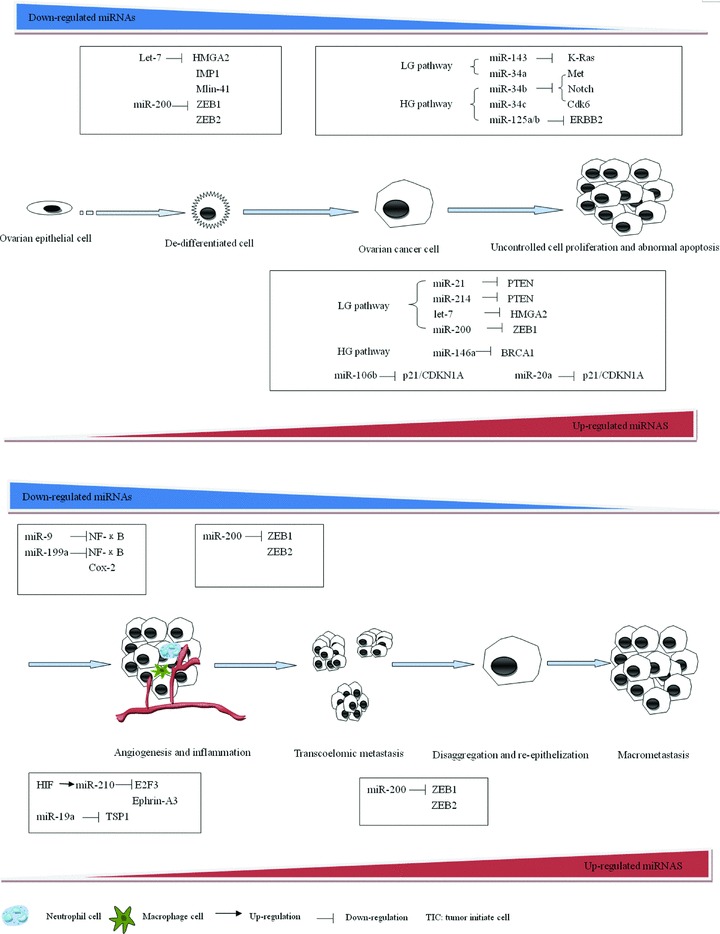
Fig 1
Fig 1
Biological function of miRNAs in EOC. In our proposed model for ovarian cancer development, EOC progresses through a process of de-differentiation, cell proliferation, angiogenesis and inflammation, transcoelomic metastasis, disaggregation and re-epithelization, and macromatasis formation. Let-7 may act as an important regulator of de-differentiation during ovarian tumour-initiating cells formation by targeting multiple oncofetal genes. Another key ‘stemness’-repressive miRNA, miR-200 may also down-regulated in this process. The de-differentiated cells may proceed along two pathways: the HG pathway, which showed more aggressive phenotypes, and the LG pathway. Different miRNAs may act as important regulators during this process. Let-7 and miR-200 re-expression may occur in the LG pathway, resulting in cancer cells characteristic of the epithelial phenotype. However, let-7 and miR-200 may remain lowly expressed in mesenchymal HG tumours. miR-21, miR-214, miR-143 may be involved in the LG pathway by targeting PTEN and K-ras, while miR-125b and miR-146a may play a role in the HG pathway by repressing ERBB2 and BRCA1. In addition, other miRNAs, such as miR-20a and miR-106b, may affect cell proliferation and apoptosis in both pathways. Subsequently, multiple miRNAs may play a role in chronic inflammation and angiogenesis, which are two main processes facilitating ovarian cancer progression. The dynamic expression of miR-200c, which regulates EMT, may cause transcoelomic metastasis and ultimately macrometastasis formation of ovarian cancer.

References

    1. Jemal A, Siegel R, Ward E, et al. Cancer statistics, 2009. CA Cancer J Clin. 2009;59:225–49. - PubMed
    1. Köbel M, Kalloger SE, Boyd N, et al. Ovarian carcinoma subtypes are different diseases: implications for biomarker studies. PLoS Med. 2008;5:e232. - PMC - PubMed
    1. Esquela-Kerscher A, Slack FJ. Oncomirs – microRNAs with a role in cancer. Nat Rev Cancer. 2006;6:259–69. - PubMed
    1. Zhang L, Huang J, Yang N, et al. MicroRNAs exhibit high frequency genomic alterations in human cancer. Proc Natl Acad Sci USA. 2006;103:9136–41. - PMC - PubMed
    1. Zhang L, Volinia S, Bonome T, et al. Genomic and epigenetic alterations deregulate microRNA expression in human epithelial ovarian cancer. Proc Natl Acad Sci USA. 2008;105:7004–9. - PMC - PubMed

Publication types