


Human midsagittal brain shape variation: patterns, allometry and integration
- PMID: 20345859
- PMCID: PMC2871995
- DOI: 10.1111/j.1469-7580.2010.01221.x
Human midsagittal brain shape variation: patterns, allometry and integration
Abstract
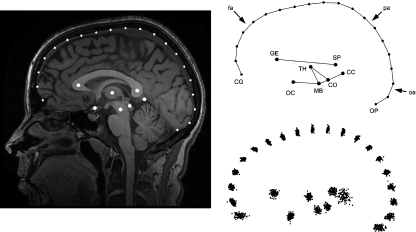
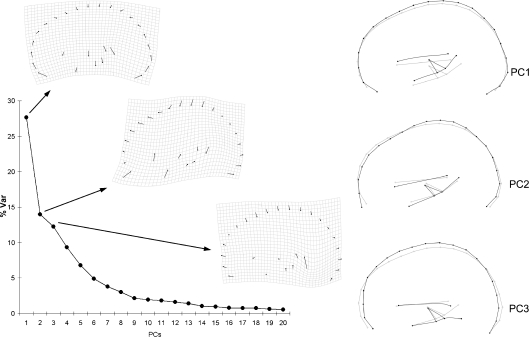
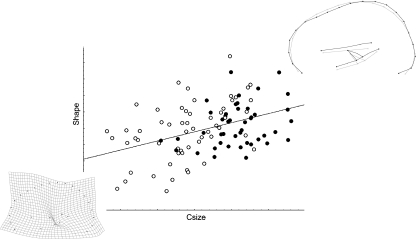
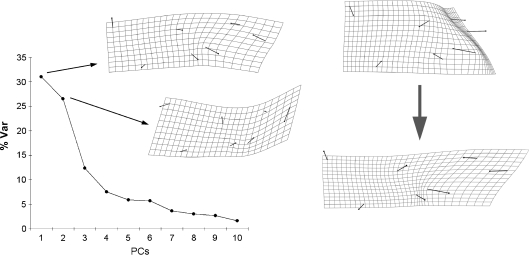
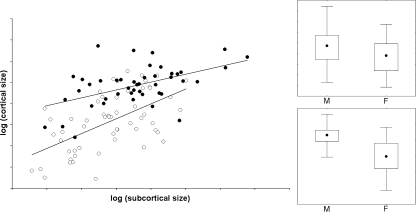
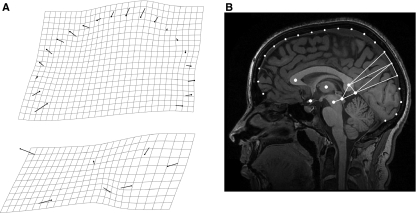
Midsagittal cerebral morphology provides a homologous geometrical reference for brain shape and cortical vs. subcortical spatial relationships. In this study, midsagittal brain shape variation is investigated in a sample of 102 humans, in order to describe and quantify the major patterns of correlation between morphological features, the effect of size and sex on general anatomy, and the degree of integration between different cortical and subcortical areas. The only evident pattern of covariation was associated with fronto-parietal cortical bulging. The allometric component was weak for the cortical profile, but more robust for the posterior subcortical areas. Apparent sex differences were evidenced in size but not in brain shape. Cortical and subcortical elements displayed scarcely integrated changes, suggesting a modular separation between these two areas. However, a certain correlation was found between posterior subcortical and parietal cortical variations. These results should be directly integrated with information ranging from functional craniology to wiring organization, and with hypotheses linking brain shape and the mechanical properties of neurons during morphogenesis.
Figures
References
-
- Bastir M. A systems-model for the morphological analysis of integration and modularity in human craniofacial evolution. J Anthropol Sci. 2008;86:37–58. - PubMed
-
- Bastir M, Rosas A. Mosaic evolution of the basicranium in Homo and its relation to modular development. Evol Biol. 2009;36:57–70.
-
- Battaglia-Mayer A, Caminiti R. Optic ataxia as a result of the breakdown of the global tuning fields of parietal neurons. Brain. 2002;125:225–237. - PubMed
Publication types
MeSH terms
LinkOut - more resources
Full Text Sources
