. 2010 Aug;9(6):545-61.
doi: 10.1111/j.1601-183X.2010.00583.x. Epub 2010 Mar 25.

A locus for an auditory processing deficit and language impairment in an extended pedigree maps to 12p13.31-q14.3

Affiliations
Free PMC article

A locus for an auditory processing deficit and language impairment in an extended pedigree maps to 12p13.31-q14.3

L Addis et al. Genes Brain Behav. 2010 Aug.
Free PMC article

Abstract

Despite the apparent robustness of language learning in humans, a large number of children still fail to develop appropriate language skills despite adequate means and opportunity. Most cases of language impairment have a complex etiology, with genetic and environmental influences. In contrast, we describe a three-generation German family who present with an apparently simple segregation of language impairment. Investigations of the family indicate auditory processing difficulties as a core deficit. Affected members performed poorly on a nonword repetition task and present with communication impairments. The brain activation pattern for syllable duration as measured by event-related brain potentials showed clear differences between affected family members and controls, with only affected members displaying a late discrimination negativity. In conjunction with psychoacoustic data showing deficiencies in auditory duration discrimination, the present results indicate increased processing demands in discriminating syllables of different duration. This, we argue, forms the cognitive basis of the observed language impairment in this family. Genome-wide linkage analysis showed a haplotype in the central region of chromosome 12 which reaches the maximum possible logarithm of odds ratio (LOD) score and fully co-segregates with the language impairment, consistent with an autosomal dominant, fully penetrant mode of inheritance. Whole genome analysis yielded no novel inherited copy number variants strengthening the case for a simple inheritance pattern. Several genes in this region of chromosome 12 which are potentially implicated in language impairment did not contain polymorphisms likely to be the causative mutation, which is as yet unknown.


Figures
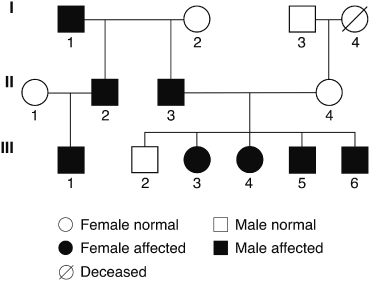
Figure 1
Figure 1
Pedigree of the three-generational NE family. All members indicated are native speakers of German, with the exception of II-1 whose first language is Portuguese and her second language is German, and III-1 who was brought up to be a bilingual. Circles indicate females and squares males. Black shaded figures indicate affected individuals.
Figure 2
Figure 2
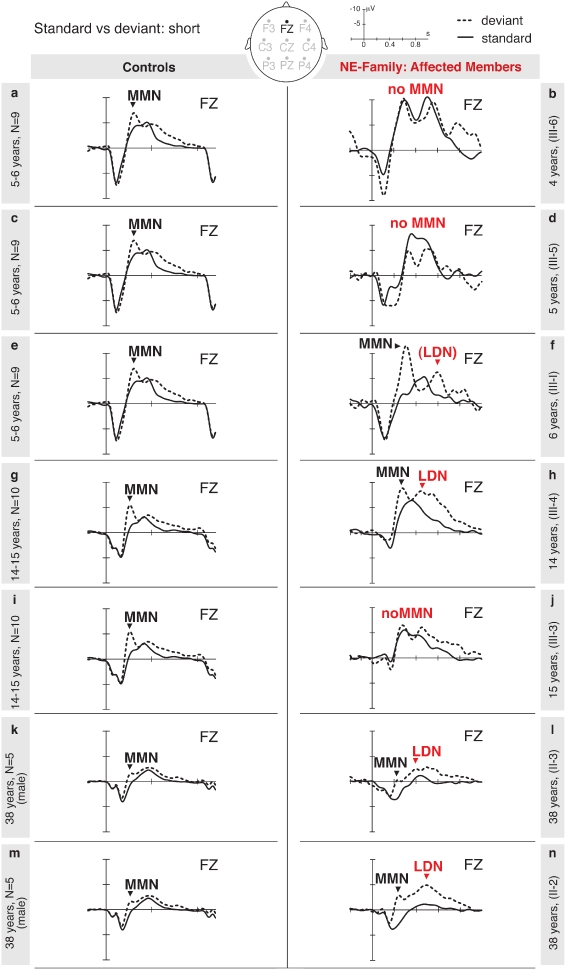
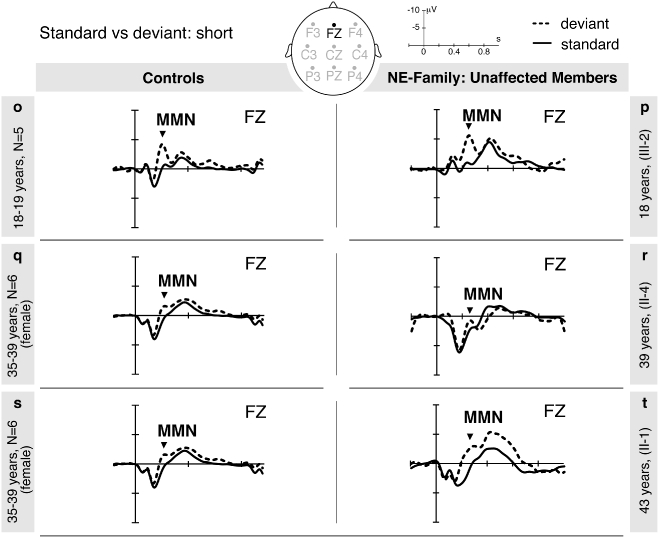
(a) ERP data—affected members of the NE family; (b) ERP data—unaffected members of the NE family. Averaged ERPs to short syllables for controls (left panel) in different age- and sex-matched groups and for members of the NE family (right panels). Solid lines are for the deviant and dotted lines for the standard stimulus. Negativity is plotted up.
Figure 2
Figure 2
(a) ERP data—affected members of the NE family; (b) ERP data—unaffected members of the NE family. Averaged ERPs to short syllables for controls (left panel) in different age- and sex-matched groups and for members of the NE family (right panels). Solid lines are for the deviant and dotted lines for the standard stimulus. Negativity is plotted up.
Figure 3
Figure 3
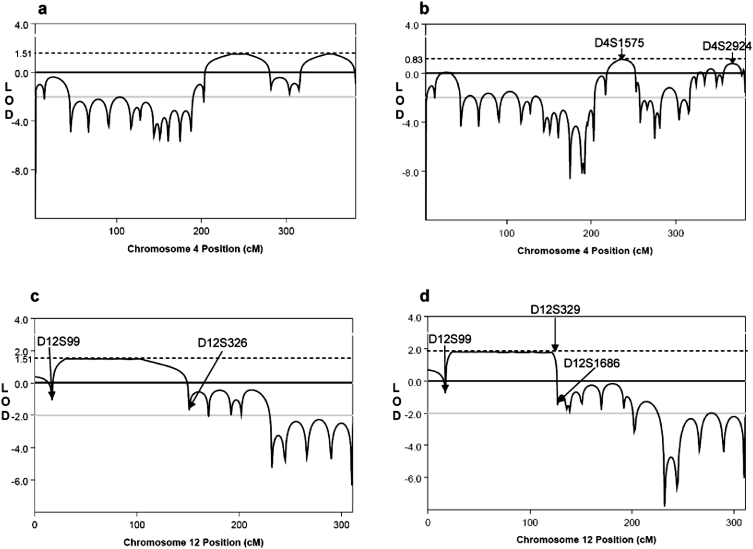
Parametric linkage analysis plots from MERLIN. All distances are in Haldane Centimorgans. Dotted lines indicate values of maximum LOD scores. a and b show linkage to chromosome 4 decreases in second wave analysis. (a) Plot with 10 original family members and markers 20 cM (Hal) apart. Maximum LOD score is 1.51. (b) Revised linkage plot with 10 cM (Hal) marker density in the distal arm of the chromosome, and including genotypes from II-1, II-2 and III-1. Arrows indicate positions of microsatellites D4S1575 and D2S2924, the phase of which could not be inferred. Maximum LOD score is 0.83. c and d show chromosome 12. The maximum LOD score increases on second wave analysis and critical region size decreases. (c) Plot with 10 original family members and markers 20 cM (Hal) apart. Maximum LOD score is 1.51. (d) Revised linkage plot with 10 cM (Hal) marker density in the proximal arm of the chromosome, and including genotypes from all 13 family members. Microsatellites, D12S99 and D12S329, indicate where breakpoints define the region of linkage. Maximum LOD score is 2.1.
Figure 4
Figure 4
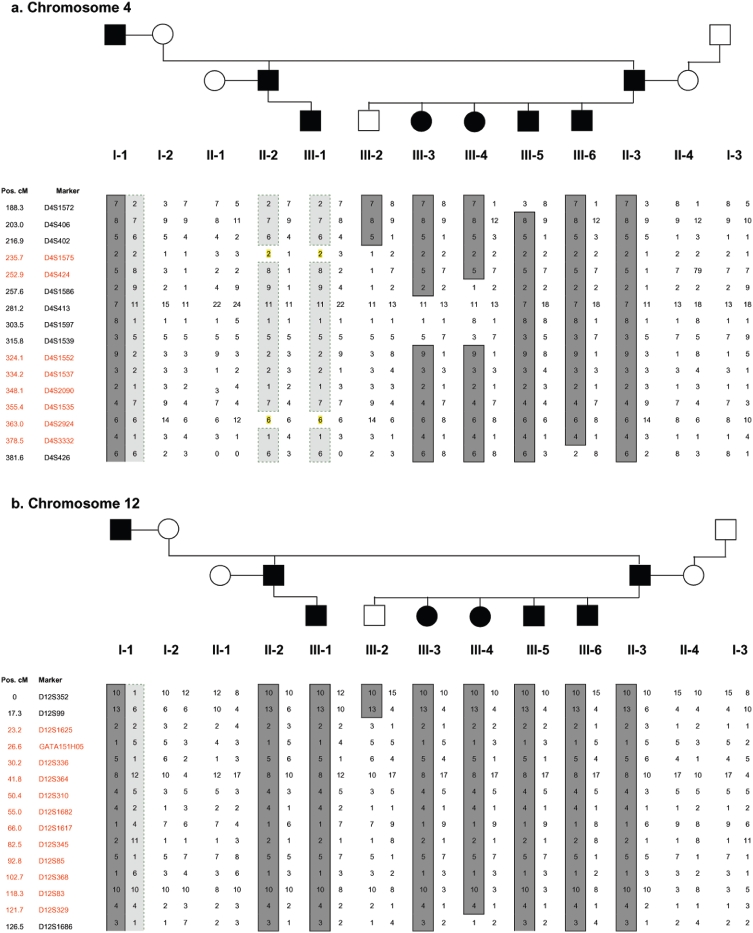
Haplotype analysis of informative markers on chromosomes 4 and 12. Paternal haplotypes on the left, maternal on the right. Affected individuals shaded in black in the pedigree. Alleles in dark gray are those shared by affected individuals in the initial screen. (a) Chromosome 4—indicates there is no segregation with the disorder in II-1 and III-1. It can be seen that although affected, II-1 and III-1 do not carry the ‘affected’ haplotype (dark grey) from I-1 showing lack of segregation with the disorder on chromosome 4. However, because of homozygosity of markers D4S1575 and D4S2924, highlighted, the phase of the alleles cannot be ascertained, meaning the LOD score can not be reduced to 0. (b) Chromosome 12—indicates continued and complete segregation of the risk alleles with the disorder. It can be seen that the affected chromosome (dark grey) is also inherited by II-1 and III-1, showing continued segregation with affection status.

References

    1. Abecasis GR, Cherny SS, Cookson WO, Cardon LR. Merlin–rapid analysis of dense genetic maps using sparse gene flow trees. Nat Genet. 2002;30:97–101. - PubMed
    1. Aihara K, Kuroda S, Kanayama N, Matsuyama S, Tanizawa K, Horie M. A neuron-specific EGF family protein, NELL2, promotes survival of neurons through mitogen-activated protein kinases. Brain Res Mol Brain Res. 2003;116:86–93. - PubMed
    1. Alarcon M, Abrahams BS, Stone JL, Duvall JA, Perederiy JV, Bomar JM, Sebat J, Wigler M, Martin CL, Ledbetter DH, Nelson SF, Cantor RM, Geschwind DH. Linkage, association, and gene-expression analyses identify CNTNAP2 as an autism-susceptibility gene. Am J Hum Genet. 2008;82:150–159. - PMC - PubMed
    1. Arking DE, Cutler DJ, Brune CW, Teslovich TM, West K, Ikeda M, Rea A, Guy M, Lin S, Cook EH, Chakravarti A. A common genetic variant in the neurexin superfamily member CNTNAP2 increases familial risk of autism. Am J Hum Genet. 2008;82:160–164. - PMC - PubMed
    1. Arnold PD, Rosenberg DR, Mundo E, Tharmalingam S, Kennedy JL, Richter MA. Association of a glutamate (NMDA) subunit receptor gene (GRIN2B) with obsessive-compulsive disorder: a preliminary study. Psychopharmacology (Berl) 2004;174:530–538. - PubMed

Publication types