


Transient viral-mediated overexpression of alpha-calcium/calmodulin-dependent protein kinase II in the nucleus accumbens shell leads to long-lasting functional upregulation of alpha-amino-3-hydroxyl-5-methyl-4-isoxazole-propionate receptors: dopamine type-1 receptor and protein kinase A dependence
- PMID: 20345911
- PMCID: PMC3534927
- DOI: 10.1111/j.1460-9568.2010.07155.x
Transient viral-mediated overexpression of alpha-calcium/calmodulin-dependent protein kinase II in the nucleus accumbens shell leads to long-lasting functional upregulation of alpha-amino-3-hydroxyl-5-methyl-4-isoxazole-propionate receptors: dopamine type-1 receptor and protein kinase A dependence
Abstract
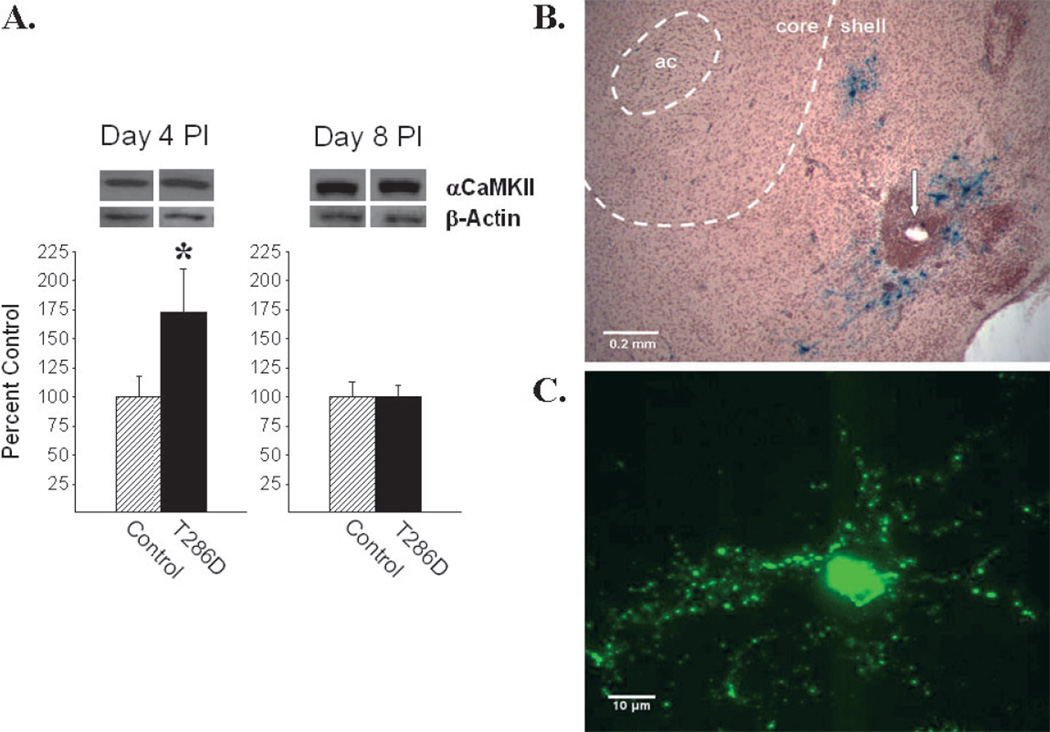
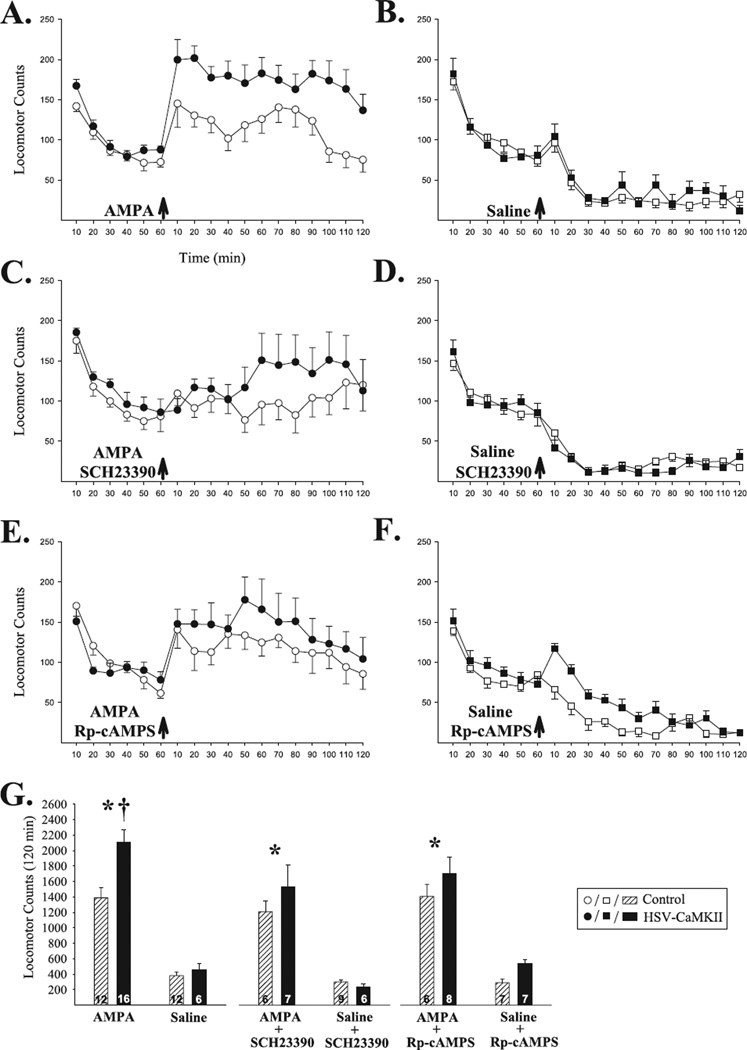
Calcium/calmodulin-dependent protein kinase II (CaMKII) activity is necessary for the long-lasting expression of locomotor sensitization and enhanced drug-taking observed in rats previously exposed to psychostimulants. Exposure to these drugs also transiently increases alphaCaMKII levels in the nucleus accumbens (NAcc), an effect that, when mimicked by transient viral-mediated overexpression of alphaCaMKII in NAcc shell neurons, leads to long-lasting enhancement in locomotor responding to amphetamine and NAcc alpha-amino-3-hydroxyl-5-methyl-4-isoxazole-propionate (AMPA). The present experiments characterized the dopamine (DA) dependence of the functional AMPA receptor upregulation observed long after transient overexpression of alphaCaMKII. Rats infected with herpes simplex virus-alphaCaMKII in the NAcc shell showed a transient increase in alphaCaMKII levels that peaked at 4 days post-infection and returned to baseline 8 days later. When challenged with AMPA (0.8 nmol/side) in the NAcc shell at 20 days post-infection, these rats showed enhanced locomotion compared with controls. This sensitized locomotor response was blocked when AMPA was coinfused with either the DA type-1 receptor antagonist SCH23390 (0.8 nmol/side) or the protein kinase A inhibitor Rp-cAMPS (80 nmol/side). Neither SCH23390 nor Rp-cAMPS produced locomotor effects when infused by itself into the NAcc shell. Furthermore, these antagonists did not block the acute non-sensitized locomotor response to AMPA observed in control rats. These findings show that transient viral-mediated overexpression of alphaCaMKII in neurons of the NAcc shell leads to long-lasting functional upregulation of AMPA receptors that is DA type-1 receptor and protein kinase A dependent. Thus, transient increases in levels of alphaCaMKII in the NAcc shell produce long-lasting changes in the way that DA and glutamate interact in this site to generate locomotor behavior.
Figures
References
-
- Anderson SM, Famous KR, Sadri-Vakili G, Kumaresan V, Schmidt HD, Bass CE, Terwilliger EF, Cha JJ, Pierce RC. CaMKII: a biochemical bridge linking accumbens dopamine and glutamate systems in cocaine seeking. Nat. Neurosci. 2008;11:344–353. - PubMed
-
- Barria A, Derkach V, Soderling T. Identification of the Ca2+/calmodulin-dependent protein kinase II regulatory phosphorylation site in the alpha-amino-3-hydroxyl-5-methyl-4-isoxazole-propinate-typeglutamate receptor. J. Biol. Chem. 1997;272:32727–32730. - PubMed
-
- Bell K, Duffy P, Kalivas PW. Context-specific enhancement of glutamate transmission by cocaine. Neuropsychopharmacology. 2000;23:335–344. - PubMed
-
- Bennett MK, Erondu NE, Kennedy MB. Purification and characterization of a calmodulin-dependent protein kinase that is highly concentrated in brain. J. Biol. Chem. 1983;258:12735–12744. - PubMed
Publication types
MeSH terms
Substances
Grants and funding
LinkOut - more resources
Full Text Sources
