


Trends in the utilization and impact of radiofrequency ablation for hepatocellular carcinoma
- PMID: 20347736
- PMCID: PMC2847589
- DOI: 10.1016/j.jamcollsurg.2009.12.026
Trends in the utilization and impact of radiofrequency ablation for hepatocellular carcinoma
Abstract
Background: The incidence of hepatocellular carcinoma (HCC) is rising and radiofrequency ablation (RFA) appears to be increasingly used. The nationwide use and impact of RFA have not been well characterized.
Study design: We performed an historical cohort study of US patients 18 years old and older, with a diagnosis of HCC (n = 22,103) using the national Surveillance, Epidemiology, and End Results (SEER) limited-use database (1998 to 2005). Main outcomes measures were receipt of different therapeutic interventions (ablation, RFA, resection, or transplantation) and adjusted 1- and 2-year survivals.
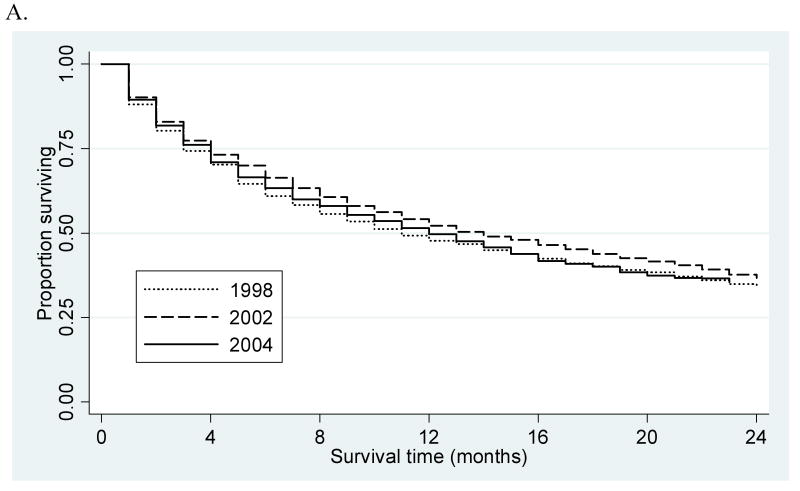
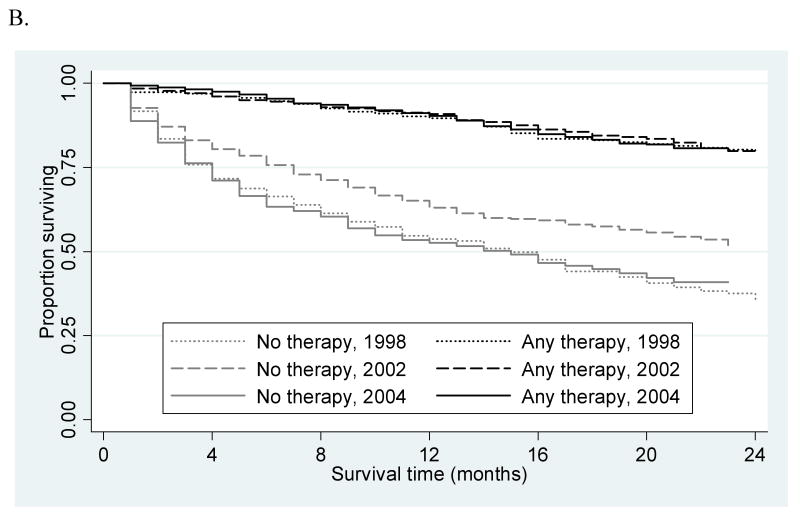
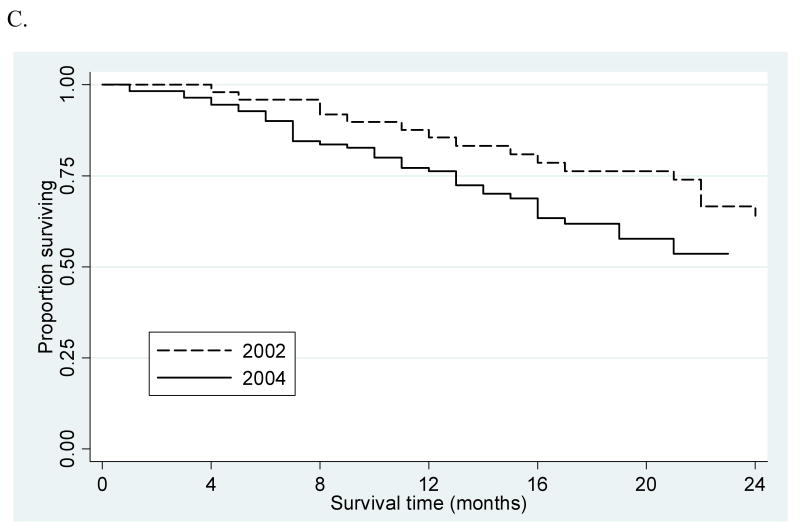
Results: A total of 4,924 (22%) patients underwent any intervention, with a 93% increase over the 8-year study period (trend test, p < 0.001). RFA accounted for 43% of this increase. Despite increased use of therapeutic interventions, 1- and 2-year survival rates did not improve over time for patients in the study cohort (48% and 34%, 52% and 37%, 50% and 36%; in 1998, 2002, and 2004, respectively; p = 0.31). Among patients with solitary lesions, adjusted 1- and 2-year survivals remained stable over time after transplantation (97% and 94%, 95% and 89%, 94% and 86% in 1998, 2002, and 2004, respectively; p = 0.99) and RFA (86% and 64%, 76% and 54%, in 2002 and 2004, respectively; p = 0.97), but improved after resection (83% and 71%, 91% and 84%, 97% and 94% in 1998, 2002, and 2004, respectively; p = 0.03).
Conclusions: Use of interventions for the treatment of HCC, and specifically RFA, have markedly increased over time. Because increased use of RFA among patients with potentially resectable disease is likely to occur, and because of a lack of high-level evidence supporting expanded indications, continued evaluation of the indications for RFA and subsequent outcomes among US patients is warranted.
Copyright (c) 2010 American College of Surgeons. Published by Elsevier Inc. All rights reserved.
Conflict of interest statement
Disclosure Information: Nothing to disclose.
Figures
Comment in
-
Radiofrequency ablation use in hepatocellular carcinoma.J Am Coll Surg. 2010 Aug;211(2):293-4; author reply 293. doi: 10.1016/j.jamcollsurg.2010.04.021. J Am Coll Surg. 2010. PMID: 20670870 No abstract available.
References
-
- Parkin DM. Global cancer statistics in the year 2000. Lancet Oncol. 2001;2:533–543. - PubMed
-
- El-Serag HB, Mason AC. Rising incidence of hepatocellular carcinoma in the United States. N Engl J Med. 1999;340:745–750. - PubMed
-
- Donckier V, Van Laethem JL, Van Gansbeke D, et al. New considerations for an overall approach to treat hepatocellular carcinoma in cirrhotic patients. J Surg Oncol. 2003;84:36–44. discussion 44. - PubMed
-
- Davis GL, Albright JE, Cook SF, Rosenberg DM. Projecting future complications of chronic hepatitis C in the United States. Liver Transpl. 2003;9:331–338. - PubMed
Publication types
MeSH terms
Grants and funding
LinkOut - more resources
Full Text Sources
Medical
