. 2010 Apr;82(4):746-54.
doi: 10.4269/ajtmh.2010.09-0716.

A silent enzootic of an orthopoxvirus in Ghana, West Africa: evidence for multi-species involvement in the absence of widespread human disease

Affiliations

A silent enzootic of an orthopoxvirus in Ghana, West Africa: evidence for multi-species involvement in the absence of widespread human disease

Mary G Reynolds et al. Am J Trop Med Hyg. 2010 Apr.

Abstract

Human monkeypox has never been reported in Ghana, but rodents captured in forested areas of southern Ghana were the source of the monkeypox virus introduced into the United States in 2003. Subsequent to the outbreak in the United States, 204 animals were collected from two commercial trapping sites in Ghana. Animal tissues were examined for the presence of orthopoxvirus (OPXV) DNA using a real-time polymerase chain reaction, and sera were assayed for antibodies against OPXV. Animals from five genera (Cricetomys, Graphiurus, Funiscirus, and Heliosciurus) had antibodies against OPXV, and three genera (Cricetomys, Graphiurus, and Xerus) had evidence of OPXV DNA in tissues. Additionally, 172 persons living near the trapping sites were interviewed regarding risk factors for OPXV exposure, and their sera were analyzed. Fifty-three percent had IgG against OPXV; none had IgM. Our findings suggest that several species of forest-dwelling rodents from Ghana are susceptible to naturally occurring OPXV infection, and that persons living near forests may have low-level or indirect exposure to OPXV-infected animals, possibly resulting in sub-clinical infections.


Figures
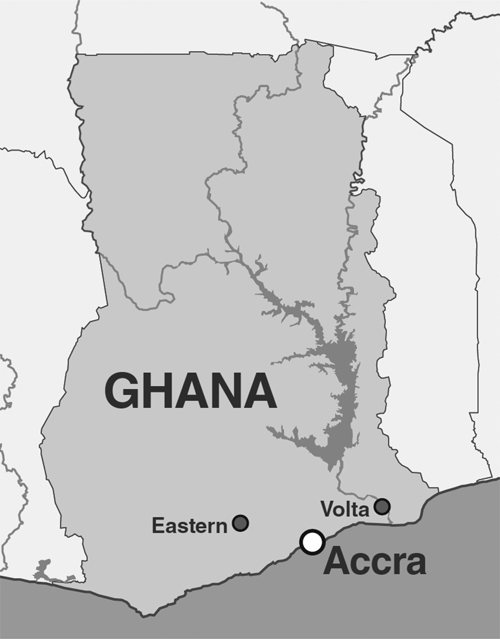
Figure 1.
Figure 1.
Map of Ghana, showing the two survey locations.
Figure 2.
Figure 2.
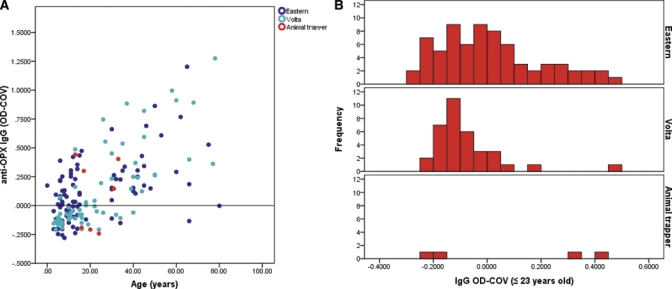
Levels of serum IgG against orthopoxvirus (OPXV) (OD-COV) among study participants in Ghana, by age and region. A, Scatterplot depicting OPXV IgG levels by age (years) across the study population. Blue = Easter region; cyan = Volta region; red = persons engaged in exotic animal trade. B, Histograms showing the distribution of OD-COV values among persons ≤ 23 years of age, stratified by region, including persons ≤ 23 years of age engaged in exotic animal trade.
Figure 3.
Figure 3.
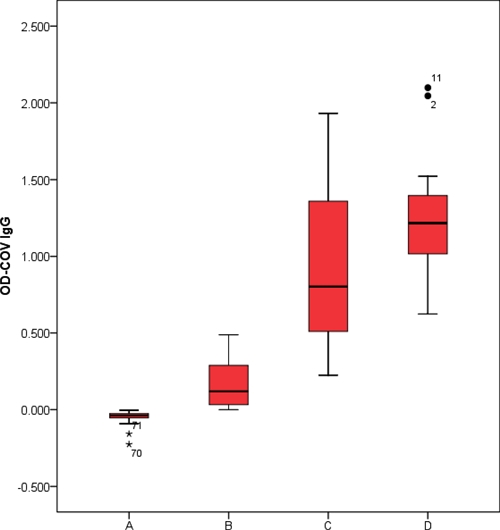
Box plots of levels of serum IgG against orthopoxvirus (OPXV) (OD-COV) for A, non–smallpox-vaccinated persons who were not infected with monkeypox virus (MPXV) infection by clinical, epidemiologic, and laboratory criteria during the MPX outbreak in United States in 2003 (n = 74); B, persons positive for IgG against OPXV ≤ 23 years of age in this study (n = 40); C, persons confirmed as having MPXV infection during the U.S. outbreak approximately one year post-illness onset (n = 14); and D, persons confirmed as having MPXV infection during the U.S. outbreak with acute-phase illness (n = 15). This figure appears in color at www.ajtmh.org.

References

    1. Ladnyj ID, Ziegler P, Kima E. A human infection caused by monkeypox virus in Basankusu Territory, Democratic Republic of the Congo. Bull World Health Organ. 1972;46:593–597. - PMC - PubMed
    1. Foster SO, Brink EW, Hutchins DL, Pifer JM, Lourie B, Moser CR, Cummings EC, Kuteyi OE, Eke RE, Titus JB, Smith EA, Hicks JW, Foege WH. Human monkeypox. Bull World Health Organ. 1972;46:569–576. - PMC - PubMed
    1. Marennikova SS, Seluhina EM, Mal'ceva NN, Cimiskjan KL, Macevic GR. Isolation and properties of the causal agent of a new variola-like disease (monkeypox) in man. Bull World Health Organ. 1972;46:599–611. - PMC - PubMed
    1. Arita I, Jezek Z, Khodakevich L, Ruti K. Human monkeypox: a newly emerged orthopoxvirus zoonosis in the tropical rain forests of Africa. Am J Trop Med Hyg. 1985;34:781–789. - PubMed
    1. Khodakevich L, Jezek Z, Kinzanzka K. Isolation of monkeypox virus from wild squirrel infected in nature. Lancet. 1986;1:98–99. - PMC - PubMed

Publication types

LinkOut - more resources