


Changes in herbivore control in arable fields by detrital subsidies depend on predator species and vary in space
- PMID: 20349249
- PMCID: PMC2903711
- DOI: 10.1007/s00442-010-1604-6
Changes in herbivore control in arable fields by detrital subsidies depend on predator species and vary in space
Abstract
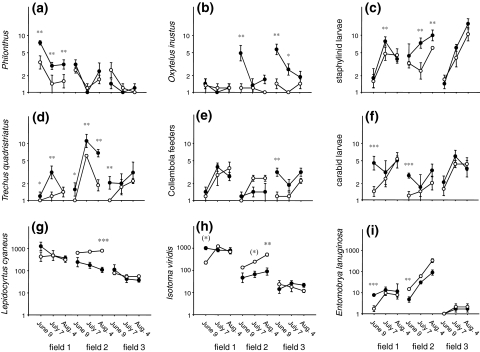
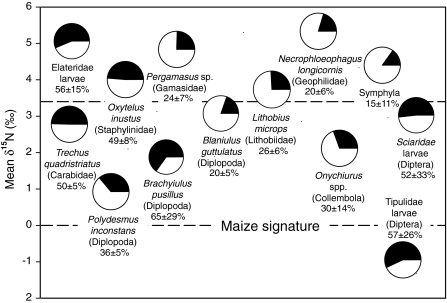
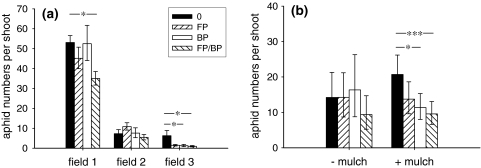
Prey from the decomposer subsystem may help sustain predator populations in arable fields. Adding organic residues to agricultural systems may therefore enhance pest control. We investigated whether resource addition (maize mulch) strengthens aboveground trophic cascades in winter wheat fields. Evaluating the flux of the maize-borne carbon into the food web after 9 months via stable isotope analysis allowed differentiating between prey in predator diets originating from the above- and belowground subsystems. Furthermore, we recorded aphid populations in predator-reduced and control plots of no-mulch and mulch addition treatments. All analyzed soil dwelling species incorporated maize-borne carbon. In contrast, only 2 out of 13 aboveground predator species incorporated maize carbon, suggesting that these 2 predators forage on prey from the above- and belowground systems. Supporting this conclusion, densities of these two predator species were increased in the mulch addition fields. Nitrogen isotope signatures suggested that these generalist predators in part fed on Collembola thereby benefiting indirectly from detrital resources. Increased density of these two predator species was associated by increased aphid control but the identity of predators responsible for aphid control varied in space. One of the three wheat fields studied even lacked aphid control despite of mulch-mediated increased density of generalist predators. The results suggest that detrital subsidies quickly enter belowground food webs but only a few aboveground predator species include prey out of the decomposer system into their diet. Variation in the identity of predator species benefiting from detrital resources between sites suggest that, depending on locality, different predator species are subsidised by prey out of the decomposer system and that these predators contribute to aphid control. Therefore, by engineering the decomposer subsystem via detrital subsidies, biological control by generalist predators may be strengthened.
Figures

References
-
- Bell JR, Traugott M, Sunderland KD, Skirvin DJ, Mead A, Kravar-Garde L, Reynolds K, Fenlon JS, Symondson WOC. Beneficial links for the control of aphids: the effects of compost applications on predators and prey. J Appl Ecol. 2008;45:1266–1273. doi: 10.1111/j.1365-2664.2008.01479.x. - DOI
-
- Bilde T, Axelsen JA, Toft S. The value of Collembola from agricultural soils as food for a generalist predator. J Appl Ecol. 2000;37:672–683. doi: 10.1046/j.1365-2664.2000.00527.x. - DOI
-
- Birkhofer K, Wise D, Scheu S. Dual-subsystem omnivory, but not microhabitat complexity affects the role of generalist predators in an aboveground herbivore food web. Oikos. 2008;117:494–500. doi: 10.1111/j.0030-1299.2008.16361.x. - DOI
-
- Bohan DA, Bohan AC, Glen DM, Symondson WOC, Wiltshire CW, Hughes L. Spatial dynamics of predation by carabid beetles on slugs. J Anim Ecol. 2000;69:367–379. doi: 10.1046/j.1365-2656.2000.00399.x. - DOI
Publication types
MeSH terms
Substances
LinkOut - more resources
Full Text Sources
