Following your heart or your head: focusing on emotions versus information differentially influences the decisions of younger and older adults
- PMID: 20350046
- PMCID: PMC3919140
- DOI: 10.1037/a0018500
Following your heart or your head: focusing on emotions versus information differentially influences the decisions of younger and older adults
Erratum in
- J Exp Psychol Appl. 2010 Jun;16(2):157
Abstract
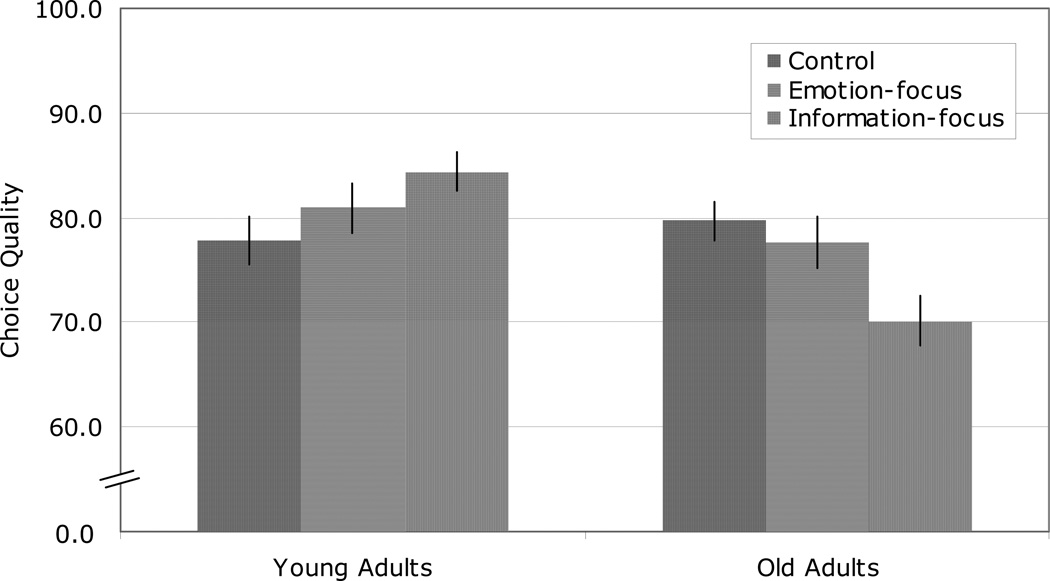
Research on aging has indicated that whereas deliberative cognitive processes decline with age, emotional processes are relatively spared. To examine the implications of these divergent trajectories in the context of health care choices, we investigated whether instructional manipulations emphasizing a focus on feelings or details would have differential effects on decision quality among younger and older adults. We presented 60 younger and 60 older adults with health care choices that required them to hold in mind and consider multiple pieces of information. Instructional manipulations in the emotion-focus condition asked participants to focus on their emotional reactions to the options, report their feelings about the options, and then make a choice. In the information-focus condition, participants were instructed to focus on the specific attributes, report the details about the options, and then make a choice. In a control condition, no directives were given. Manipulation checks indicated that the instructions were successful in eliciting different modes of processing. Decision quality data indicate that younger adults performed better in the information-focus than in the control condition whereas older adults performed better in the emotion-focus and control conditions than in the information-focus condition. Findings support and extend extant theorizing on aging and decision making as well as suggest that interventions to improve decision-making quality should take the age of the decision maker into account.
Figures
References
-
- Babcock RL, Salthouse TA. Effects of increased processing demands on age differences in working memory. Psychology & Aging. 1990;5(3):421–428. - PubMed
-
- Baddeley AD. Working memory. Oxford, England UK: Clarendon Press/Oxford University Press; 1986.
-
- Baddeley AD, Hitch G. Working Memory. In: Bower G, editor. The Psychology of Learning and Motivation. vol. 8. New York: Academic Press; 1974. pp. 47–89.
-
- Baltes PB. On the incomplete architecture of human ontogeny: Selection, optimization, and compensation as foundation of developmental theory. American Psychologist. 1997;52(4):366–380. - PubMed
-
- Botti S, Iyengar S-S. The Dark Side of Choice: When Choice Impairs Social Welfare. Journal of Public Policy and Marketing. 2006;25(1):24–38.
Publication types
MeSH terms
Grants and funding
LinkOut - more resources
Full Text Sources
Medical