. 2010 May 21;285(21):16378-86.
doi: 10.1074/jbc.M109.077859. Epub 2010 Mar 29.

Reduction of sympathetic activity via adrenal-targeted GRK2 gene deletion attenuates heart failure progression and improves cardiac function after myocardial infarction

Affiliations

Reduction of sympathetic activity via adrenal-targeted GRK2 gene deletion attenuates heart failure progression and improves cardiac function after myocardial infarction

Anastasios Lymperopoulos et al. J Biol Chem. .

Abstract

Chronic heart failure (HF) is characterized by sympathetic overactivity and enhanced circulating catecholamines (CAs), which significantly increase HF morbidity and mortality. We recently reported that adrenal G protein-coupled receptor kinase 2 (GRK2) is up-regulated in chronic HF, leading to enhanced CA release via desensitization/down-regulation of the chromaffin cell alpha(2)-adrenergic receptors that normally inhibit CA secretion. We also showed that adrenal GRK2 inhibition decreases circulating CAs and improves cardiac inotropic reserve and function. Herein, we hypothesized that adrenal-targeted GRK2 gene deletion before the onset of HF might be beneficial by reducing sympathetic activation. To specifically delete GRK2 in the chromaffin cells of the adrenal gland, we crossed PNMTCre mice, expressing Cre recombinase under the chromaffin cell-specific phenylethanolamine N-methyltransferase (PNMT) gene promoter, with floxedGRK2 mice. After confirming a significant ( approximately 50%) reduction of adrenal GRK2 mRNA and protein levels, the PNMT-driven GRK2 knock-out (KO) offspring underwent myocardial infarction (MI) to induce HF. At 4 weeks post-MI, plasma levels of both norepinephrine and epinephrine were reduced in PNMT-driven GRK2 KO, compared with control mice, suggesting markedly reduced post-MI sympathetic activation. This translated in PNMT-driven GRK2 KO mice into improved cardiac function and dimensions as well as amelioration of abnormal cardiac beta-adrenergic receptor signaling at 4 weeks post-MI. Thus, adrenal-targeted GRK2 gene KO decreases circulating CAs, leading to improved cardiac function and beta-adrenergic reserve in post-MI HF. GRK2 inhibition in the adrenal gland might represent a novel sympatholytic strategy that can aid in blocking HF progression.


Figures
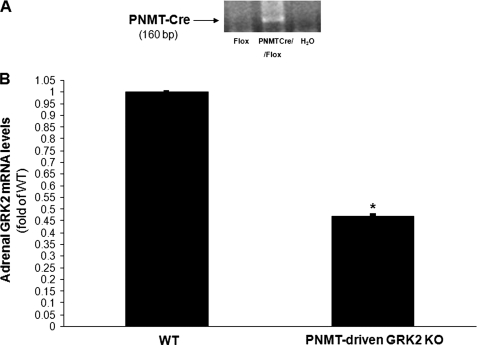
FIGURE 1.
FIGURE 1.
A, PCR screening in tail genomic DNA from PNMTCre/FloxedGRK2 (PNMTCre/Flox) or control FloxedGRK2 (Flox) mice for confirmation of PNMT locus insertion of the Cre transgene. An additional lane run without DNA (H2O), thus serving as negative control for the assay is also shown. B, real-time PCR in total adrenal mRNA isolated from 2-month-old PNMT-driven GRK2 KO or control FloxedGRK2 (WT) mice for determination of total adrenal GRK2 mRNA levels (*, p < 0.05, n = 6 mice/litter).
FIGURE 2.
FIGURE 2.
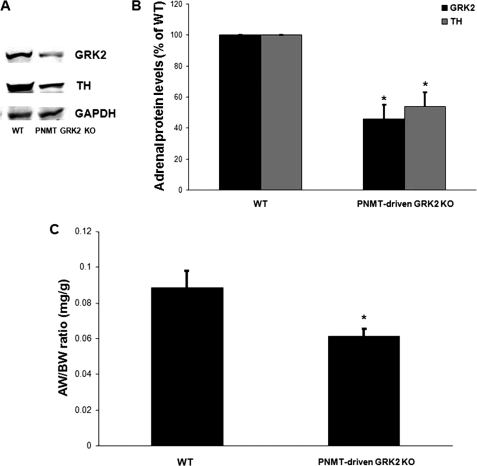
A, representative Western blots in total adrenal protein extracts from 2-month-old PNMT-driven GRK2 KO or control FloxedGRK2 (WT) mice for total adrenal GRK2 or tyrosine hydroxylase (TH) protein levels. Blots for the housekeeping protein glyceraldehyde 3-phosphate dehydrogenase (GAPDH), as loading control, are also shown. B, densitometric quantitation of the four independent experiments done in A using GAPDH levels as normalization control (*, p < 0.05, versus WT, n = 4 independent experiments performed in extracts from 6 adrenals pooled from 3 mice/litter each). C, adrenal weight-to-body weight ratios of these mice (see also Table 2) (*, p = 0.023, n = 10 mice/litter).
FIGURE 3.
FIGURE 3.
A, plasma membrane α2AR density in the adrenal glands of 2-month-old PNMT-driven GRK2 KO or control FloxedGRK2 (WT) mice. Nonspecific binding was determined in the presence of 0.4 mm phentolamine (*, p < 0.05, versus WT, n = 3 independent experiments, performed with 8 adrenals pooled from 4 mice/litter each). Data are expressed as mean ± S.E. B, in vitro catecholamine secretion from chromaffin cells isolated from these mice after nicotine treatment, following pretreatment with vehicle (Nicotine) or with 10 μm UK14304 (UK14304 + Nicotine). UK14304 pretreatment alone had no effect (data not shown) (*, p < 0.05, versus WT/nicotine, **, p < 0.05, versus WT/UK14304 + nicotine, n = 3 independent experiments, performed with cells isolated from 10 adrenals pooled from 5 mice/litter each).
FIGURE 4.
FIGURE 4.
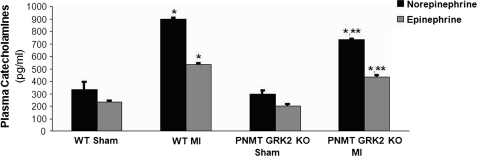
Plasma circulating norepinephrine and epinephrine levels in normal, sham-operated (Sham) or in 4-week post-MI HF (MI) PNMT-driven GRK2 KO (PNMT GRK2 KO) and control FloxedGRK2 (WT) mice. *, p < 0.05, versus Sham-either genotype; **, p < 0.05, versus WT MI, n = 6 mice/group.
FIGURE 5.
FIGURE 5.
A, ejection fraction (EF %) of sham-operated (sham) or of 4-week post-MI HF (MI) PNMT-driven GRK2 KO (PNMT GRK2 KO) and control FloxedGRK2 (WT) mice (*, p = 0.005, versus WT MI, n = 10 mice/group). B, LV end diastolic diameter (LVEDD) of these mice (*, p < 0.05, versus sham; **, p < 0.05, versus WT MI, n = 10 mice/group). C, basal and maximal dose of isoproterenol (Max. Iso)-stimulated + dP/dtmax responses of these mice (*, p < 0.05, versus sham; **, p < 0.05, versus Max. Iso/MI WT, n = 7 mice/group).
FIGURE 6.
FIGURE 6.
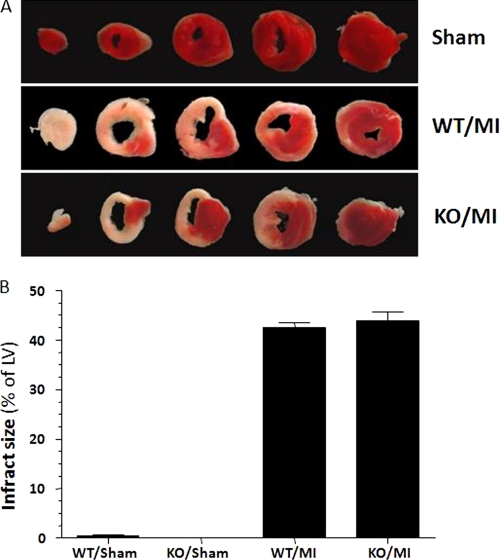
Infarct size in PNMT-driven GRK2 KO (KO) and WT mice at 24 h post-MI. Sham hearts are also shown as negative controls. A, representative triphenyltetrazolium chloride-stained cardiac cross-sections. B, average LV infarct size (n = 5 for each group). No significant difference between the MI groups was observed (p = 0.05).
FIGURE 7.
FIGURE 7.
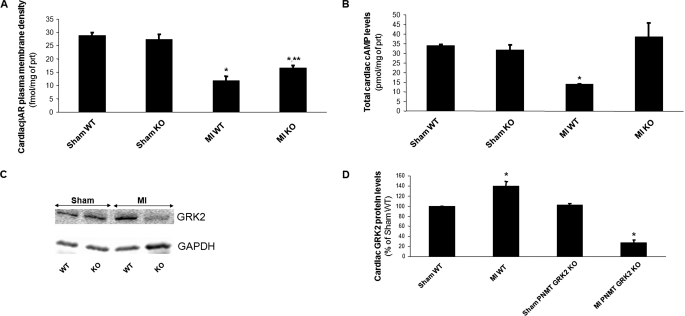
A, βAR density in cardiac plasma membranes of sham-operated (sham) or of 4-week post-MI HF (MI) PNMT-driven GRK2 KO (KO) and control WT mice. *, p < 0.01, versus either Sham (**, p < 0.05 versus MI WT, n = 6 hearts/group). B, steady-state total cAMP levels in cardiac homogenates purified from hearts of these mice (*, p < 0.05 versus all other groups, n = 6 hearts/group). C, representative Western blots in total cardiac protein extracts from these mice for cardiac GRK2 protein levels. Blots for the housekeeping protein glyceraldehyde 3-phosphate dehydrogenase (GAPDH), as loading control, are also shown. D, densitometric quantitation of the blots done in C, using GAPDH levels as normalization control (*, p < 0.05, versus respective Sham, n = 6 hearts/group).
FIGURE 8.
FIGURE 8.
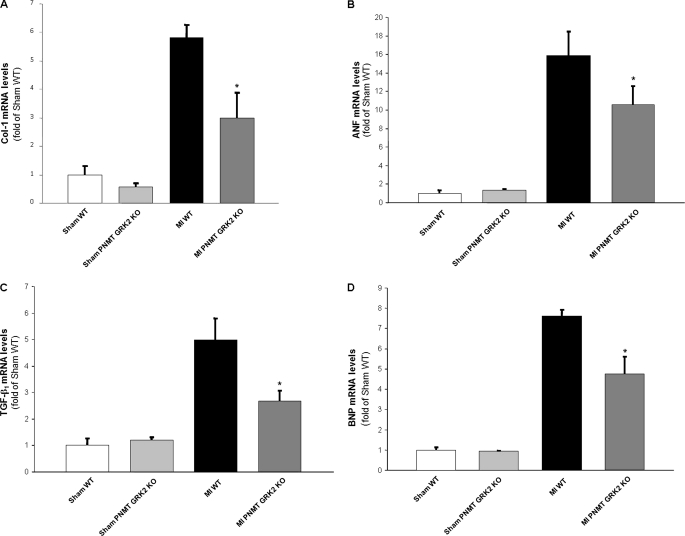
Heart mRNA levels of collagen I (A), atrial natriuretic factor (B), transforming growth factor β1 (C), and brain natriuretic peptide (D) in all experimental groups at 4 weeks post-MI. All values were standardized to amplified 28 S rRNA. Data are presented as mean ± S.E. and plotted as fold of sham WT values (*, p < 0.05, versus MI WT, n = 6 hearts/group).

References

    1. Thomas S., Rich M. W. (2007) Heart Fail. Clin. 3, 381–387 - PMC - PubMed
    1. Kaye D. M., Krum H. (2007) Nat. Rev. Drug Disc. 6, 127–139 - PubMed
    1. Port J. D., Bristow M. R. (2001) J. Mol. Cell Cardiol. 33, 887–905 - PubMed
    1. Rockman H. A., Koch W. J., Lefkowitz R. J. (2002) Nature 415, 206–212 - PubMed
    1. Tilley D. G., Rockman H. A. (2006) Exp. Rev. Cardiovasc. Ther. 4, 417–432 - PubMed

Publication types

MeSH terms

Substances