. 2010 Jun;185(2):469-77.
doi: 10.1534/genetics.110.116285. Epub 2010 Mar 29.

Critical determinants for chromatin binding by Saccharomyces cerevisiae Yng1 exist outside of the plant homeodomain finger

Affiliations

Critical determinants for chromatin binding by Saccharomyces cerevisiae Yng1 exist outside of the plant homeodomain finger

Adam Chruscicki et al. Genetics. 2010 Jun.

Abstract

The temporal and spatial regulation of histone post-translational modifications is essential for proper chromatin structure and function. The Saccharomyces cerevisiae NuA3 histone acetyltransferase complex modifies the amino-terminal tail of histone H3, but how NuA3 is targeted to specific regions of the genome is not fully understood. Yng1, a subunit of NuA3 and a member of the Inhibitor of Growth (ING) protein family, is required for the interaction of NuA3 with chromatin. This protein contains a C-terminal plant homeodomain (PHD) finger that specifically interacts with lysine 4-trimethylated histone H3 (H3K4me3) in vitro. This initially suggested that NuA3 is targeted to regions bearing the H3K4me3 mark; however, deletion of the Yng1 PHD finger does not disrupt the interaction of NuA3 with chromatin or result in a phenotype consistent with loss of NuA3 function in vivo. In this study, we uncovered the molecular basis for the discrepancies in these data. We present both genetic and biochemical evidence that full-length Yng1 has two independent histone-binding motifs: an amino-terminal motif that binds unmodified H3 tails and a carboxyl-terminal PHD finger that specifically recognizes H3K4me3. Although these motifs can bind histones independently, together they increase the apparent association of Yng1 for the H3 tail.


Figures
F<sc>igure</sc> 1.—
Figure 1.—
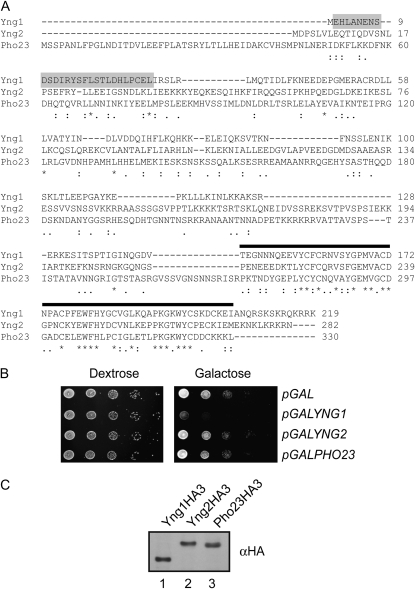
Overexpression of YNG1, but not YNG2 or PHO23, inhibits yeast cell growth. (A) CLUSTAL 2.0.12 multiple-sequence alignment of the ING proteins in S. cerevisiae. “*” indicates that the residues in that column are identical in all sequences in the alignment. “:” and “.” mean that conserved and semiconserved substitutions are observed, respectively. Sequences corresponding to the PHD finger are indicated by a solid bar, and amino-terminal residues important for unmodified tail binding are shaded. (B) Tenfold serial dilutions of a wild-type yeast strain containing the indicated low-copy plasmids were plated on synthetic leucine drop-out medium with either dextrose or galactose as a carbon source and incubated at 30° for 3 days. (C) Yeast YNG1, YNG2, and PHO23 are equivalently expressed in cells. Shown is an αHA Western blot analysis of whole-cell extracts from strains expressing HA-tagged versions of Yng1, Yng2, and Pho23 from a GAL1 promoter during growth in galactose.
F<sc>igure</sc> 2.—
Figure 2.—
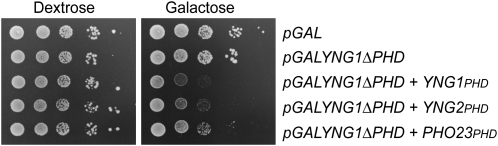
The Yng2 and Pho23 PHD fingers confer inhibition of growth when fused to the amino-terminal domain of Yng1. Tenfold serial dilutions of a wild-type yeast strain transformed with the indicated high-copy plasmids were plated on synthetic uracil drop-out medium containing either dextrose or galactose as a carbon source and incubated at 30° for 3 days.
F<sc>igure</sc> 3.—
Figure 3.—
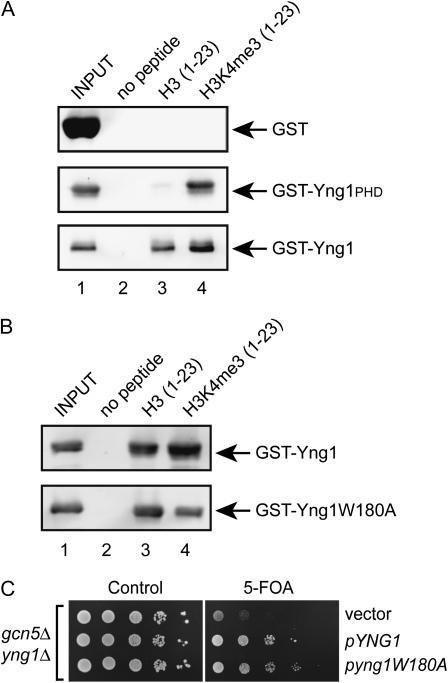
Full-length Yng1 binds unmodified histone H3 tails independently of the PHD finger. (A and B) Histone tail peptide-binding assays were performed with the indicated immobilized peptides and purified GST fusion proteins. Shown are αGST Western blots of precipitated material. Input lanes contain 10% of the proteins used for the pulldown. (C) A gcn5Δ yng1Δ strain expressing GCN5 from a URA3-based plasmid was transformed with the indicated plasmids, plated on synthetic complete medium with and without 5-FOA, and incubated at 30° for 3 days.
F<sc>igure</sc> 4.—
Figure 4.—
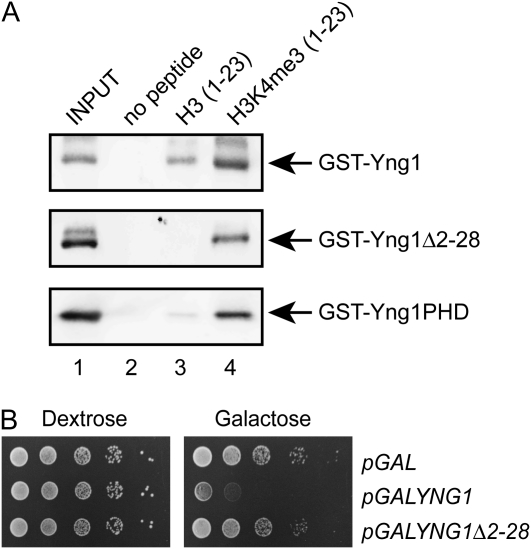
The amino terminus of Yng1 is required for binding of unmodified histone H3 tails. (A) Histone tail peptide binding assays were performed with the indicated immobilized peptides and purified GST fusion proteins. Shown are αGST Western blots of precipitated material. Input lanes contain 10% of the proteins used for the pulldown. (B) Tenfold serial dilutions of a wild-type yeast strain containing the indicated low-copy plasmids were plated on synthetic uracil drop-out medium containing either dextrose or galactose as a carbon source and incubated at 30° for 3 days.
F<sc>igure</sc> 5.—
Figure 5.—
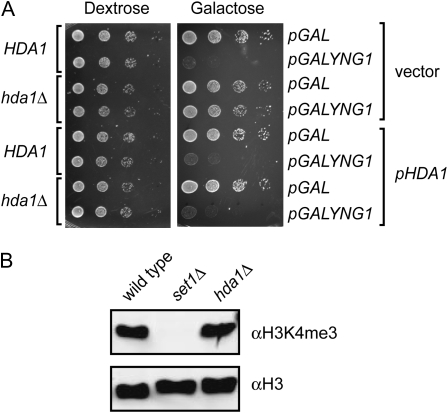
Deletion of HDA1 confers resistance to inhibition of growth by YNG1 overexpression. (A) Tenfold serial dilutions of HDA1 and hda1Δ yeast strains containing the indicated plasmids were plated on synthetic uracil/leucine drop-out medium containing either dextrose or galactose as a carbon source and incubated at 30° for 3 days. (B) Western blot of the whole-cell extracts from wild type, set1Δ, and hda1Δ strains. The blot was probed with αH3K4me3 and αH3 antibodies.
F<sc>igure</sc> 6.—
Figure 6.—
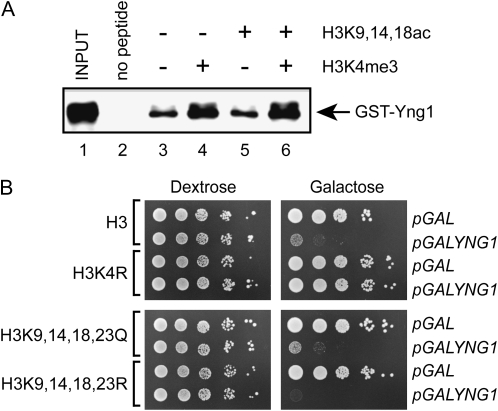
Acetylation does not alter the association of Yng1 with the histone H3 tail. (A) Histone peptide-binding assays were performed with the indicated biotinylated peptides and purified GST-Yng1. Shown is an αGST Western blot of precipitated material. Input lane contains 10% of the protein amount used for the pulldowns. (B) Tenfold serial dilutions of yeast strains, expressing wild-type and mutant versions of histone H3, containing the indicated plasmids, were plated on synthetic uracil drop-out medium containing either dextrose or galactose as a carbon source and incubated at 30° for 3 days.

References

    1. Albert, I., T. N. Mavrich, L. P. Tomsho, J. Qi, S. J. Zanton et al., 2007. Translational and rotational settings of H2A.Z nucleosomes across the Saccharomyces cerevisiae genome. Nature 446 572–576. - PubMed
    1. Ausubel, F. M., 1987. Current Protocols in Molecular Biology. Greene Publishing Associates and Wiley-Interscience/John Wiley & Sons, New York.
    1. Carmen, A. A., S. E. Rundlett and M. Grunstein, 1996. HDA1 and HDA3 are components of a yeast histone deacetylase (HDA) complex. J. Biol. Chem. 271 15837–15844. - PubMed
    1. Carrozza, M. J., B. Li, L. Florens, T. Suganuma, S. K. Swanson et al., 2005. Histone H3 methylation by Set2 directs deacetylation of coding regions by Rpd3S to suppress spurious intragenic transcription. Cell 123 581–592. - PubMed
    1. Choy, J. S., B. T. Tobe, J. H. Huh and S. J. Kron, 2001. Yng2p-dependent NuA4 histone H4 acetylation activity is required for mitotic and meiotic progression. J. Biol. Chem. 276 43653–43662. - PubMed

Publication types