


Identifying psychosocial interventions that improve both physical and mental health in patients with diabetes: a systematic review and meta-analysis
- PMID: 20351228
- PMCID: PMC2845054
- DOI: 10.2337/dc09-1519
Identifying psychosocial interventions that improve both physical and mental health in patients with diabetes: a systematic review and meta-analysis
Abstract
Objective: Patients with diabetes suffer high rates of mental health problems, and this combination is associated with poor outcomes. Although effective treatments exist for both diabetes and mental health problems, delivering services for physical and mental health problems separately ignores their interaction and may be inefficient. This systematic review sought to identify psychosocial interventions that could improve both the physical and mental health of patients with diabetes.
Research design and methods: Studies were identified from the following databases: CENTRAL, MEDLINE, Excerpta Medica (EMBASE), Psychinfo, and Cumulative Index to Nursing and Allied Health Literature (CINAHL). The review included randomized controlled trials in patients with type 1 and type 2 diabetes who received psychosocial interventions and where both mental health and physical health outcomes were reported. Data were extracted on study quality, the content and process of interventions, and outcomes.
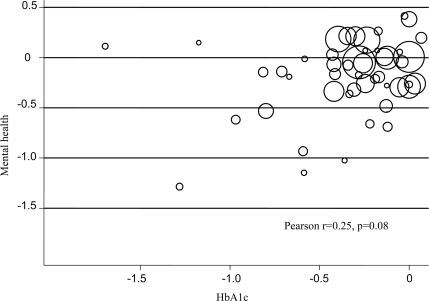
Results: Eighty-five eligible comparisons were identified, of which 49 reported sufficient data for analysis. Psychosocial interventions modestly improved A1C (standardized mean difference -0.29 [95% CI -0.37 to -0.21]) and mental health outcomes (-0.16 [-0.25 to -0.07]). However, there was a limited association between the effects on A1C and mental health, and no intervention characteristics predicted benefit on both outcomes.
Conclusions: Managing physical and mental health in long-term conditions are increasingly important. The review did not identify types of interventions that consistently provide benefits for both physical and mental health. Developing such interventions remains an important challenge. The findings have implications for understanding the interaction between physical and mental health problems and for the coordination of care.
Figures
References
-
- World Health Organization. The Global Burden of Disease: 2004 Update. Geneva, Switzerland, World Health Organization Press, 2009.
-
- Anderson RJ, Freedland KE, Clouse RE, Lustman PJ. The prevalence of comorbid depression in adults with diabetes: a meta-analysis. Diabetes Care 2001;24:1069–1078 - PubMed
-
- Piette JD, Richardson C, Valenstein M. Addressing the needs of patients with multiple chronic illnesses: the case of diabetes and depression. Am J Manag Care 2004;10:152–162 - PubMed
Publication types
MeSH terms
Grants and funding
LinkOut - more resources
Full Text Sources
Medical
Molecular Biology Databases
