


Assessing respondent-driven sampling
- PMID: 20351258
- PMCID: PMC2872407
- DOI: 10.1073/pnas.1000261107
Assessing respondent-driven sampling
Abstract
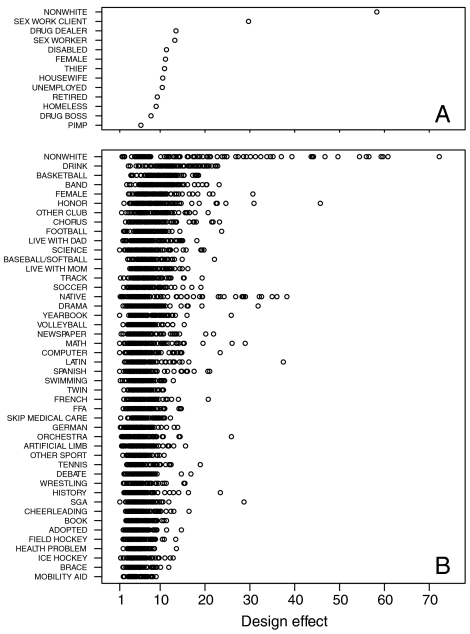
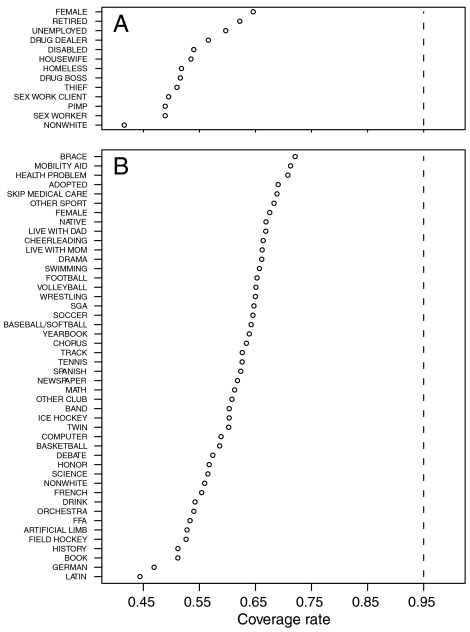
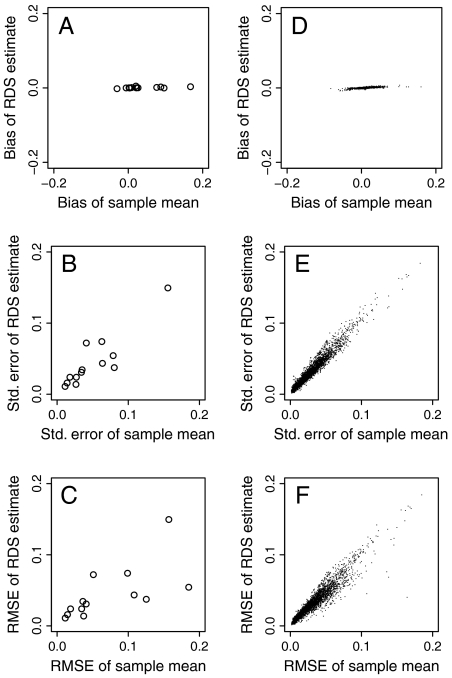
Respondent-driven sampling (RDS) is a network-based technique for estimating traits in hard-to-reach populations, for example, the prevalence of HIV among drug injectors. In recent years RDS has been used in more than 120 studies in more than 20 countries and by leading public health organizations, including the Centers for Disease Control and Prevention in the United States. Despite the widespread use and growing popularity of RDS, there has been little empirical validation of the methodology. Here we investigate the performance of RDS by simulating sampling from 85 known, network populations. Across a variety of traits we find that RDS is substantially less accurate than generally acknowledged and that reported RDS confidence intervals are misleadingly narrow. Moreover, because we model a best-case scenario in which the theoretical RDS sampling assumptions hold exactly, it is unlikely that RDS performs any better in practice than in our simulations. Notably, the poor performance of RDS is driven not by the bias but by the high variance of estimates, a possibility that had been largely overlooked in the RDS literature. Given the consistency of our results across networks and our generous sampling conditions, we conclude that RDS as currently practiced may not be suitable for key aspects of public health surveillance where it is now extensively applied.
Conflict of interest statement
The authors declare no conflict of interest.
Figures
References
-
- Magnani R, Sabin K, Saidel T, Heckathorn D. Review of sampling hard-to-reach and hidden populations for HIV surveillance. AIDS. 2005;19:S67–S72. - PubMed
-
- Heckathorn DD. Respondent-driven sampling: A new approach to the study of hidden populations. Soc Probl. 1997;44:174–199.
-
- Heckathorn DD. Respondent-driven sampling II: Deriving valid population estimates from chain-referral samples of hidden populations. Soc Probl. 2002;49:11–34.
-
- Salganik MJ, Heckathorn DD. Sampling and estimation in hidden populations using respondent-driven sampling. Sociol Methodol. 2004;34:193–239.
-
- Malekinejad M, et al. Using respondent-driven sampling methodology for HIV biological and behavioral surveillance in international settings: A systematic review. AIDS Behav. 2008;12:105–130. - PubMed
Publication types
MeSH terms
Grants and funding
LinkOut - more resources
Full Text Sources
