


Disruption of the right temporoparietal junction with transcranial magnetic stimulation reduces the role of beliefs in moral judgments
- PMID: 20351278
- PMCID: PMC2872442
- DOI: 10.1073/pnas.0914826107
Disruption of the right temporoparietal junction with transcranial magnetic stimulation reduces the role of beliefs in moral judgments
Abstract
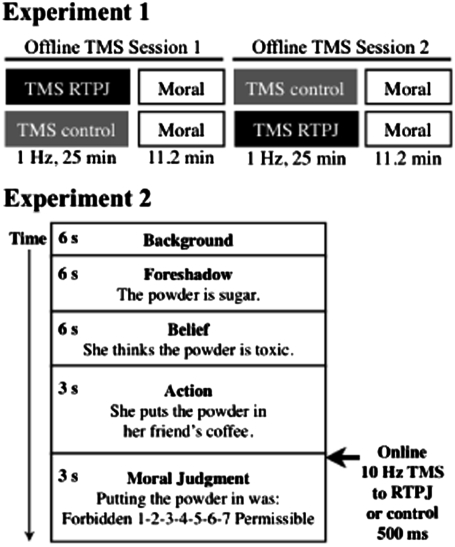
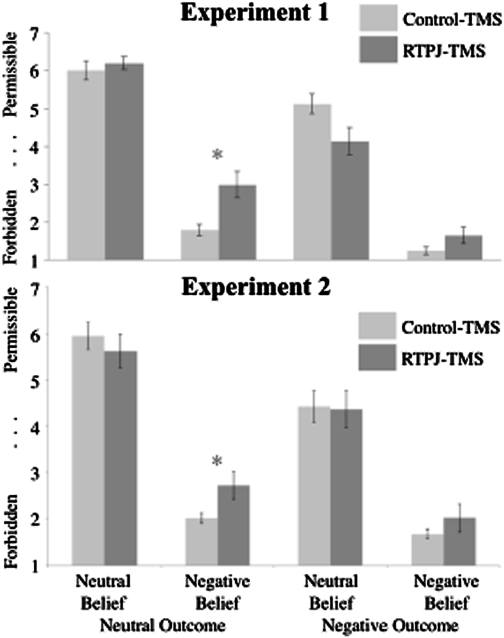
When we judge an action as morally right or wrong, we rely on our capacity to infer the actor's mental states (e.g., beliefs, intentions). Here, we test the hypothesis that the right temporoparietal junction (RTPJ), an area involved in mental state reasoning, is necessary for making moral judgments. In two experiments, we used transcranial magnetic stimulation (TMS) to disrupt neural activity in the RTPJ transiently before moral judgment (experiment 1, offline stimulation) and during moral judgment (experiment 2, online stimulation). In both experiments, TMS to the RTPJ led participants to rely less on the actor's mental states. A particularly striking effect occurred for attempted harms (e.g., actors who intended but failed to do harm): Relative to TMS to a control site, TMS to the RTPJ caused participants to judge attempted harms as less morally forbidden and more morally permissible. Thus, interfering with activity in the RTPJ disrupts the capacity to use mental states in moral judgment, especially in the case of attempted harms.
Conflict of interest statement
The authors declare no conflict of interest.
Figures
References
-
- Baird JA, Astington JW. The role of mental state understanding in the development of moral cognition and moral action. New Dir Child Adolesc Dev. 2004;103:37–49. - PubMed
-
- Karniol R. Children's use of intention cues in evaluating behavior. Psychol Bull. 1978;85:76–85.
-
- Piaget J. The Moral Judgment of the Child. New York: Free Press; 1932.
-
- Gallagher HL, Frith CD. Functional imaging of ‘theory of mind’. Trends Cogn Sci. 2003;7:77–83. - PubMed
-
- Gobbini MI, Koralek AC, Bryan RE, Montgomery KJ, Haxby JV. Two takes on the social brain: A comparison of theory of mind tasks. J Cognit Neurosci. 2007;19:1803–1814. - PubMed
Publication types
MeSH terms
Grants and funding
LinkOut - more resources
Full Text Sources
Other Literature Sources
Medical
