


Soluble gp130 promotes intestinal epithelial hyperplasia during reovirus infection
- PMID: 20353422
- PMCID: PMC2884095
- DOI: 10.1111/j.1365-2613.2010.00710.x
Soluble gp130 promotes intestinal epithelial hyperplasia during reovirus infection
Abstract
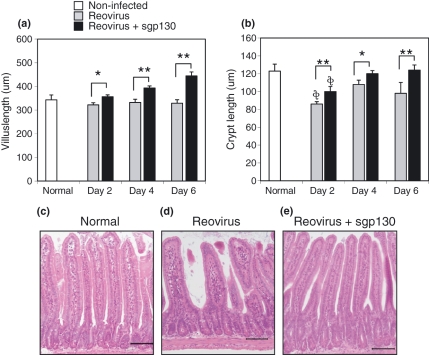
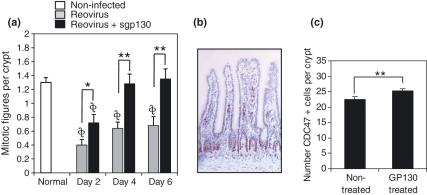
Soluble gp130 (sgp130) has been shown to suppress the inflammatory response of autoimmune pathologies; however, its effects on virus infection are not known. Here, we report that intraperitoneal treatment of mice with sgp130-Fc fusion protein at the time of oral reovirus serotype 3 infection resulted in altered morphopathological changes that were evident by less shortening of intestinal villi length and crypt depth after infection. That the effect mediated by sgp130 treatment was due to an increase in intestinal crypt cell proliferation was demonstrated by an increase in the number of crypt mitotic figures. This was further confirmed by increased immunoreactivity to the Cdc47 proliferation-associated antigen in crypts of sgp130-treated virus-infected mice compared to infected non-treated mice. These findings suggest that sgp130 may have a beneficial effect during intestinal virus infection by disrupting interleukin-6 trans-signalling, thereby reducing the local inflammatory response.
Figures
References
-
- Adams DH, Eksteen B. Aberrant homing of mucosal T cells and extra-intestinal manifestations of inflammatory bowel disease. Nat. Rev. Immunol. 2006;6:244–251. - PubMed
-
- Atreya R, Mudter J, Finotto S, et al. Blockade of interleukin 6 trans signalling suppresses T-cell resistance against apoptosis in chronic intestinal inflammation: evidence in Crohn disease and experimental colitis in vivo. Nat. Med. 2000;6:583–588. - PubMed
-
- Bradley JR. TNF-mediated inflammatory disease. J. Pathol. 2008;214:149–160. - PubMed
Publication types
MeSH terms
Substances
Grants and funding
LinkOut - more resources
Full Text Sources
