


In vivo measurement of lumbar facet joint area in asymptomatic and chronic low back pain subjects
- PMID: 20354471
- PMCID: PMC2855783
- DOI: 10.1097/BRS.0b013e3181c9fc04
In vivo measurement of lumbar facet joint area in asymptomatic and chronic low back pain subjects
Abstract
Study design: In vivo measurement of lumbar facet joint surface area.
Objective: To investigate lumbar facet joint surface area in relation to age and the presence of chronic low back pain.
Summary of background data: Facet joint surface area is an important parameter for understanding facet joint function and pathology, but information on the lumbar facet joint is limited, especially in relation with age and low back pain symptoms.
Methods: In vivo measurements of the lumbar facet joints (L3/L4-L5/S1) were performed on 90 volunteers (57 asymptomatic subjects and 33 chronic low back pain subjects) using subject-based 3-dimensional facet joint surface computed tomography models.
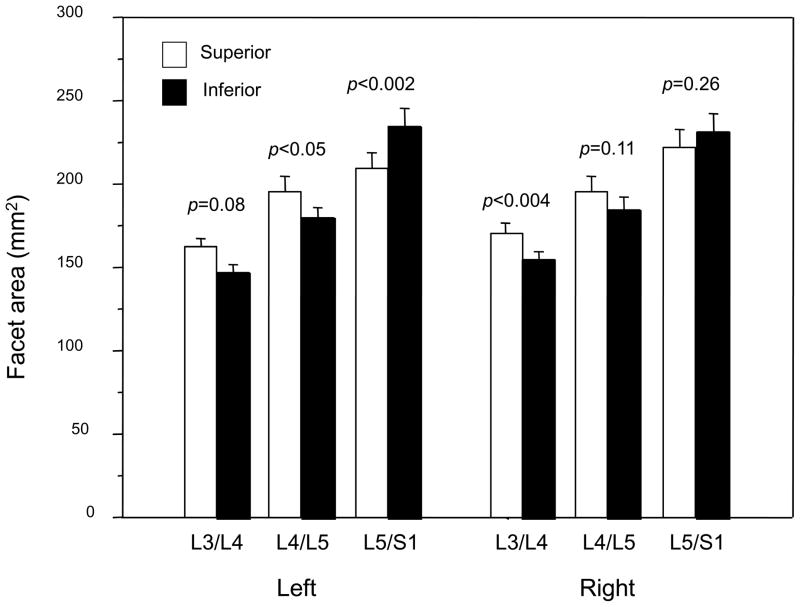
Results: The facet joint surface area increased significantly at each successive inferior level. In the low back pain subjects aged >40 years, both superior and inferior facet surface areas increased except superior facets at L5/S1 compared with younger subjects. In the asymptomatic subjects aged >40 years, only the superior facets showed an increase in the L3/4 facet surface area compared with younger subjects.
Conclusion: The lumbar facet areas measured in vivo in this study were similar to previous cadaveric studies. The lumbar facet area was significantly greater at the inferior lumbar levels and also increased with age. This age-related increase in the facet joint surface was observed more in the low back pain subjects compared with asymptomatic subjects. The increase in the area of the facet joint surface is probably secondary to increased load-bearing in the lower lumbar segments and facet joint osteoarthritis.
Figures
References
-
- el-Bohy AA, Yang KH, King AI. Experimental verification of facet load transmission by direct measurement of facet lamina contact pressure. J Biomech. 1989;22:931–41. - PubMed
-
- Fujiwara A, Tamai K, An HS, et al. The relationship between disc degeneration, facet joint osteoarthritis, and stability of the degenerative lumbar spine. Journal of Spinal Disorders. 2000;13:444–50. - PubMed
-
- Yang KH, King AI. Mechanism of facet load transmission as a hypothesis for low-back pain. Spine. 1984;9:557–65. - PubMed
-
- Masharawi Y, Rothschild B, Dar G, et al. Facet orientation in the thoracolumbar spine: three-dimensional anatomic and biomechanical analysis. Spine. 2004;29:1755–63. - PubMed
-
- Natarajan RN, Andersson GB, Patwardhan AG, et al. Study on effect of graded facetectomy on change in lumbar motion segment torsional flexibility using three-dimensional continuum contact representation for facet joints. Journal of Biomechanical Engineering. 1999;121:215–21. - PubMed
Publication types
MeSH terms
Grants and funding
LinkOut - more resources
Full Text Sources
Research Materials
