. 2010 Apr 13;102(8):1276-83.
doi: 10.1038/sj.bjc.6605626. Epub 2010 Mar 30.

Ovarian cancer stem-like side-population cells are tumourigenic and chemoresistant

Affiliations

Ovarian cancer stem-like side-population cells are tumourigenic and chemoresistant

L Hu et al. Br J Cancer. .

Abstract

Background: Ovarian cancer is the most lethal gynaecological malignancy. Although ovarian cancer patients often respond initially to chemotherapy, they usually develop chemoresistance. We hypothesised that a small portion of ovarian cancer cells have stem-like cell properties that contribute to tumourigenesis and drug resistance.

Methods: Flow cytometry and Hoechst 33342 efflux isolated side-population (SP) cells from ascites derived from ovarian cancer patients and from mice inoculated with human ovarian cancer cell lines. The SP cells were examined for stem cell markers OCT4, NANOG, STELLAR, and ABCG2/BCRP1 by immunocytochemistry and RT-PCR. The SP cells and non-SP cells were studied for tumourigenesis and chemoresistance in vitro and in vivo.

Results: The SP cells expressed ABCG2/BCRP1, OCT4, STELLAR, and NANOG, detected by immunocytochemistry and RT-PCR. ABCG2/BCRP1 expression was higher in SP than in non-SP cells. Xenogeneic mice inoculated with SP cells yielded more tumours than did mice inoculated with non-SP cells. In parallel, SP cell culture resulted in extensive cell proliferation, which was markedly more than in non-SP cells. SP cells resisted chemotherapy compared with non-SP cells, both in vivo and in vitro.

Conclusion: Ovarian cancer SP cells are tumourigenic and chemoresistant. ABCG2/BCRP1 has an important role in chemoresistance, which has implications for new therapeutic approaches.


Figures
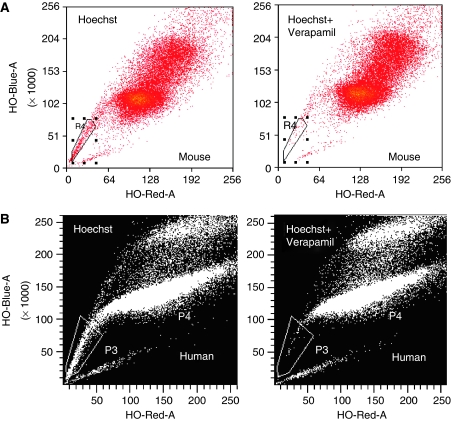
Figure 1
Figure 1
(A) Side population (SP) of human OVCAR3 ovarian cancer cells from mouse ascites detected by flow cytometry. Boxed cells (labelled R4) indicate Hoechst-excluding SP. (B) SP of patient ascites-derived ovarian cancer cells detected by flow cytometry. Boxed cells (labelled P3) indicate Hoechst-excluding SP. Addition of 50 μM verapamil resulted in a marked reduction in SP in A and B.
Figure 2
Figure 2
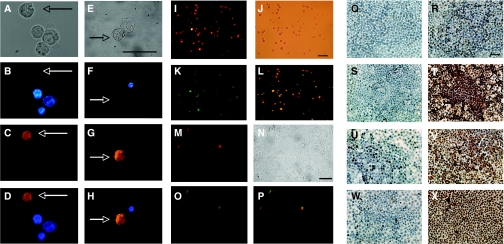
(A–D) Colocalisation of cells from mouse ascites bearing human ovarian cancer cells with OCT4 and Hoechst dye 33342. (E–H) Colocalisation of cells from mouse ascites bearing human ovarian cancer cells with ABCG2/BCRP1 and Hoechst dye 33342. (A, E) Bright-field; (B, F) Hoechst-dye uptake (blue); (C) OCT4 (bronze); (G) ABCG2/BCRP1 (bronze); (D) merged image B and C; and (H) merged image F and G. Arrows indicate the cells that are immunoreactive for OCT4 or ABCG2 and Hoechst-dim. Bar =10 μm. (I–L) Immunolocalisation of ABCG2/BCRP1 (red fluorescence) and NANOG (green fluorescence) in side population of human ovarian cancer cells (OVCAR3) derived from mouse ascites. (I) ABCG2/BCRP1; (J) bright-field; (K) NANOG; (L) merged I and J. Bar =10 μm. (MP) Immunolocalisation of ABCG2/BCRP1 (red fluorescence) and NANOG (green fluorescence) in mouse cancer tissues bearing human ovarian cancer cells. (M) ABCG2/BCRP1; (N) bright-field; (O) NANOG; and (P) merged M and O. Arrows indicate cells that are immunoreactive for OCT4 or ABCG2. Bar =10 μm. (QX) SP vs non-SP cell apoptosis in vitro. Apoptosis of SP (QT) vs non-SP cells (UX) after 48-h treatment with cisplatin and/or verapamil in vitro. (Q, U) Control; (R, V) cisplatin; (S, W) verapamil; and (T, W) cisplatin plus verapamil. Brown nuclei indicate apoptotic cells. Scale bar=10 μm. Note that SP cells are resistant to cisplatin (R), but this resistance is reversed by verapamil (T).
Figure 3
Figure 3
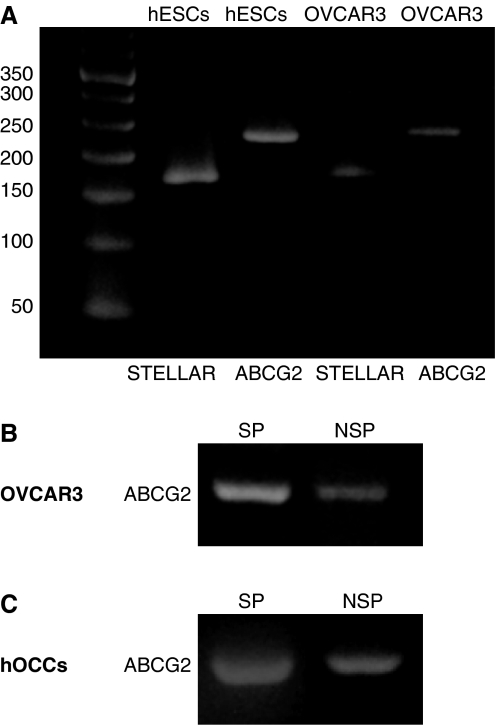
(A) RT–PCR analysis of ABCG2 and STELLAR in mouse ascites from human ovarian cancer (OVCAR3) and human embryonic stem cells (hESCs). (B) RT–PCR analysis of ABCG2 in non-SP and SP from human ovarian cancer cells (OVCAR3). (C) RT–PCR analysis of ABCG2 in non-SP and SP cells from human ovarian cancer cells (hOCCs).
Figure 4
Figure 4
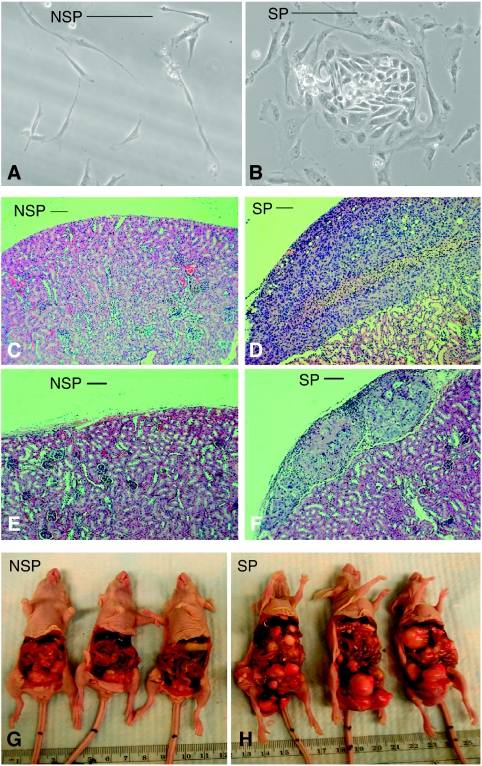
Non-SP cells (A) vs SP cells (B) from patient's ovarian cancer ascites were cultured for 5 days. Non-SP cells (C) and SP cells (D) from human ovarian cancer cells (500 cells) derived from patient's ascites were grafted under kidney capsules in each of two mice for 8 weeks. Non-SP cells (E) and SP cells (F) from OVCAR3 cells (500 cells) derived from mouse model ascites were grafted under kidney capsules in each of two mice for 8 weeks. Non-SP cells (G, three mice) and SP cells (H, three mice) from A2780-CP (cisplatin resistant) cells were injected i.p. into six mice (20 000 cells per mouse) for 8 weeks. Bar=10 μm.
Figure 5
Figure 5
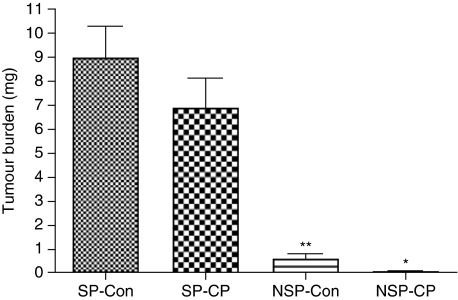
Effect of cisplatin on tumour burden in mice inoculated i.p. with SP vs non-SP isolated from A2780-CP cells. Treatments began 8 weeks after inoculation. Treatment groups consisted of control (vehicle) and cisplatin alone. At the end of the experiment (3 weeks of treatment), the mice were killed. At autopsy, tumours were excised and weighed. SP-Con (control)=side population without treatment; SP-CP=side population with cisplatin treatment; NSP-Con=non-side population without treatment (control); NSP-CP=non-side population with cisplatin treatment; *P<0.05 vs NSP-CP; **P<0.01 vs SP-CON. Data are expressed as the mean (bars±s.d.).

References

    1. Abbott BL (2006) ABCG2 (BCRP): a cytoprotectant in normal and malignant stem cells. Clin Adv Hematol Oncol 4: 63–72 - PubMed
    1. Ahmed-Belkacem A, Pozza A, Macalou S, Pe Rez-Victoria JM, Boumendjel AN, Di Pietro A (2006) Inhibitors of cancer cell multidrug resistance mediated by breast cancer resistance protein (BCRP/ABCG2). Anticancer Drugs 17: 239–243 - PubMed
    1. Allikmets R, Schriml L, Hutchinson A, Romano-Spica V, Dean M (1998a) A human placenta-specific ATP-binding cassette gene (ABCP) on chromosome 4q22 that is involved in multidrug resistance. Cancer Res 58: 5337–5339 - PubMed
    1. Allikmets R, Schriml LM, Hutchinson A, Romano-Spica V, Dean M (1998b) A human placenta-specific ATP-binding cassette gene (ABCP) on chromosome 4q22 that is involved in multidrug resistance. Cancer Res 58: 5337–5339 - PubMed
    1. Alvi AJ, Clayton H, Joshi C, Enver T, Ashworth A, Vivanco MM, Dale TC, Smalley MJ (2003) Functional and molecular characterisation of mammary side population cells. Breast Cancer Res 5: R1–R8 - PMC - PubMed

Publication types

Substances