


Effect of Representational Distance between Meanings on Recognition of Ambiguous Spoken Words
- PMID: 20354577
- PMCID: PMC2846663
- DOI: 10.1111/j.1551-6709.2009.01069.x
Effect of Representational Distance between Meanings on Recognition of Ambiguous Spoken Words
Abstract
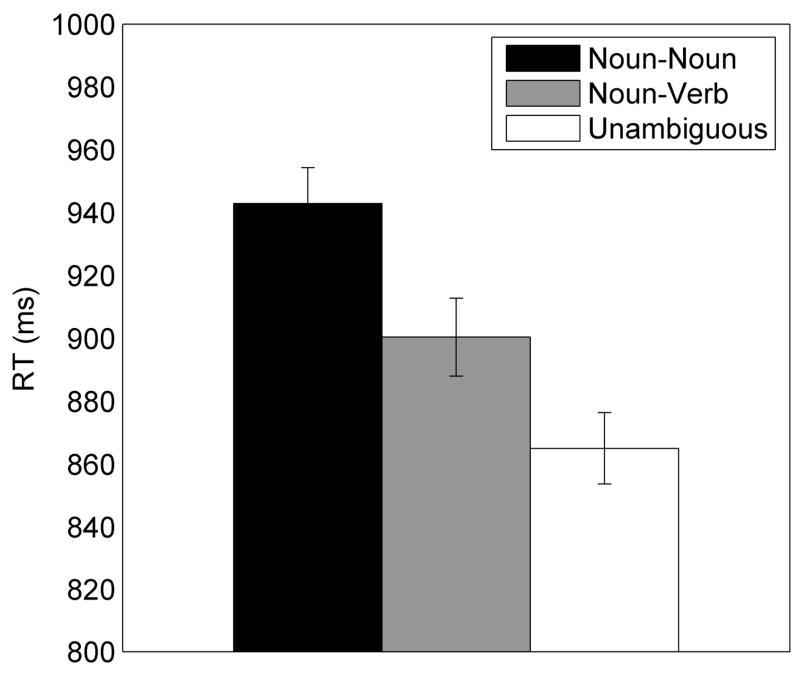
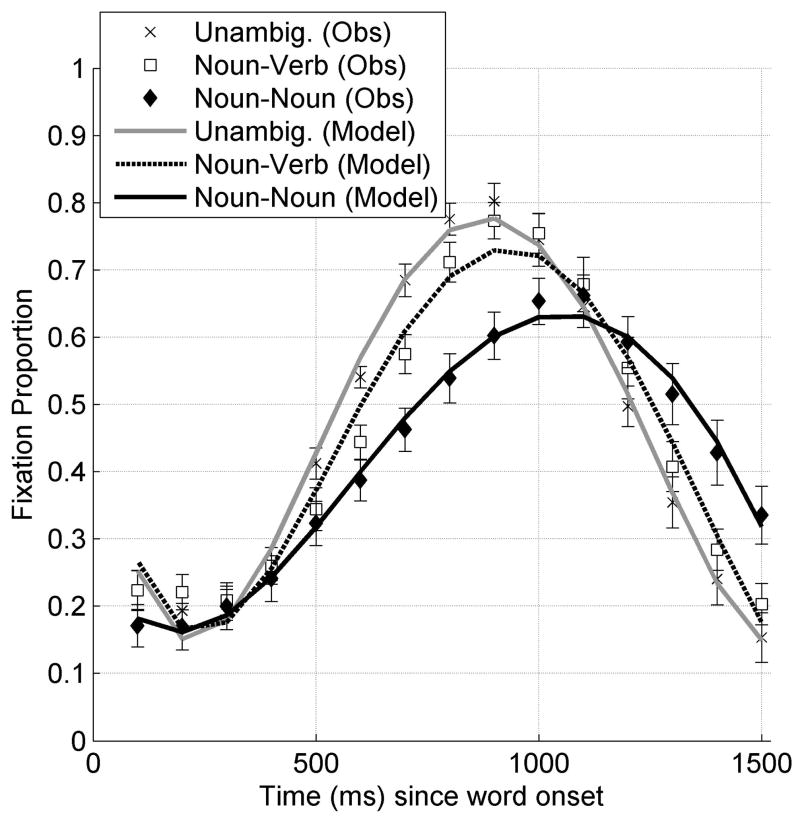
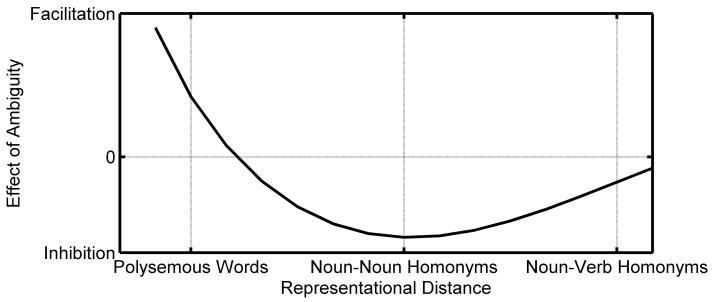
Previous research indicates that mental representations of word meanings are distributed along both semantic and syntactic dimensions such that nouns and verbs are relatively distinct from one another. Two experiments examined the effect of representational distance between meanings on recognition of ambiguous spoken words by comparing recognition of unambiguous words, noun-verb homonyms, and noun-noun homonyms. In Experiment 1, auditory lexical decision was fastest for unambiguous words, slower for noun-verb homonyms, and slowest for noun-noun homonyms. In Experiment 2, response times for matching spoken words to pictures followed the same pattern and eye fixation time courses revealed converging, gradual time course differences between conditions. These results indicate greater competition between meanings of ambiguous words when the meanings are from the same grammatical class (noun-noun homonyms) than they when are from different grammatical classes (noun-verb homonyms).
Figures
References
-
- Allopenna PD, Magnuson JS, Tanenhaus MK. Tracking the time course of spoken word recognition using eye movements: Evidence for continuous mapping models. Journal of Memory & Language. 1998;38(4):419–439.
-
- Cree GS, McRae K, McNorgan C. An attractor model of lexical conceptual processing: Simulating semantic priming. Cognitive Science. 1999;23(3):371–414.
-
- Dahan D, Magnuson JS, Tanenhaus MK, Hogan EM. Subcategorical mismatches and the time course of lexical access: Evidence for lexical competition. Language and Cognitive Processes. 2001;16(5/6):507–534.
-
- Elman JL. Finding structure in time. Cognitive Science. 1990;14(2):179–211.
-
- Elman JL. An alternative view of the mental lexicon. Trends in Cognitive Sciences. 2004;8:301–306. - PubMed
Grants and funding
LinkOut - more resources
Full Text Sources
