


Long-chain acyl-CoA synthetases and fatty acid channeling
- PMID: 20354580
- PMCID: PMC2846691
- DOI: 10.2217/17460875.2.4.465
Long-chain acyl-CoA synthetases and fatty acid channeling
Abstract
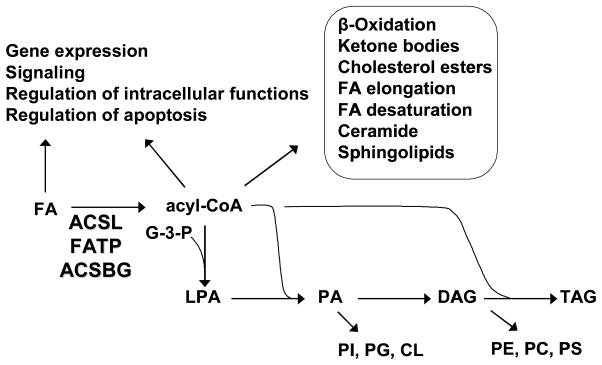
Thirteen homologous proteins comprise the long-chain acyl-CoA synthetase (ACSL), fatty acid transport protein (FATP), and bubblegum (ACSBG) subfamilies that activate long-chain and very-long-chain fatty acids to form acyl-CoAs. Gain- and loss-of-function studies show marked differences in the ability of these enzymes to channel fatty acids into different pathways of complex lipid synthesis. Further, the ability of the ACSLs and FATPs to enhance cellular FA uptake does not always require these proteins to be present on the plasma membrane; instead, FA uptake can be increased by enhancing its conversion to acyl-CoA and its metabolism in downstream pathways. Since altered fatty acid metabolism is a hallmark of numerous metabolic diseases and pathological conditions, the ACSL, FATP and ACSBG isoforms are likely to play important roles in disease etiology.
Figures
References
-
- Steinberg SJ, Morgenthaler J, Heinzer AK, Smith KD, Watkins PA. Very long-chain acyl-CoA synthetases: Human “bubblegum” represents a new family of proteins capable of activating very long-chain fatty acids. J Biol Chem. 2000;275:35162–35169. Identifies amino acid motifs that differentiate the ACS subfamilies. - PubMed
-
- Mashek DG, Bornfeldt KE, Coleman RA, et al. Revised nomenclature for the mammalian long chain acyl-CoA synthetase gene family. J Lipid Res. 2004;45:1958–1961. This paper clarifies the ACS nomenclature. - PubMed
Grants and funding
LinkOut - more resources
Full Text Sources
Other Literature Sources