


Observing responses and serial stimuli: searching for the reinforcing properties of the S-
- PMID: 20354600
- PMCID: PMC2732326
- DOI: 10.1901/jeab.2009.92-215
Observing responses and serial stimuli: searching for the reinforcing properties of the S-
Abstract
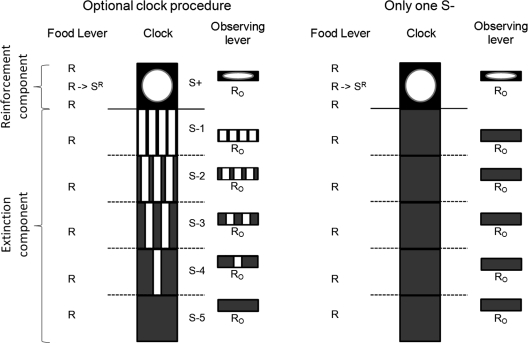
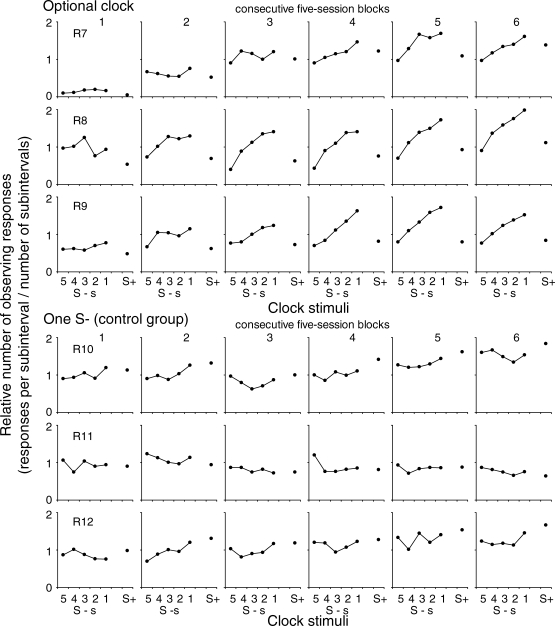
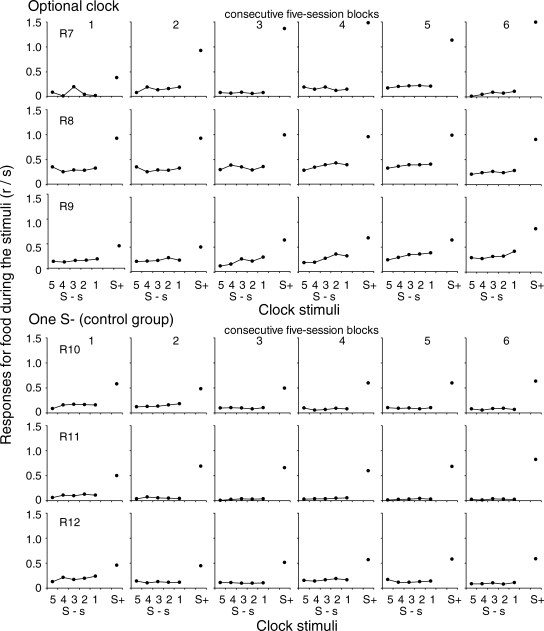
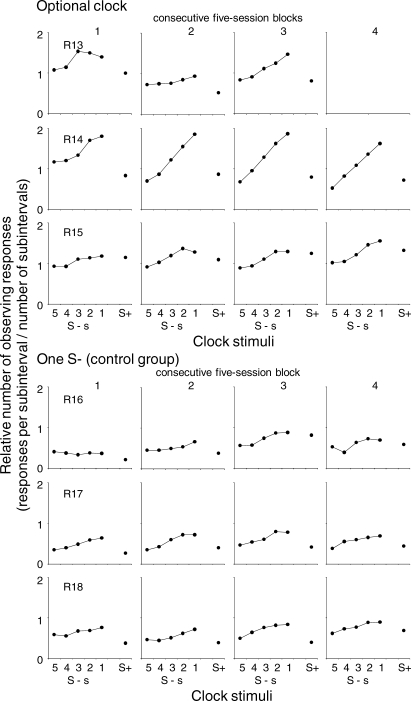
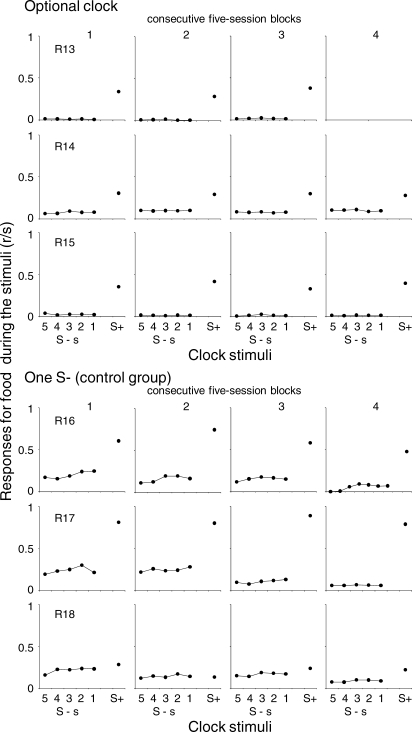
The control exerted by a stimulus associated with an extinction component (S-) on observing responses was determined as a function of its temporal relation with the onset of the reinforcement component. Lever pressing by rats was reinforced on a mixed random-interval extinction schedule. Each press on a second lever produced stimuli associated with the component of the schedule in effect. In Experiment 1 a response-dependent clock procedure that incorporated different stimuli associated with an extinction component of a variable duration was used. When a single S- was presented throughout the extinction component, the rate of observing remained relatively constant across this component. In the response-dependent clock procedure, observing responses increased from the beginning to the end of the extinction component. This result was replicated in Experiment 2, using a similar clock procedure but keeping the number of stimuli per extinction component constant. We conclude that the S- can function as a conditioned reinforcer, a neutral stimulus or as an aversive stimulus, depending on its temporal location within the extinction component.
Keywords: clock stimuli; conditioned reinforcement; lever pressing; observing responses; rats.
Figures
References
-
- Bersh P.J. The influence of two variables upon the establishment of a secondary reinforcer for operant responses. Journal of Experimental Psychology. 1951;41:62–73. - PubMed
-
- Dinsmoor J.A. Observing and conditioned reinforcement. Behavioral and Brain Sciences. 1983;6:693–728 (includes commentary).
Publication types
MeSH terms
LinkOut - more resources
Full Text Sources
