Comparative Study
. 2010 Aug;38(8):2588-93.
doi: 10.1007/s10439-010-0018-2. Epub 2010 Mar 31.

Estimating dynamic gait stability using data from non-aligned inertial sensors

Affiliations
Comparative Study

Estimating dynamic gait stability using data from non-aligned inertial sensors

Sjoerd M Bruijn et al. Ann Biomed Eng. 2010 Aug.

Abstract

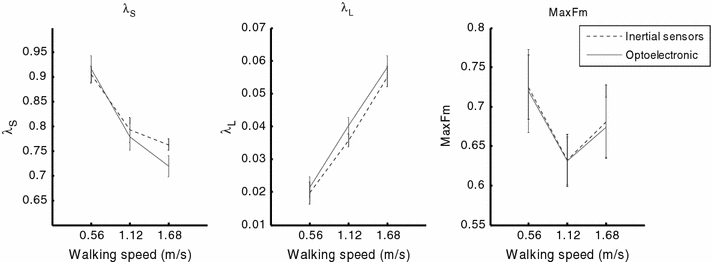
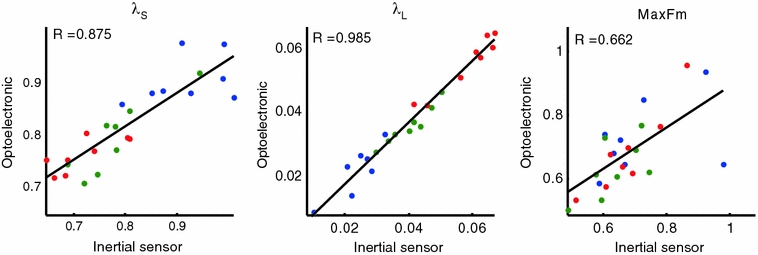
Recently, two methods for quantifying the stability of a dynamical system have been applied to human locomotion: local stability (quantified by finite time maximum Lyapunov exponents, lambda(s) and lambda(L)) and orbital stability (quantified by maximum Floquet multipliers, MaxFm). In most studies published to date, data from optoelectronic measurement systems were used to calculate these measures. However, using wireless inertial sensors may be more practical as they are easier to use, also in ambulatory applications. While inertial sensors have been employed in some studies, it is unknown whether they lead to similar stability estimates as obtained with optoelectronic measurement systems. In the present study, we compared stability measures of human walking estimated from an optoelectronic measurement system with those calculated from an inertial sensor measurement system. Subjects walked on a treadmill at three different speeds while kinematics were recorded using both measurement systems. From the angular velocities and linear accelerations, lambda(s), lambda(L), and MaxFm were calculated. Both measurement systems showed the same effects of walking speed for all variables. Estimates from both measurement systems correlated high for lambda(s) and lambda(L,) (R > 0.85) but less strongly for MaxFm (R = 0.66). These results indicate that inertial sensors constitute a valid alternative for an optoelectronic measurement system when assessing dynamic stability in human locomotion, and may thus be used instead, which paves the way to studying gait stability during natural, everyday walking.


Figures
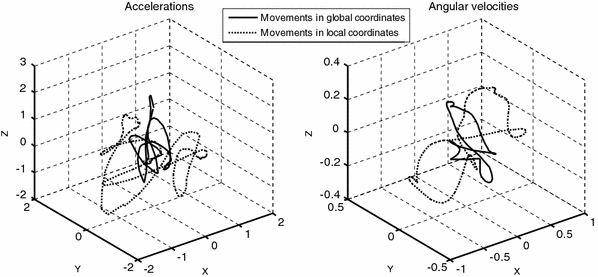
Figure 1
Figure 1
Attractors in different reference frames. Attractors constructed from 3D acceleration patterns (left) and rotational velocity (right) during walking, in global (solid trajectories, optoelectronic measurement system) and local (dashed trajectories, inertial sensor measurement) coordinate systems. Note that due to the inclusion of the gravitational acceleration in the inertial sensor acceleration signals, the corresponding attractor is much larger than that of the optoelectronic accelerations
Figure 2
Figure 2
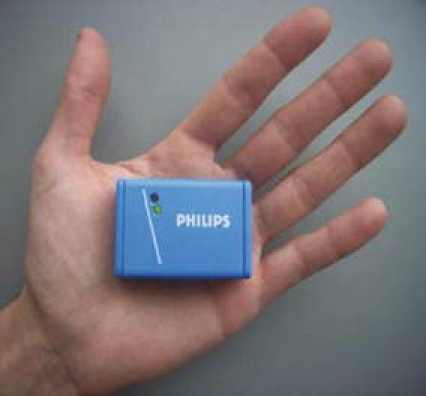
Inertial sensor unit. The wireless inertial sensor, which contains accelerometers, magnetometers, and gyroscopes. Note that for the current study only the data from the accelerometers and gyroscopes were used
Figure 3
Figure 3
Effects of walking speed. Effects of walking speed on λs, λL and MaxFm. Error bars represent standard errors
Figure 4
Figure 4
Correlation between measurement systems. The correlation between the two different measurement systems for λs, λL, and MaxFm. Blue = 0.56 m/s, green = 1.12 m/s, and red = 1.68 m/s

References

    1. Bruijn SM, van Dieen JH, Meijer OG, Beek PJ. Statistical precision and sensitivity of measures of dynamic gait stability. J. Neurosci. Methods. 2009;178(2):327–333. doi: 10.1016/j.jneumeth.2008.12.015. - DOI - PubMed
    1. Bruijn SM, van Dieën JH, Meijer OG, Beek PJ. Is slow walking more stable? J. Biomech. 2009;42(10):1506–1512. doi: 10.1016/j.jbiomech.2009.03.047. - DOI - PubMed
    1. de Vries WH, Veeger HE, Baten CT, van der Helm FC. Magnetic distortion in motion labs, implications for validating inertial magnetic sensors. Gait Posture. 2009;29(4):535–541. doi: 10.1016/j.gaitpost.2008.12.004. - DOI - PubMed
    1. Dingwell JB, Cusumano JP. Nonlinear time series analysis of normal and pathological human walking. Chaos. 2000;10(4):848–863. doi: 10.1063/1.1324008. - DOI - PubMed
    1. Dingwell JB, Cusumano JP, Cavanagh PR, Sternad D. Local dynamic stability versus kinematic variability of continuous overground and treadmill walking. J. Biomech. Eng. 2001;123(1):27–32. doi: 10.1115/1.1336798. - DOI - PubMed

Publication types