


Clinical complexity in middle-aged and older adults with diabetes: the Health and Retirement Study
- PMID: 20355264
- PMCID: PMC3153504
- DOI: 10.1097/mlr.0b013e3181ca4035
Clinical complexity in middle-aged and older adults with diabetes: the Health and Retirement Study
Abstract
Background: Some patients with diabetes may have health status characteristics that could make diabetes self-management (DSM) difficult and lead to inadequate glycemic control, or limit the benefit of some diabetes management interventions.
Objective: To investigate how many older and middle-aged adults with diabetes have such health status characteristics.
Design: Secondary data analysis of a nationally representative health interview survey, the Health and Retirement Study, and its diabetes mail-out survey.
Setting/participants: Americans aged 51 and older with diabetes (n = 3506 representing 13.6 million people); aged 56 and older in diabetes survey (n = 1132, representing 9.9 million).
Measurements: Number of adults with diabetes and (a) relatively good health; (b) health status that could make DSM difficult (eg, comorbidities, impaired instrumental activities of daily living; and (c) characteristics like advanced dementia and activities of daily living dependency that could limit benefit of some diabetes management. Health and Retirement Study measures included demographics. Diabetes Survey included self-measured HbA1c.
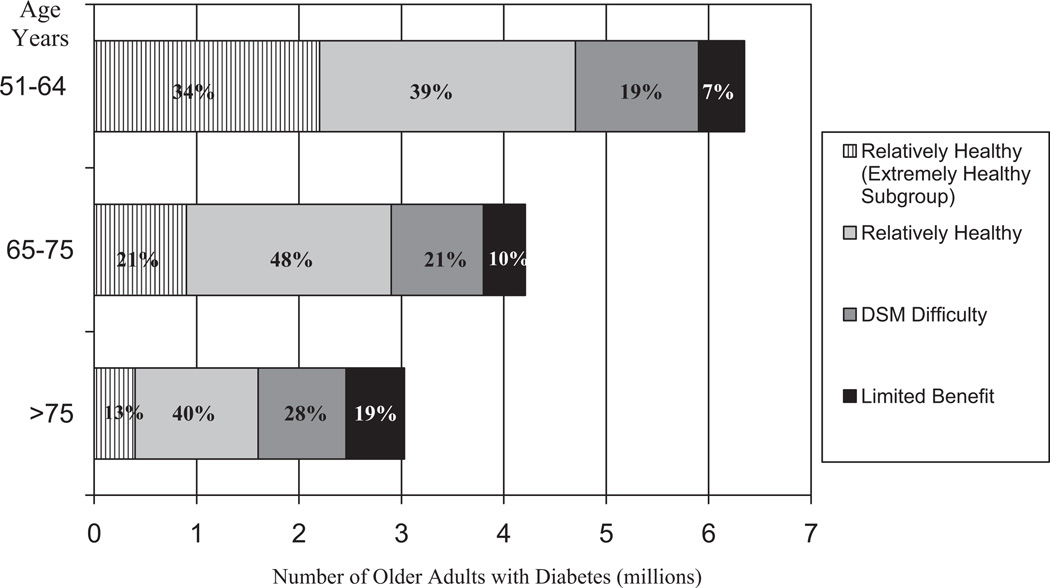
Results: Nearly 22% of adults > or =51 with diabetes (about 3 million people) have health characteristics that could make DSM difficult. Another 10% (1.4 million) may receive limited benefit from some diabetes management. Mail-out respondents with health characteristics that could make DSM difficult had significantly higher mean HbA1c compared with people with relatively good health (7.6% vs. 7.3%, P < 0.04.).
Conclusions: Some middle-aged as well as older adults with diabetes have health status characteristics that might make DSM difficult or of limited benefit. Current diabetes quality measures, including measures of glycemic control, may not reflect what is possible or optimal for all patient groups.
Figures
References
-
- Center for Disease Control. Diabetes surveillance. [Accessed April 17, 2009];2009 Available at: http://www.cdc.gov/diabetes/statistics/incidence_national.htm.
-
- Center for Disease Control. Prevalence of diabetes by age. [Accessed April 17, 2009];2008 Available at: http://www.cdc.gov/diabetes/statistics/prev/national/figbyage.htm.
-
- UK Prospective Diabetes Study Group. A randomized trial of efficacy of early addition of metformin in sulfonylurea-treated type 2 diabetes. (UKPDS 28) Diabetes Care. 1998;21:87–92. - PubMed
-
- UK Prospective Diabetes Study Group. Intensive blood-glucose control with sulphonylureas or insulin compared with conventional treatment and risk of complications in patients with type 2 diabetes (UKPDS 33) Lancet. 1998;352:837–853. - PubMed
Publication types
MeSH terms
Grants and funding
LinkOut - more resources
Full Text Sources
Medical
