


doi: 10.1039/b924236h.
Macromolecular crowding induces polypeptide compaction and decreases folding cooperativity
Affiliations
- PMID: 20355290
- PMCID: PMC3050011
- DOI: 10.1039/b924236h
Item in Clipboard
Macromolecular crowding induces polypeptide compaction and decreases folding cooperativity
Phys Chem Chem Phys.
.
Abstract
A cell's interior is comprised of macromolecules that can occupy up to 40% of its available volume. Such crowded environments can influence the stability of proteins and their rates of reaction. Using discrete molecular dynamics simulations, we investigate how both the size and number of neighboring crowding reagents affect the thermodynamic and folding properties of structurally diverse proteins. We find that crowding induces higher compaction of proteins. We also find that folding becomes less cooperative with the introduction of crowders into the system. The crowders may induce alternative non-native protein conformations, thus creating barriers for protein folding in highly crowded media.
Figures

Proteins simulated under crowded conditions. These proteins are comprised of a variety of topologies and sequence lengths. (A) Trp-cage, (B) villin subdomain, (C) SH3 domain, (D) hemoglobin alpha chain.
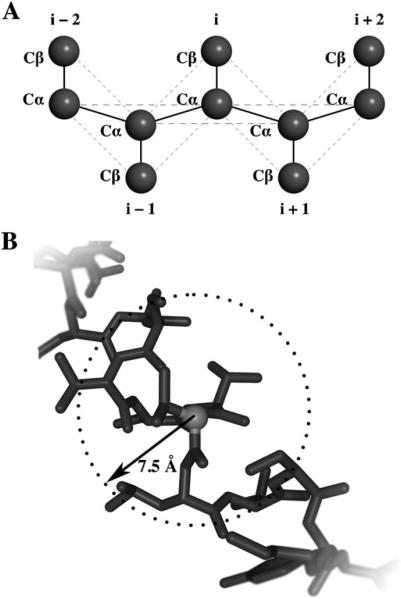
Coarse-grained modeling of proteins. (A) Proteins are represented as beads on a string with each residue comprised of two beads, Cα and Cβ. Bonds are denoted by solid lines and non-bonding interactions are denoted by dashed lines. (B) Interactions defined within Gō model. Atoms within a defined range σ are assigned attractive potentials while those atoms outside σ are assigned repulsive potentials. In our Gō model we have defined σ = 7.5 Å.

Insertion of crowders shifts protein folding equilibria toward the native state. The native state (as measured using its radius of gyration) becomes increasingly resistant to thermal denaturation as a function of increasing crowder concentration. (A) Trp-cage, (B) villin subdomain, (C) SH3 domain, (D) hemoglobin alpha chain. Legend: ( ) 0%, (
 ) 5%, (
 ) 13%, (-·-) 26%, (
 ) 39%, (⋯) 52% fractional volume.
) 0%, () 5%, () 13%, (-·-) 26%, () 39%, (⋯) 52% fractional volume.
Macromolecular crowding influences specific heat of folding. As the concentration of crowders increase, the specific heat of folding decreases. The transition between the folded and unfolded state becomes less cooperative, denoted by peak broadening. (A) Trp-cage, (B) Villin subdomain, (C) SH3 domain, (D) Hemoglobin alpha chain. Legend: ( ) 0%, (
 ) 5%, (
 ) 13%, (-·-) 26%, (
 ) 39%, (⋯) 52% fractional volume. Gray regions indicate the estimated error for each curve.
) 0%, () 5%, () 13%, (-·-) 26%, () 39%, (⋯) 52% fractional volume. Gray regions indicate the estimated error for each curve.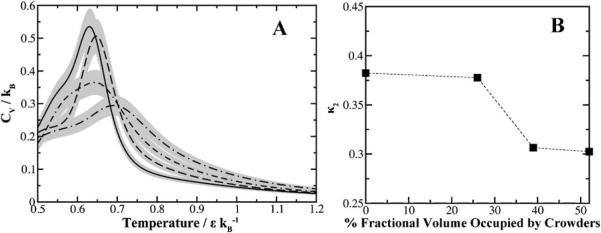
All-atom simulations of Trp-cage. (A) The thermodynamic profile of Trp-cage as a function of crowder concentration demonstrates the same trends in folding cooperativity irrespective of the model used. Legend: ( ) 0%, (
 ) 26%, (
 ) 39%, (-·-) 52% fractional volume. Gray regions indicate the estimated error for each curve. (B) Degree of cooperativity for Trp-cage as measured by the ratio κ2. Increasing concentrations of crowders lowers the two-state folding cooperativity.
) 0%, () 26%, () 39%, (-·-) 52% fractional volume. Gray regions indicate the estimated error for each curve. (B) Degree of cooperativity for Trp-cage as measured by the ratio κ2. Increasing concentrations of crowders lowers the two-state folding cooperativity.
Modulation of crowder size or number density affects protein compactness. At a constant concentration of crowders, as the diameter of the crowder increases the fractional volume increases thus leaving limited volume available to the polypeptide. The average radius of gyration obtained from replica-exchange simulations is plotted as a function of the crowder's diameter for (A) Trp-cage, (B) villin subdomain, (C) SH3 domain, and (D) hemoglobin alpha chain. A comparison is made by plotting the average radius of gyration as a function of increasing the number density of the system at constant crowder size for (E) Trp-cage, (F) villin subdomain, (G) SH3 domain, and (H) hemoglobin alpha chain. Fluctuations of RG are plotted for constant crowder size to show diminishing fluctuations at high crowder concentrations. We do not plot the fluctuations at constant number density since the scaling is smaller than the explored conformations for each protein.

Effective packing of smaller crowders. We simulated the proteins (A) Trp-cage, (B) villin subdomain, (C) SH3 domain, and (D) hemoglobin alpha chain, with crowders at a constant fractional volume of 26% and varying diameter. By measuring the radius of gyration as a function of thermal denaturation, we see that smaller crowder sizes are more effective at stabilizing the protein's native state versus larger crowders. Legend: ( ) 5 Å, (
 )10 Å, (
 )15 Å, (-·-) 20 Å crowder diameter.
) 5 Å, ()10 Å, ()15 Å, (-·-) 20 Å crowder diameter.
Loss of folding cooperativity as a function of crowder size. (A) At constant fractional volume, both the specific heat and folding cooperativity of SH3 domain decrease with respect to decreasing crowder diameter. Legend: ( ) 5 Å, (
 )10Å, (
 ) 15Å, (-·-) 20 Å crowder diameter. Gray regions indicate the estimated error associated with each curve. (B) Comparison of the degree of cooperativity for SH3 domain under various crowding conditions. The top X-axis corresponds to the open circles plotted and represent the set of simulations at constant fractional volume. For comparison we have plotted the degree of cooperativity as a function of crowder concentration at a constant diameter of 10 Å, measured on the bottom X-axis and denoted by closed squares. Dashed lines are plotted to aid in identifying the trends between the two sets. (C) Energy histogram plotted for SH3 domain under different crowding diameters at constant fractional volume. Two-state folding kinetics are represented by the folded state on the left and the unfolded state on the right. The diminishing and shifting peak representative of the unfolded state is indicative of effective compacting obtained by smaller crowders. Legend: (
 ) No crowders, (
 ) 20 Å, (
 )15 Å, (-·-) 5 Å.
) 5 Å, ()10Å, () 15Å, (-·-) 20 Å crowder diameter. Gray regions indicate the estimated error associated with each curve. (B) Comparison of the degree of cooperativity for SH3 domain under various crowding conditions. The top X-axis corresponds to the open circles plotted and represent the set of simulations at constant fractional volume. For comparison we have plotted the degree of cooperativity as a function of crowder concentration at a constant diameter of 10 Å, measured on the bottom X-axis and denoted by closed squares. Dashed lines are plotted to aid in identifying the trends between the two sets. (C) Energy histogram plotted for SH3 domain under different crowding diameters at constant fractional volume. Two-state folding kinetics are represented by the folded state on the left and the unfolded state on the right. The diminishing and shifting peak representative of the unfolded state is indicative of effective compacting obtained by smaller crowders. Legend: () No crowders, () 20 Å, ()15 Å, (-·-) 5 Å.References
-
- Hall D, Minton AP. Biochim. Biophys. Acta, Proteins Proteomics. 2003;1649:127–139. - PubMed
Publication types
MeSH terms
Substances
Grants and funding
LinkOut - more resources
Full Text Sources
