


Near-infrared phosphorescent polymeric nanomicelles: efficient optical probes for tumor imaging and detection
- PMID: 20355951
- PMCID: PMC3681954
- DOI: 10.1021/am9001293
Near-infrared phosphorescent polymeric nanomicelles: efficient optical probes for tumor imaging and detection
Abstract
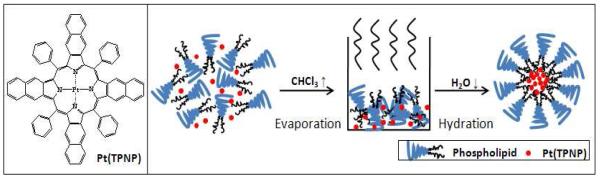
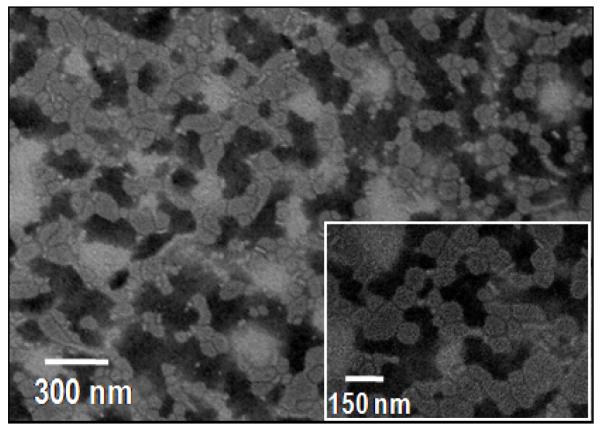
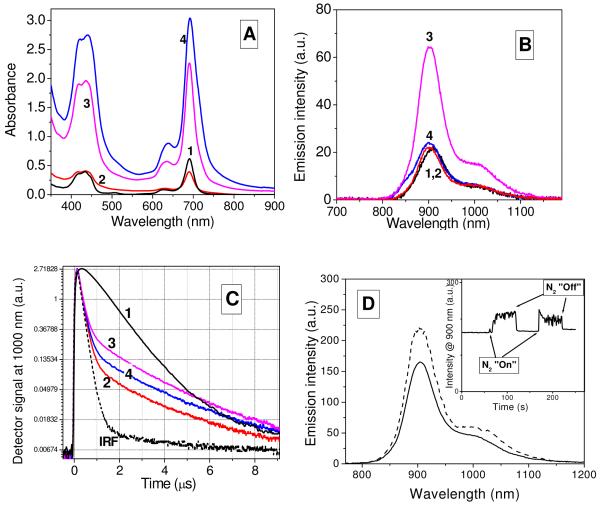
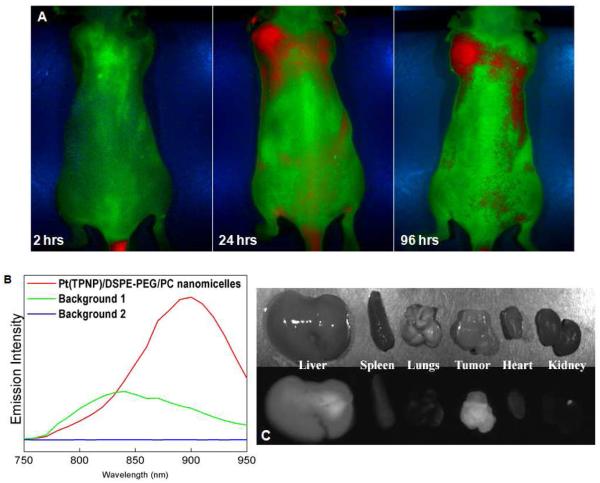
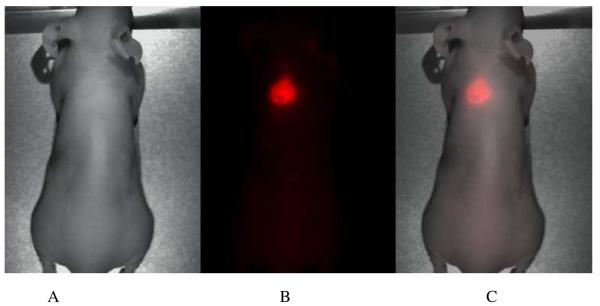
We report a formulation of near-infrared (near-IR) phosphorescent polymeric nanomicelles and their use for in vivo high-contrast optical imaging, targeting, and detection of tumors in small animals. Near-IR phosphorescent molecules of Pt(II)-tetraphenyltetranaphthoporphyrin (Pt(TPNP)) were found to maintain their near-IR phosphorescence properties when encapsulated into phospholipid nanomicelles. The prepared phosphorescent micelles are of approximately 100 nm size and are highly stable in aqueous suspensions. A large spectral separation between the Pt(TPNP) absorption, with a peak at approximately 700 nm, and its phosphorescence emission, with a peak at approximately 900 nm, allows a dramatic decrease in the level of background autofluorescence and scattered excitation light in the near-IR spectral range, where the signal from the phosphorescent probe is observed. In vivo animal imaging with subcutaneously xenografted tumor-bearing mice has resulted in high contrast optical images, indicating highly specific accumulation of the phosphorescent micelles into tumors. Using optical imaging with near-IR phosphorescent nanomicelles, detection of smaller, visually undetectable tumors has also been demonstrated.
Figures
References
Publication types
MeSH terms
Substances
Grants and funding
LinkOut - more resources
Full Text Sources
Other Literature Sources
