


N-Acetylgalactosaminyltransferase-14 as a potential biomarker for breast cancer by immunohistochemistry
- PMID: 20356418
- PMCID: PMC2873381
- DOI: 10.1186/1471-2407-10-123
N-Acetylgalactosaminyltransferase-14 as a potential biomarker for breast cancer by immunohistochemistry
Abstract
Background: The post-translational modification of proteins, including glycosylation, differs between normal and tumor cells. The UDP-N-acetyl-D-galactosamine polypeptide N-acetylgalactosaminyltransferases (GalNAc-Tases) family of enzymes regulates the initial steps of mucin O-glycosylation and is responsible for the altered glycosylation state observed in cancer cells. Recently it was found that GalNAc-T14 mRNA is heterogeneously expressed in breast carcinomas compared to normal tissue, however the expression profile of GalNAc-T14 protein in breast carcinomas compared to normal tissue is still unknown. In this study, we assessed the expression profile of GalNAc-T14 protein in malignant and non-malignant breast tissues by immunohistochemistry to evaluate whether GalNAc-T14 might be a potential biomarker for breast cancer.
Methods: In formalin-fixed tissues, the expression level of GalNAc-T14 protein was evaluated by immunohistochemistry assay in breast tissues. Expression profiles were assessed in normal tissues, benign fibroadenomas and several types of carcinomas.
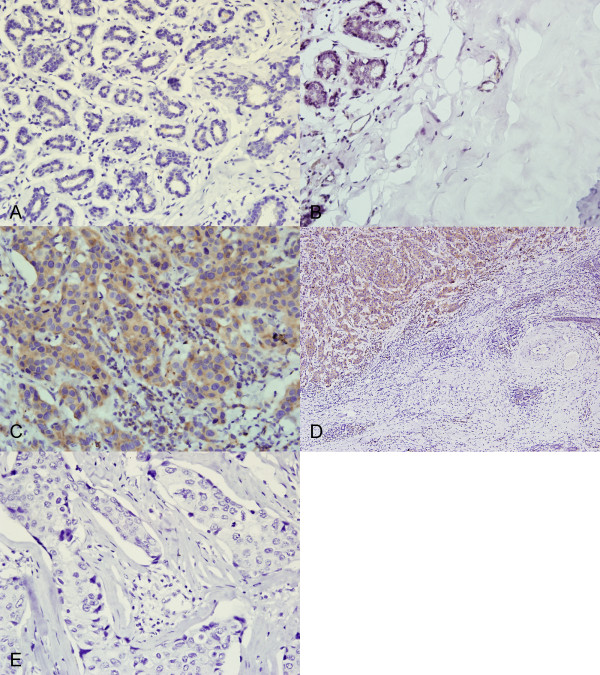
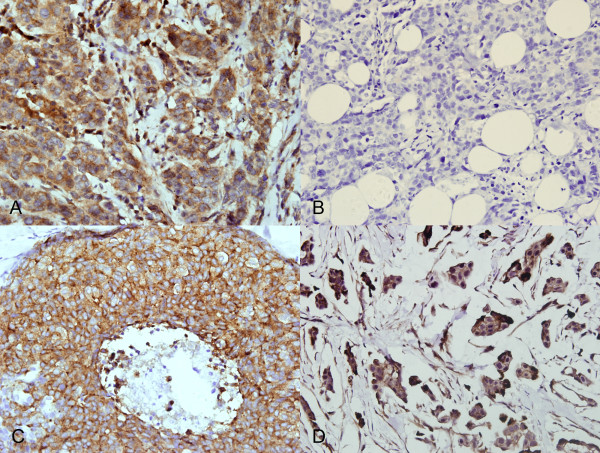
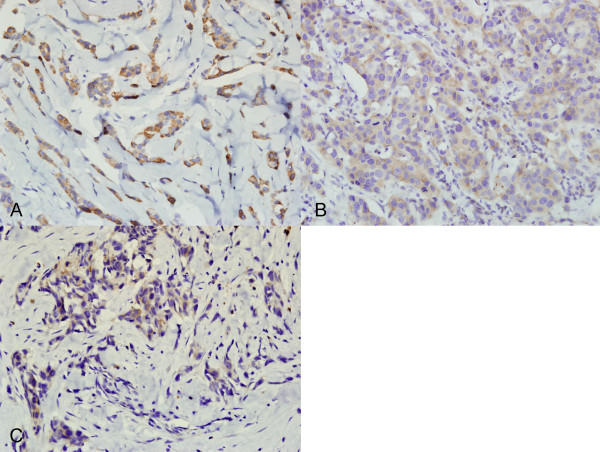
Results: Our results showed that GalNAc-T14 was heterogeneously expressed in breast carcinomas compared to non-malignant tissue. GalNAc-T14 expression was observed in 47/56 (83.9%) carcinoma samples, 7/48 (14.6%) non-malignant breast tissue samples. GalNAc-T14 expression level was associated with histological grade. For this enzyme a significant association with invasive ductal type, mucinous adenocarcinoma and ductal carcinoma in situ (DCIS) type was found.
Conclusion: Our results provide evidence that GalNAc-T14 may be a potential biomarker for breast cancer by immunohistochemistry. GalNAc-T14 expression level was associated with histological grade. GalNAc-T14 expression can provide new insights about breast cancer glycobiology.
Figures
References
-
- White KE, Lorenz B, Evans WE, Meitinger T, Strom TM, Econs MJ. Molecular cloning of a novel human UDP-GalNAc:polypeptide N-acetylgalactosaminyltransferase, GalNAc-T8, and analysis as a candidate autosomal dominant hypophosphatemic rickets (ADHR) gene. Gene. 2000;246:347–356. doi: 10.1016/S0378-1119(00)00050-0. - DOI - PubMed
-
- Zhang Y, Iwasaki H, Wang H, Kudo T, Kalka TB, Hennet T. Cloning and characterization of a new human UDP-N-acetyl-alpha-D-galactosamine:polypeptide N-acetylgalactosaminyltransferase, designated pp-GalNAc-T13, that is specifically expressed in neurons and synthesizes GalNAc alpha-serine/threonine antigen. J Biol Chem. 2003;278:573–584. doi: 10.1074/jbc.M203094200. - DOI - PubMed
Publication types
MeSH terms
Substances
LinkOut - more resources
Full Text Sources
Medical
Molecular Biology Databases
Research Materials
