


Docosahexaenoic acid confers neuroprotection in a rat model of perinatal hypoxia-ischemia potentiated by Escherichia coli lipopolysaccharide-induced systemic inflammation
- PMID: 20356570
- PMCID: PMC3535291
- DOI: 10.1016/j.ajog.2010.01.076
Docosahexaenoic acid confers neuroprotection in a rat model of perinatal hypoxia-ischemia potentiated by Escherichia coli lipopolysaccharide-induced systemic inflammation
Abstract
Objective: Lipopolysaccharide pretreatment potentiates hypoxic ischemic injury. We hypothesized that docosahexaenoic acid pretreatment would improve function and reduce brain volume loss in this rat model of perinatal brain injury and inflammation.
Study design: Seven-day-old rats were divided into 3 groups: intraperitoneal docosahexaenoic acid 1 mg/kg and lipopolysaccharide 0.1 mg/kg, 25% albumin and lipopolysaccharide, and normal saline. Injections were given 2.5 hours before carotid ligation, followed by 90 minutes 8% O2. Rats underwent sensorimotor function testing and brain volume loss assessment on postnatal day 14.
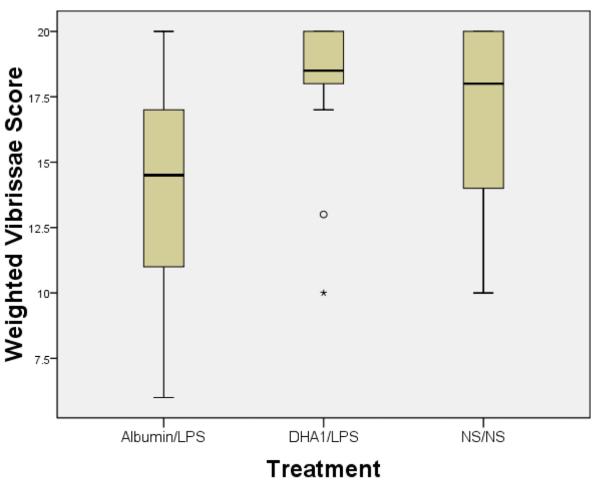
Results: Docosahexaenoic acid pretreatment improved vibrissae forepaw placing scores compared with albumin/lipopolysaccharide (mean+/-standard deviation weighted score/20: 17.72+/-0.92 docosahexaenoic acid/lipopolysaccharide vs 13.83+/-0.82 albumin/lipopolysaccharide; P<.007). Albumin/lipopolysaccharide rats scores were worse than those of the normal saline/normal saline rats (13.83+/-0.82 vs 17.21+/-0.71; P=.076). No significant differences in brain volume loss were observed among groups.
Conclusion: Lipopolysaccharide inflammatory stimulation in conjunction with hypoxic ischemic resulted in poorer function than hypoxic ischemic alone. Docosahexaenoic acid pretreatment had significantly improved function in neonatal rats exposed to lipopolysaccharide and hypoxic ischemic.
Copyright (c) 2010 Mosby, Inc. All rights reserved.
Figures
References
-
- Graham EM, Ruis KA, Hartman AL, Northington FJ, Fox HE. A systematic review of the role of intrapartum hypoxia-ischemia in the causation of neonatal encephalopathy. Am J Obstet Gynecol. 2008;199:587–95. PubMed: 19084096. - PubMed
-
- Quilligan EJ, Paul RH. Fetal monitoring: is it worth it? Obstet Gynecol. 1975;45:96–100. PubMed: 122861. - PubMed
-
- Thacker SB, Stroup D, Chang M. Continuous electronic heart rate monitoring for fetal assessment during labor. Cochrane Database Syst Rev. 2009 - PubMed
-
- Nelson KB, Dambrosia JM, Grether JK, Phillips TM. Neonatal cytokines and coagulation factors in children with cerebral palsy. Ann Neurol. 1998;44:665–675. PubMed: 9778266. - PubMed
-
- Yoon BH, Romero R, Park JS, et al. Fetal exposure to an intra-amniotic inflammation and the development of cerebral palsy at the age of three years. Am J Obstet Gynecol. 2000;182:675–81. PubMed: 10739529. - PubMed
MeSH terms
Substances
Grants and funding
LinkOut - more resources
Full Text Sources
