


Review
doi: 10.1016/j.ceb.2010.03.003.
Epub 2010 Mar 29.
Decoding the function of nuclear long non-coding RNAs
Affiliations
- PMID: 20356723
- PMCID: PMC2916961
- DOI: 10.1016/j.ceb.2010.03.003
Item in Clipboard
Review
Decoding the function of nuclear long non-coding RNAs
Curr Opin Cell Biol.
2010 Jun.
Abstract
Long non-coding RNAs (lncRNAs) are mRNA-like, non-protein-coding RNAs that are pervasively transcribed throughout eukaryotic genomes. Rather than silently accumulating in the nucleus, many of these are now known or suspected to play important roles in nuclear architecture or in the regulation of gene expression. In this review, we highlight some recent progress in how lncRNAs regulate these important nuclear processes at the molecular level.
Copyright 2010 Elsevier Ltd. All rights reserved.
Figures
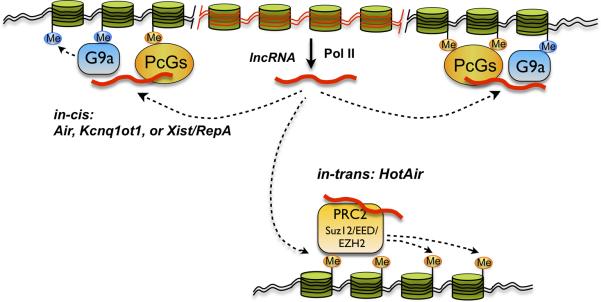
Long non-coding RNA-mediated chromatin remodeling. Some lncRNAs that are transcribed by RNA polymerase II recruit transcriptional repressive complexes including PcGs and G9a to silence specific genomic regions, both in cis (top) and in trans (bottom). See text for details.
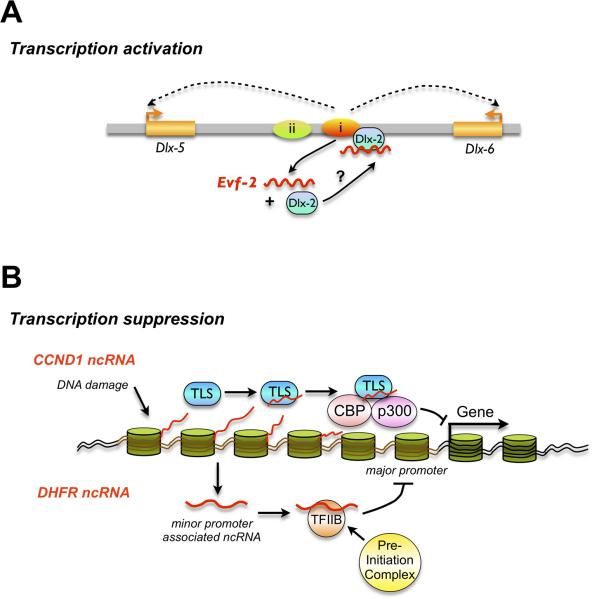
Long non-coding RNA-mediated transcription regulation. A. Transcription activation by lncRNA. In this example, Evf-2 is transcribed from an ultraconserved enhancer and forms a stable complex with Dlx-2, which in turn activates Dlx-2 as a transcriptional enhancer. B. Transcription suppression by lncRNA. Top: in response to DNA damage, lncRNAs are transcribed from the 5’-upstream region of the CCND1 gene and recruit the RNA-binding protein TLS to modulate CBP and p300 to inhibit CCND1 transcription. Bottom: lncRNA transcribed from the upstream of the minor promoter of DHFR gene competes with transcription factors to inhibit the major promoter transcription in quiescent cells.
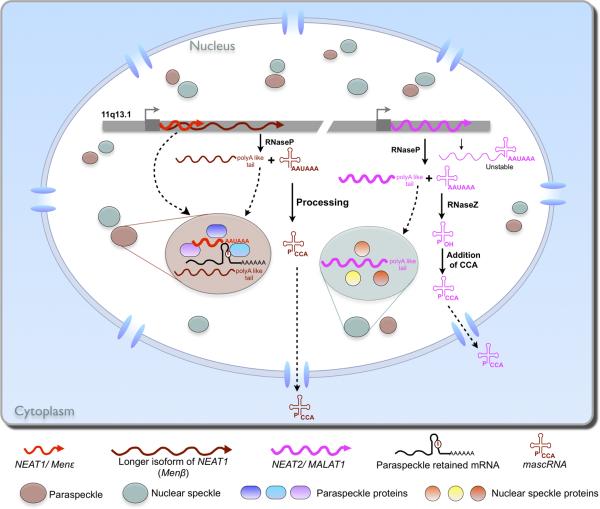
Long non-coding RNAs in nuclear subcompartments. Human NEAT1 (Menε in mouse) localizes to paraspeckles and is required for paraspeckle structural integrity. NEAT2 (MALAT1) localizes to splicing speckles but is not required for their structural integrity. See text for details. Nascent Menβ and MALAT1 transcripts can each be processed by the unusual mechanism of RNase P cleavage to generate the 5’ end of mascRNA (MALAT1-associated small cytoplasmic RNA) and the 3’ end of the mature Menβ and MALAT1 transcripts, which localize to paraspeckles and splicing speckles, respectively.
References
-
- Okazaki Y, Furuno M, Kasukawa T, Adachi J, Bono H, Kondo S, Nikaido I, Osato N, Saito R, Suzuki H, et al. Analysis of the mouse transcriptome based on functional annotation of 60,770 full-length cDNAs. Nature. 2002;420:563–573. - PubMed
-
- Bertone P, Stolc V, Royce TE, Rozowsky JS, Urban AE, Zhu X, Rinn JL, Tongprasit W, Samanta M, Weissman S, et al. Global identification of human transcribed sequences with genome tiling arrays. Science. 2004;306:2242–2246. - PubMed
-
- Kapranov P, Cheng J, Dike S, Nix DA, Duttagupta R, Willingham AT, Stadler PF, Hertel J, Hackermuller J, Hofacker IL, et al. RNA maps reveal new RNA classes and a possible function for pervasive transcription. Science. 2007;316:1484–1488. - PubMed
-
- Borsani G, Tonlorenzi R, Simmler MC, Dandolo L, Arnaud D, Capra V, Grompe M, Pizzuti A, Muzny D, Lawrence C, et al. Characterization of a murine gene expressed from the inactive X chromosome. Nature. 1991;351:325–329. - PubMed
-
- Brown CJ, Hendrich BD, Rupert JL, Lafreniere RG, Xing Y, Lawrence J, Willard HF. The human XIST gene: analysis of a 17 kb inactive X-specific RNA that contains conserved repeats and is highly localized within the nucleus. Cell. 1992;71:527–542. - PubMed
Publication types
MeSH terms
Substances
Grants and funding
LinkOut - more resources
Full Text Sources
Other Literature Sources
