


Plant Fe status affects the composition of siderophore-secreting microbes in the rhizosphere
- PMID: 20356952
- PMCID: PMC2859925
- DOI: 10.1093/aob/mcq071
Plant Fe status affects the composition of siderophore-secreting microbes in the rhizosphere
Erratum in
- Ann Bot. 2010 Jun;105(6):1071. Zheng, Shao Jiang [corrected to Zheng, Shao Jian]
Abstract
Background and aims: Soil microbes have been demonstrated to play an important role in favouring plant iron (Fe) uptake under Fe-limiting conditions. However, the mechanisms involved are still unclear. This present study reported the effects of plant Fe status on the composition of siderophore-secreting microbes in the rhizosphere, and their potential function in improving plant Fe nutrition.
Methods: An Fe-efficient plant, red clover (Trifolium pratense 'Kenland') was cultured in a calcareous soil to obtain rhizosphere soils with (Fe-sufficient) or without (Fe-stressed) foliar FeEDTA spraying. The siderophore-producing ability of rhizospheric microbes was measured. The bioavailability of the siderophore-solubilized Fe from iron oxides/hydroxides was tested in hydroponic culture.
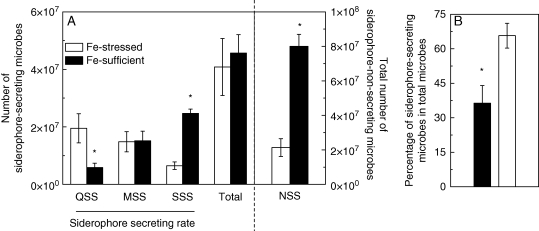
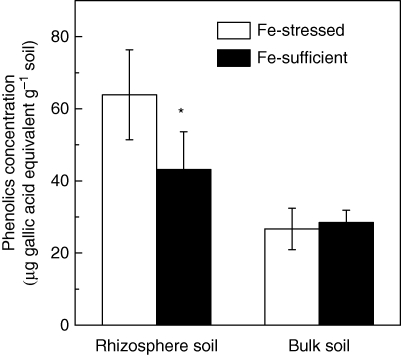
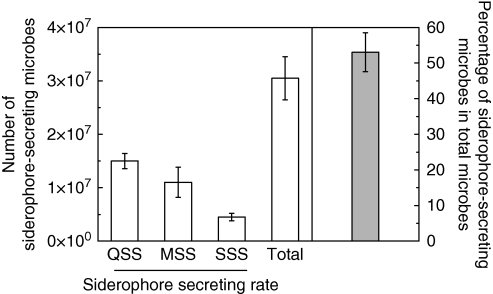
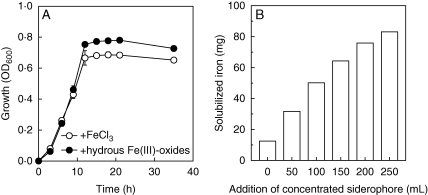
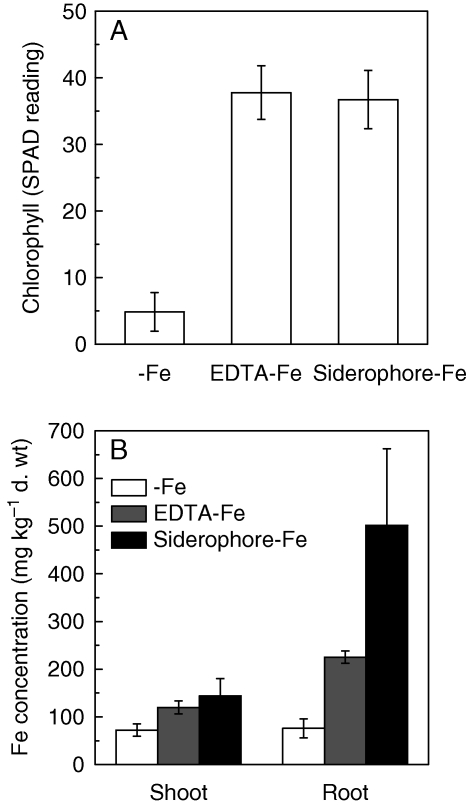
Key results: In rhizosphere soil, the number of microbes that secreted siderophores quickly was more in the Fe-stressed treatment than in the Fe-sufficient one, while the number of microbes that did not secret siderophores was the opposite. A significantly higher concentration of phenolics was detected in the rhizosphere soil of Fe-stressed plants. Moreover, after the soil was incubated with phenolic root exudates, the composition of the siderophore-secreting microbial community was similar with that of the rhizosphere of Fe-stressed plant. Additionally, the siderophores produced by a rhizospheric microbe isolated from the Fe-stressed treatment can well solubilize iron oxides/hydroxides, and the utilization of the siderophore-solubilized Fe by plant was even more efficient than EDTA-Fe.
Conclusions: Iron-deficiency stress of red clover would alter the composition of siderophore-secreting microbes in the rhizosphere, which is probably due to the phenolics secretion of the root, and may in turn help to improve the solubility of Fe in soils and plant Fe nutrition via elevated microbial siderophore secretion.
Figures
References
-
- Bienfait HF, Bino AM, van der Bliek AM, Duivenvoorden JF, Fontaine JM. Characterization of ferric reducing activity in roots of Fe-deficient Phaseolus vulgaris. Physiologia Plantarum. 1983;59:196–202.
-
- Blum U, Staman KL, Flint LJ, Shafer SR. Induction and/or selection of phenolic acid-utilizing bulk-soil and rhizosphere bacteria and their influence on phenolic acid phytotoxicity. Journal of Chemical Ecology. 2000;26:2059–2078.
-
- Boukhalfa H, Crumbliss AL. Chemical aspects of siderophore mediated iron transport. Biometals. 2002;15:325–339. - PubMed
-
- Chang YC, Ma JF, Iwashita T, Matsumoto H. Effect of Al on the phytosiderophore-mediated solubilization of Fe and uptake of Fe-phytosiderophore complex in wheat (Triticum aestivum) Physiologia Plantarum. 1999;106:62–68.
-
- Chen LM, Dick WA, Streeter JG, Hoitink HAJ. Fe chelates from compost microorganisms improve Fe nutrition of soybean and oat. Plant and Soil. 1998;200:139–147.
Publication types
MeSH terms
Substances
LinkOut - more resources
Full Text Sources
Other Literature Sources
Medical
