


The IgG-specific endoglycosidase EndoS inhibits both cellular and complement-mediated autoimmune hemolysis
- PMID: 20357243
- PMCID: PMC2890147
- DOI: 10.1182/blood-2009-08-239020
The IgG-specific endoglycosidase EndoS inhibits both cellular and complement-mediated autoimmune hemolysis
Abstract
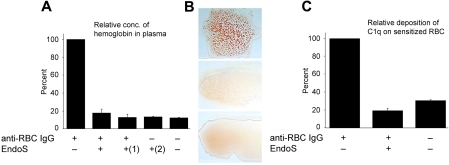
EndoS from Streptococcus pyogenes is an immunomodulating enzyme that specifically hydrolyzes glycans from human immunoglobulin G and thereby affects antibody effector functions. Autoimmune hemolytic anemia is caused by antibody-mediated red blood cell (RBC) destruction and often resists treatment with corticosteroids that also cause frequent adverse effects. We show here that anti-RhD (anti-D) and rabbit anti-human-RBC antibodies (anti-RBC) mediated destruction of RBC, ie, phagocytosis, complement activation, and hemolysis in vitro and in vivo was inhibited by EndoS. Phagocytosis by monocytes in vitro was inhibited by pretreatment of anti-D with EndoS before sensitization of RBCs and abrogated by direct addition of EndoS to blood containing sensitized RBCs. The toxic effects of monocytes stimulated with anti-D-sensitized RBCs, as measured by interleukin-8 secretion and oxygen metabolite production, was restrained by EndoS. Agglutination of RBCs and complement-mediated hemolysis in vitro in whole human blood caused by rabbit anti-RBCs was inhibited by EndoS. Development of anemia in mice caused by a murine anti-RBC immunoglobulin G2a monoclonal autoantibody and complement activation and erythrophagocytosis by Kupffer cells in the liver were reduced by EndoS. Our data indicate that EndoS is a potential therapeutic agent that might be evaluated as an alternative to current treatment regimens against antibody-mediated destruction of RBCs.
Figures



References
-
- Petz L, Garatty G. Immune Hemolytic Anemias. 2nd ed. Philadelphia, PA: Churchill Livingstone; 2004.
-
- Kavai M, Szegedi G. Immune complex clearance by monocytes and macrophages in systemic lupus erythematosus. Autoimmun Rev. 2007;6(7):497–502. - PubMed
-
- Daniels G. Naming blood groups and the genes that control them. ISBT Science Series. 2009;4(1):118–120.
-
- Suto Y, Ishikawa Y, Hyodo H, Uchikawa M, Juji T. Gene organization and rearrangements at the human Rhesus blood group locus revealed by fiber-FISH analysis. Hum Genet. 2000;106(2):164–171. - PubMed
-
- Kumpel BM, Goodrick MJ, Pamphilon DH, et al. Human Rh D monoclonal antibodies (BRAD-3 and BRAD-5) cause accelerated clearance of Rh D+ red blood cells and suppression of Rh D immunization in Rh D− volunteers. Blood. 1995;86(5):1701–1709. - PubMed
Publication types
MeSH terms
Substances
LinkOut - more resources
Full Text Sources
Other Literature Sources
Molecular Biology Databases
