. 2009 Apr-Jun;2(2):99-106.
doi: 10.4161/oxim.2.2.8493.

Implications for degenerative disorders: antioxidative activity, total phenols, flavonoids, ascorbic acid, beta-carotene and beta-tocopherol in Aloe vera

Affiliations
Free PMC article

Implications for degenerative disorders: antioxidative activity, total phenols, flavonoids, ascorbic acid, beta-carotene and beta-tocopherol in Aloe vera

Nurten Ozsoy et al. Oxid Med Cell Longev. 2009 Apr-Jun.
Free PMC article

Abstract

In order to demonstrate whether the known biological effects of Aloe vera (L.) Burm. fil. could correlate with the antioxidant activity of the plant, the antioxidant activity of the aqueous leaf extract was investigated. The present study demonstrated that the aqueous extract from A. vera leaves contained naturally occuring antioxidant components, including total phenols, flavonoids, ascorbic acid, beta-carotene and alpha-tocopherol. The extract exhibited inhibitory capacity against Fe(3+)/ascorbic acid induced phosphatidylcholine liposome oxidation, scavenged stable DPPH(*), ABTS(*+) and superoxide anion radicals, and acted as reductant. In contrast, the leaf inner gel did not show any antioxidant activity. It was concluded that the known beneficial effects of Aloe vera could be attributed to its antioxidant activity and could be related to the presence of phenolic compounds and antioxidant vitamins.

Keywords: Aloe vera; antioxidant activity; antioxidant vitamins; aqueous extract.


Figures
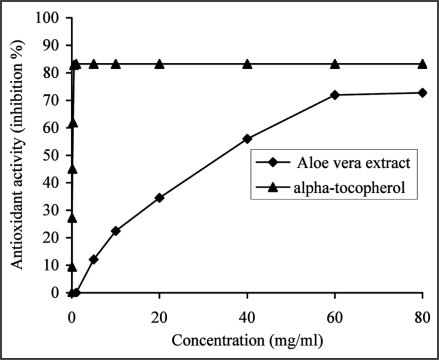
Figure 1
Figure 1
The ability of the aqueous extract from Aloe vera leaf and α-tocopherol, used as a reference antioxidant to inhibit Fe3+/ascorbic acid induced peroxidation in liposomes was estimated as a function of increasing extract (from 5 to 60 mg/ml) and α-tocopherol (from 0.031 to 0.5 mg/ml) concentrations and by recording the absorbance at 532 nm. The results were expressed as a mean percent inhibiton on MDA formation by extract (from 12.0 ± 1.38 to 71.9 ± 0.65%) and α-tocopherol (from 9.4 ± 0.76 to 82.9 ± 0.56%), derived from three separate assays. The extract (at 60 mg/ml) was significantly less effective (p < 0.05) than α-tocopherol (at 0.5 mg/ml).
Figure 2
Figure 2
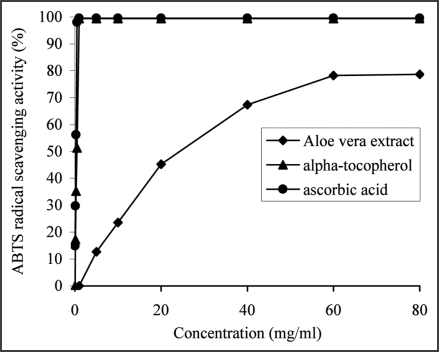
The ability of the aqueous extract from Aloe vera leaf or α-tocopherol and ascorbic acid, used as reference antioxidants to scavenge ABTS*+ was estimated as a function of increasing extract (from 5 to 60 mg/ml) or α-tocopherol (from 0.125 to 1 mg/ml) and ascorbic acid (from 0.0625 to 0.5 mg/ml) concentrations and by recording the decrease in absorbance at 734 nm. The results were expressed as a mean percent scavenging activity of the extract (from 12.6 ± 0.96 to 78.2 ± 0.85%), α-tocopherol (from 17.2 ± 0.43 to 99.4 ± 0.45%) and ascorbic acid (from 14.8 ± 0.78 to 98.03 ± 0.64%), derived from three separate assays. The extract (at 60 mg/ml) was significantly less effective (p < 0.05) than α-tocopherol (at 1 mg/ml) and ascorbic acid (at 0.5 mg/ml).
Figure 3
Figure 3
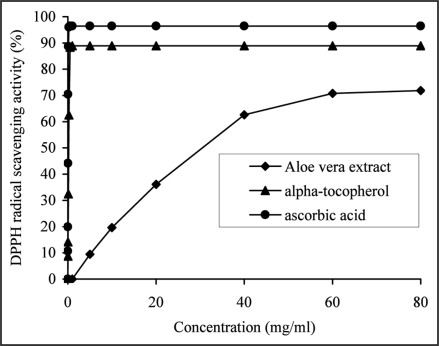
The ability of the aqueous extract from Aloe vera leaf or α-tocopherol and ascorbic acid, used as reference antioxidants to scavenge DPPH was estimated as a function of increasing extract (from 5 to 60 mg/ml) or α-tocopherol (from 0.031 to 0.5 mg/ml) and ascorbic acid (from 0.008 to 0.25 mg/ml) concentrations and by recording the decrease in absorbance at 517 nm. The results were expressed as a mean percent DPPH scavenging activity of the extract (from 6.4 ± 0.84 to 70.8 ± 0.27%), α-tocopherol (from 8.7 ± 1.06 to 88.3 ± 1.81%) and ascorbic acid (from 10.6 ± 1.74 to 96.01 ± 0.37%), derived from three separate assays. The extract (at 60 mg/ml) was significantly less effective (p < 0.05) than α-tocopherol (at 0.5 mg/ml) and ascorbic acid (at 0.25 mg/ml).
Figure 4
Figure 4
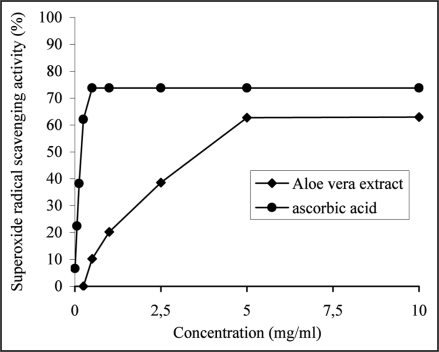
The ability of the aqueous extract from Aloe vera leaves and ascorbic acid, used as a reference antioxidant to inhibit the generation of superoxide radical by xanthine/xanthine oxidase system was estimated as a function of increasing extract (from 0.5 to 5 mg/ml) and ascorbic acid (from 0.05 to 0.25 mg/ml) concentration and by recording the decrease in absorbance at 560 nm. The results were expresed as percent inhibiton of NBT reduction by the extract (from 10.2 ± 1.33 to 62.72 ± 2.06%) and ascorbic acid (from 6.63 ± 1.23 to 62.06 ± 1.44%), derived from three separate assays. No difference was observed between the superoxide radical scavenging activities of the extract at 5 mg/ml and ascorbic acid at 0.25 mg/ml, p > 0.05.

References

    1. Govindarajan R, Vijayakumar M, Pushpangadan P. Antioxidant approach to disease menagement and the role of ‘Rasayana’ herbs of Ayurveda. J Ethnopharmacol. 2005;99:165–178. - PubMed
    1. Kaliora AC, Dedoussis GVZ, Schmidt H. Dietary antioxidants in preventing atherogenesis. Atherosclerosis. 2006;187:1–17. - PubMed
    1. Shahidi F, Wanasundara PKJPD. Phenolic antioxidants. Crit Rev Food Sci Nutr. 1992;32:67–103. - PubMed
    1. Saito H. Purification of active substances of Aloe arborescens Miller and their biological and pharmacological activity. Phytother Res. 1993;7:S14–S19.
    1. Vázquez B, Avila G, Segura D, Escalante B. Antiinflammatory activity of extracts from Aloe vera gel. J Ethnopharmacol. 1996;55:69–75. - PubMed

Publication types

MeSH terms