. 2010 Jul;38(13):4325-36.
doi: 10.1093/nar/gkq175. Epub 2010 Mar 31.

Cell-type-specific long-range looping interactions identify distant regulatory elements of the CFTR gene

Affiliations

Cell-type-specific long-range looping interactions identify distant regulatory elements of the CFTR gene

Nele Gheldof et al. Nucleic Acids Res. 2010 Jul.

Abstract

Identification of regulatory elements and their target genes is complicated by the fact that regulatory elements can act over large genomic distances. Identification of long-range acting elements is particularly important in the case of disease genes as mutations in these elements can result in human disease. It is becoming increasingly clear that long-range control of gene expression is facilitated by chromatin looping interactions. These interactions can be detected by chromosome conformation capture (3C). Here, we employed 3C as a discovery tool for identification of long-range regulatory elements that control the cystic fibrosis transmembrane conductance regulator gene, CFTR. We identified four elements in a 460-kb region around the locus that loop specifically to the CFTR promoter exclusively in CFTR expressing cells. The elements are located 20 and 80 kb upstream; and 109 and 203 kb downstream of the CFTR promoter. These elements contain DNase I hypersensitive sites and histone modification patterns characteristic of enhancers. The elements also interact with each other and the latter two activate the CFTR promoter synergistically in reporter assays. Our results reveal novel long-range acting elements that control expression of CFTR and suggest that 3C-based approaches can be used for discovery of novel regulatory elements.


Figures

Figure 1.
Figure 1.
Chromosome conformation capture (3C) reveals four elements that interact with the CFTR transcription start site. All experiments used EcoRI to digest the chromatin. Interaction frequencies between the CFTR transcription start site and a 460 kb surrounding region are determined by 3C. Primer sequences can be found in Supplementary Table S1. 3C data can be found in Supplementary Table S2. (A) 3C profile of Caco2 cells (black circles), which express the CFTR gene, and GM06990 cells (white circles), which express the gene at low levels. (B) 3C profile of HT29 cells (black circles), which express the CFTR gene, and K562 cells (white circles) which do not express the gene. (C) 3C profile of HeLa S3 cells (black circles) which express the CFTR gene, and HepG2 cells (white circles), which do not express the gene.
Figure 2.
Figure 2.
3C interaction profiles for each of the four elements. All experiments used EcoRI to digest the chromatin. 3C data can be found in Supplementary Table S2. (A) The anchor point is set at element I in Caco2 and GM06990 cells, showing interactions between elements I and II, the transcription start site (TSS), and elements III and IV in Caco2 cells, with no notable interactions in GM06990 cells. (B) The anchor point is set at element I in HeLa S3 and HepG2 cells, showing interactions between element I and elements II, TSS, III and IV in HeLa S3 cells, with no notable interactions in HepG2 cells. (C) The anchor point is set at element II in Caco2 and GM06990 cells, showing interactions between elements II and I, TSS, elements III and IV in Caco2 cells, with no notable interactions in GM06990 cells. (D) The anchor point is set at element II in HeLa S3 and HepG2 cells, showing interactions between element II and elements I, TSS, III and IV in HeLa S3 cells, with no notable interactions in HepG2 cells. (E) The anchor point is set at element III in Caco2 and GM06990 cells, showing interactions between element III and elements I, II, TSS and element IV in Caco2 cells, with no notable interactions in GM cells. (F) The anchor point is set at element III in HeLa S3 and HepG2 cells, showing interactions between element III and elements I, II, TSS, and element IV in HeLa S3 cells, with no notable interactions in HepG2 cells. (G) The anchor point is set at element IV in Caco2 and GM06990 cells, showing interactions between element IV and elements I, II, TSS, and element III in Caco2 cells, with no notable interactions in GM06990 cells. (H) The anchor point is set at element IV in HeLa S3 and HepG2 cells, showing interactions between element IV and elements I, II, TSS, and element III in HeLa S3 cells, with no notable interactions in HepG2 cells.
Figure 3.
Figure 3.
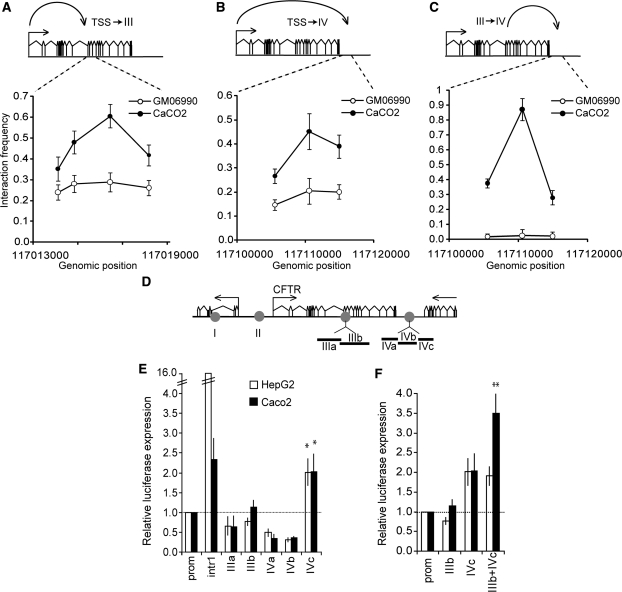
Fine mapping of the looping interactions between the CFTR promoter and elements III and IV, and luciferase assays showing that these two elements can synergistically activate the CFTR promoter. 3C primers and data can be found in Supplementary Tables S1 and S2. (A–C) 3C profiles using BsrGI to digest the chromatin focused on element III (A), anchored at the TSS. The interaction peak corresponds to a 1066 bp fragment. (B) 3C focused on element IV, anchored at the TSS. The interaction peak corresponds to a 1560 bp fragment. (C) 3C focused on element IV anchored at element III. The interaction peak corresponds to the same 1560 bp fragment that interacts with the CFTR TSS. (D) Outline of the fragments used in the luciferase assay. Element III was split into two fragments; element IV was split into three fragments. (E) Relative luciferase expression data, where ‘Prom’ refers to the fragment containing only the CFTR TSS and promoter region (pGL3-basic vector-promoter alone construct; see ‘Materials and Methods’ section), and was set as 1, and ‘intr1’ is a known enhancer element from intron 1 of the CFTR gene used as a positive control. Only element IVc showed enhanced luciferase expression compared to the promoter alone [P<0.05 (t-test) for both Caco2 and HepG2 cells]. (F) When elements IIIb and IVc were combined, a synergistic enhancer effect was observed only in the CFTR-expressing cell line Caco2 [P<0.01 (t-test)] when compared to element IVc alone in Caco2 cells. Asterisks indicate statistically significant differences from [Prom] (Panel E), or from [IIIb+IVc in HepG2] (Panel F). *P < 0.05; **P < 0.01.
Figure 4.
Figure 4.
Data from the ENCODE consortium in the UCSC Genome Browser hg18 [(10); http://genome.ucsc.edu/ENCODE/]. Fragments used in the luciferase assay are indicated by black bars with white arrows. Restriction fragments that show 3C interaction peaks are outlined with grey boxes. A boxed outline indicates the narrowed-down functional region. Histone methylation, acetylation and DHS data are shown, with ‘positive hits’ shown as darker grey regions. (A) Region 117 013 000–117 019 000 on chromosome 7, which contains element III. (B) Region 117 100 000–117 120 000 on chromosome 7, which contains element IV.
Figure 5.
Figure 5.
Different models of the conformation of the CFTR locus. (A) The CFTR locus in a cell line in which the gene is not expressed. The locus assumes a linear conformation without specific long-range interactions. Thick black line indicates the CFTR gene. (B) The CFTR locus in a cell line that does express the gene. All four elements interact with the promoter, and with each other. The grey circle symbolizes the spatial domain containing the clustered promoter and regulatory elements.

References

    1. Kleinjan DA, van Heyningen V. Long-range control of gene expression: emerging mechanisms and disruption in disease. Am. J. Hum. Genet. 2005;76:8–32. - PMC - PubMed
    1. West AG, Fraser P. Remote control of gene transcription. Hum. Mol. Genet. 2005;14:R101–111. - PubMed
    1. Dekker J. Gene regulation in the third dimension. Science. 2008;319:1793–1794. - PMC - PubMed
    1. Kleinjan DA, Seawright A, Schedl A, Quinlan RA, Danes S, van Heyningen V. Aniridia-associated translocations, DNase hypersensitivity, sequence comparison and transgenic analysis redefine the functional domain of PAX6. Hum. Mol. Genet. 2001;10:2049–2059. - PubMed
    1. D’haene B, Attanasio C, Beysen D, Dostie J, Lemire E, Bouchard P, Field M, Jones K, Lorenz B, Menten B, et al. Disease-causing 7.4 kb cis-Regulatory deletion disrupting conserved non-coding sequences and their interaction with the FOXL2 promotor: implications for mutation screening. PLoS Genet. 2009;5:e1000522. - PMC - PubMed

Publication types

MeSH terms

Substances