doi: 10.1681/ASN.2009070759.
Epub 2010 Apr 1.
Macula densa sensing and signaling mechanisms of renin release
Affiliations
- PMID: 20360309
- PMCID: PMC4577295
- DOI: 10.1681/ASN.2009070759
Item in Clipboard
Macula densa sensing and signaling mechanisms of renin release
J Am Soc Nephrol.
2010 Jul.
Abstract
Macula densa cells in the distal nephron, according to the classic paradigm, are salt sensors that generate paracrine chemical signals in the juxtaglomerular apparatus to control vital kidney functions, including renal blood flow, glomerular filtration, and renin release. Renin is the rate-limiting step in the activation of the renin-angiotensin system, a key modulator of body fluid homeostasis. Here, we discuss recent advances in understanding macula densa sensing and suggest these cells, in addition to salt, also sense various chemical and metabolic signals in the tubular environment that directly trigger renin release.
Figures
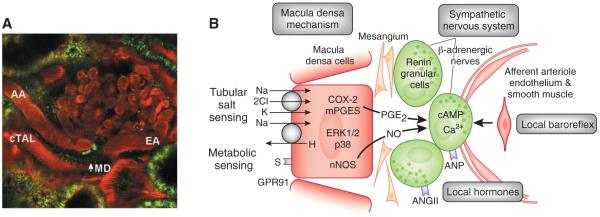
Fluorescence microscopic image (A) and schematic (B) of the juxtaglomerular apparatus (juxtaglomerular apparatus). (A) A multiphoton confocal fluorescence image of the juxtaglomerular apparatus in the intact rat kidney in vivo showing the afferent (AA) and efferent arterioles (EA) and cortical thick ascending limb (cTAL) containing the macula densa. Original magnification, ×250. Renin granular content in juxtaglomerular cells under the macula densa is labeled green using quinacrine as described before. (B) The main control mechanisms of renin release and elements of the macula densa sensing and signaling apparatus. Macula densa cells can sense variations in tubular fluid composition, including salt content and metabolites such as succinate. Salt is sensed via the NKCC2 and NHE2, whereas tubular succinate triggers the metabolic receptor GPR91 at the luminal plasma membrane. Signal transduction includes activation of MAP kinases p38 and pERK1/2, PGE2 synthesis through COX-2, and mPGES. PGE2 via paracrine signaling causes increased renin synthesis and release from adjacent juxtaglomerular cells and activation of the renin-angiotensin system (RAS). S, succinate; nNOS, neural nitric oxide synthase.
References
-
- Schnermann J, Briggs JP. Function of the juxtaglomerular apparatus: Control of glomerular hemodynamics and renin secretion. In: Alpern RJ, Hebert SC, editors. The Kidney Physiology and Pathophysiology. Elsevier Academic Press; Burlington/San Diego/London: 2008. pp. 589–626.
-
- Schnermann J, Levine DZ. Paracrine factors in tubuloglomerular feedback: Adenosine ATP, and nitric oxide. Annu Rev Physiol. 2003;65:501–529. - PubMed
-
- Bell PD, Lapointe JY, Peti-Peterdi J. Macula densa cell signaling. Annu Rev Physiol. 2003;65:481–500. - PubMed
-
- Lorenz JN, Weihprecht H, Schnermann J, Skøtt O, Briggs JP. Renin release from isolated juxtaglomerular apparatus depends on macula densa chloride transport. Am J Physiolv. 1991;260:F486–F493. - PubMed
Publication types
MeSH terms
Substances
Grants and funding
LinkOut - more resources
Full Text Sources
Other Literature Sources