


Locomotor activity and gait in aged mice deficient for type IX collagen
- PMID: 20360435
- PMCID: PMC2904201
- DOI: 10.1152/japplphysiol.00056.2010
Locomotor activity and gait in aged mice deficient for type IX collagen
Abstract
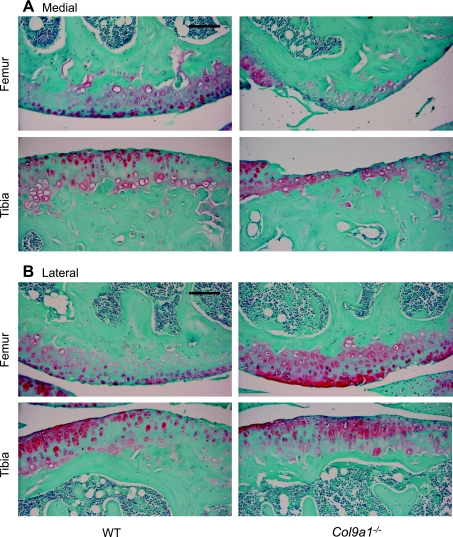
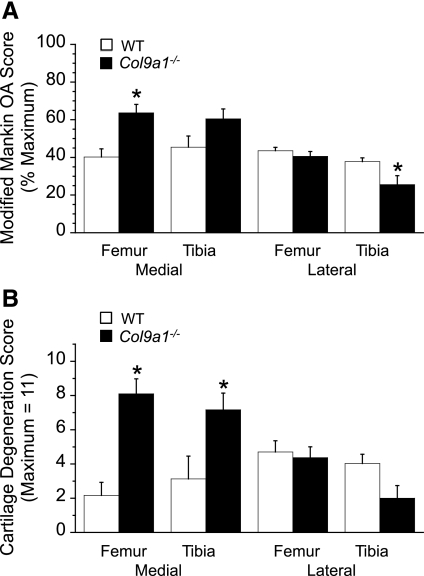
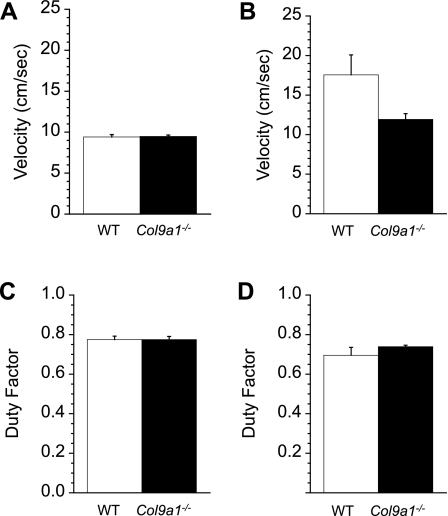
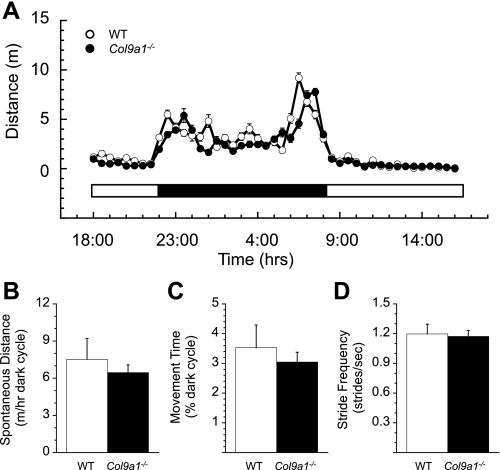
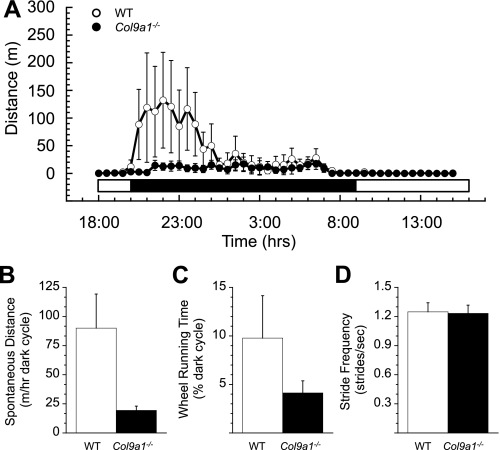
Osteoarthritis (OA) is a risk factor for physical inactivity and impaired mobility, but it is not well understood how these locomotor behaviors are affected by the age of onset of OA and disease severity. Male mice homozygous for a Col9a1 gene inactivation (Col9a1(-/-)) develop early onset knee OA, increased tactile pain sensitivity, and gait alterations by 9 mo of age. We hypothesized that aged Col9a1(-/-) mice would reduce joint pain by adopting locomotor behaviors that reduce both the magnitude and daily frequency of joint loading. We tested this hypothesis by evaluating gait and spontaneous locomotor activity in 15- to 17-mo-old male Col9a1(-/-) (n = 5) and Col9a1(+/+)(WT) (n = 5) mice using well-controlled measures of voluntary activity in overground and running wheel conditions, as well as studies of gait in a velocity-controlled treadmill. We found no difference due to genotype in freely chosen locomotor velocity, stride frequency, hindfoot duty factor, dark phase activity time, or dark-phase travel distance during overground, running wheel, or speed-matched treadmill locomotion. Interpretation of these findings is potentially confounded by the observation that WT mice have greater knee OA than Col9a1(-/-) mice in the lateral tibial plateau by 17 mo of age. When accounting for individual differences in knee OA, functional locomotor impairments in aged Col9a1(-/-) and WT mice are manifested as reductions in total locomotor activity levels (e.g., both distance traveled and time active), particularly for wheel running. These results support the concept that current disease status, rather than age of disease onset, is the primary determinant of impaired locomotor activity with aging.
Figures
References
-
- Akimoto T, Ribar TJ, Williams RS, Yan Z. Skeletal muscle adaptation in response to voluntary running in Ca2+/calmodulin-dependent protein kinase IV-deficient mice. Am J Physiol Cell Physiol 287: C1311– C1319, 2004 - PubMed
-
- Al-Zahrani KS, Bakheit AM. A study of the gait characteristics of patients with chronic osteoarthritis of the knee. Disabil Rehabil 24: 275– 280, 2002 - PubMed
-
- Alexander RM, Jayes AS. Fourier analysis of forces exerted in walking and running. J Biomech 13: 383– 390, 1980 - PubMed
-
- Allen DL, Harrison BC, Maass A, Bell ML, Byrnes WC, Leinwand LA. Cardiac and skeletal muscle adaptations to voluntary wheel running in the mouse. J Appl Physiol 90: 1900– 1908, 2001 - PubMed
Publication types
MeSH terms
Substances
Grants and funding
LinkOut - more resources
Full Text Sources
Medical
Molecular Biology Databases
