


Chronic hypercapnia alters lung matrix composition in mouse pups
- PMID: 20360436
- PMCID: PMC2904197
- DOI: 10.1152/japplphysiol.00610.2009
Chronic hypercapnia alters lung matrix composition in mouse pups
Abstract
Rationale: permissive hypercapnia, a stretch-limiting ventilation strategy, often results in high Pa(CO(2)). This strategy is associated with reduced morbidity and mortality in premature infants and its benefits have been attributed to diminished barotrauma. However, little is known about the independent effect of high CO(2) levels during the lung development.
Methods: mice were exposed to 8% CO(2) or room air for 2 wk either from postnatal day 2 through 17 or as adults (approximately 2 mo of age). Lungs were excised and processed for protein, RNA, histology, and total lung volumes.
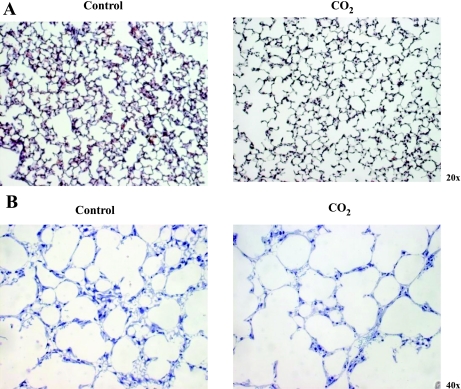
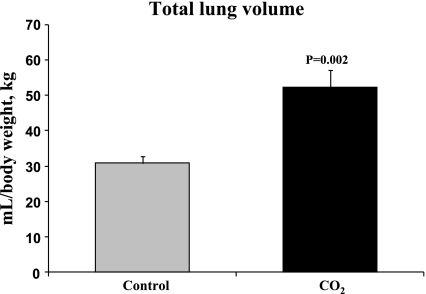
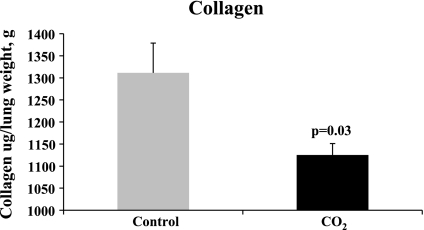
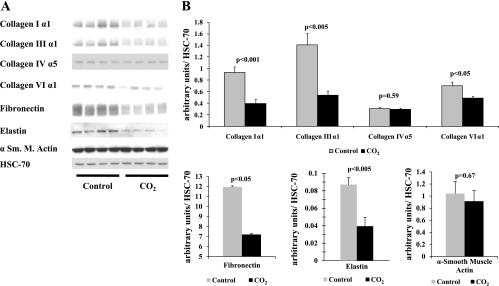
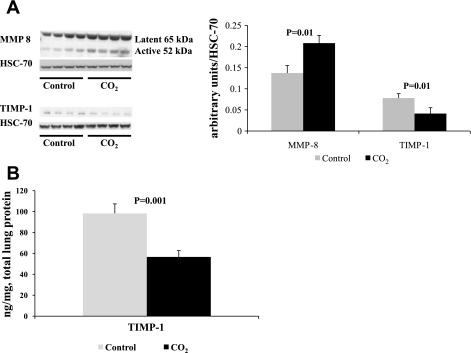
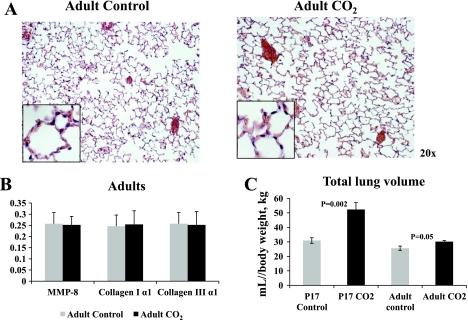
Results: histologic analysis demonstrated that alveolar walls of CO(2)-exposed mouse pups were thinner than those of controls and had twice the total lung volume. Molecular analysis revealed that several matrix proteins in the lung were downregulated in mouse pups exposed to hypercapnia. Interstitial collagen type I alpha1, type III alpha1, elastin and fibronectin protein, and mRNA levels were less than half of controls while collagen IV alpha 5 was unaffected. This decrease in interstitial collagen could thus account for the thinning of the interstitial matrix and the altered lung biomechanics. Matrix metalloproteinase (MMP)-8, a collagenase that has specificity for collagen types I and III, increased in hypercapnic mouse pups, suggesting increased collagen degradation. Moreover, tissue inhibitor of MMP (TIMP)-1, a potent inhibitor of MMP-8, was significantly decreased. However, unlike pups, adult mice exposed to hypercapnia demonstrated only a mild increase in total lung volumes and did not exhibit similar molecular or histologic changes.
Conclusions: although permissive hypercapnia may prevent lung injury from barotrauma, our study revealed that exposure to hypercapnia may be an important factor in lung remodeling and function, especially in early life.
Figures
References
-
- Amato MB, Barbas CS, Medeiros DM, Magaldi RB, Schettino GP, Lorenzi-Filho G, Kairalla RA, Deheinzelin D, Munoz C, Oliveira R, Takagaki TY, Carvalho CR. Effect of a protective-ventilation strategy on mortality in the acute respiratory distress syndrome. N Engl J Med 338: 347– 354, 1998 - PubMed
-
- Bamford OS, Schuen JN, Carroll JL. Effect of nicotine exposure on postnatal ventilatory responses to hypoxia and hypercapnia. Respir Physiol 106: 1– 11, 1996 - PubMed
-
- Bradley KH, McConnell SD, Crystal RG. Lung collagen composition and synthesis. Characterization and changes with age. J Biol Chem 249: 2674– 2683, 1974 - PubMed
-
- Burchardi H. New strategies in mechanical ventilation for acute lung injury. Eur Respir J 9: 1063– 1072, 1996 - PubMed
-
- Burri PH. Postnatal growth and maturation of the lung. Chest 67: 2S– 3S, 1975 - PubMed
Publication types
MeSH terms
Substances
Grants and funding
LinkOut - more resources
Full Text Sources
Research Materials
Miscellaneous
