


Intra-arterial iodinated radiographic contrast material injection administration in a rat middle cerebral artery occlusion and reperfusion model: possible effects on intracerebral hemorrhage
- PMID: 20360541
- PMCID: PMC3726333
- DOI: 10.1161/STROKEAHA.110.578245
Intra-arterial iodinated radiographic contrast material injection administration in a rat middle cerebral artery occlusion and reperfusion model: possible effects on intracerebral hemorrhage
Abstract
Background and purpose: Observations in human interventional stroke treatment led us to hypothesize that iodinated radiographic contrast material use may contribute to intracerebral hemorrhage. Effects of intra-arterial iodinated radiographic contrast material on hemorrhagic transformation after middle cerebral artery occlusion and reperfusion were studied in a placebo-controlled, blinded preclinical study in rats.
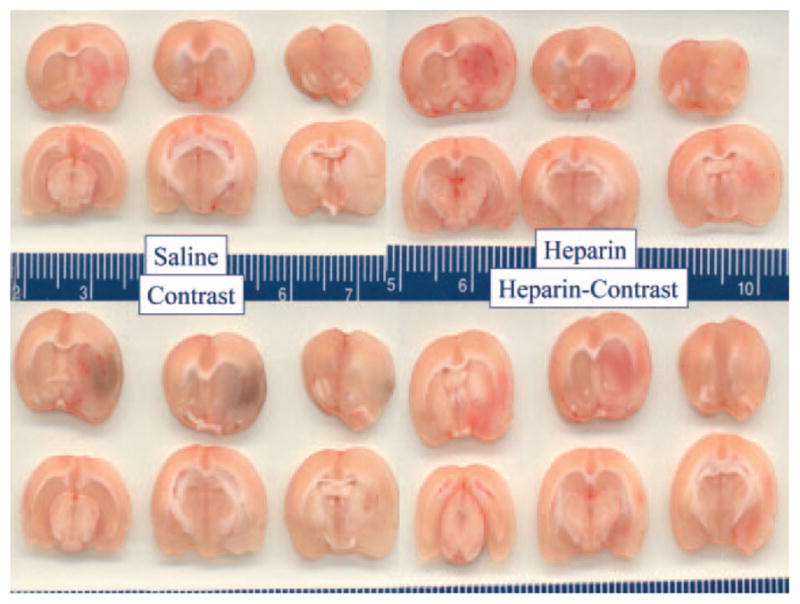
Methods: Four groups of male Sprague-Dawley rats were studied: saline group (n=8), contrast group (n=12), heparin group (n=9), and contrast+heparin group (n=9). The middle cerebral artery was occluded for 5 hours using suture placement. Heparin was infused before suture removal and reperfusion. Saline and/or contrast were infused immediately during reperfusion. Incidence, location, and size of hemorrhage were determined by brain necropsy inspection at 24 hours.
Results: There was a significant increase in incidence of cortical hemorrhage from control (37.5%), contrast (75.0%), heparin (77.8%) to contrast+heparin (100%; Cochran-Mantel-Haenszel correlation, P<0.01). Both pooled contrast groups (85.7%) and pooled heparin groups (88.9%) had higher rates of cortical intracerebral hemorrhage compared with the control group (P<0.05). Similar trends for increased cortical intracerebral hemorrhage were seen in the contrast-only (P=0.18) and heparin-only (P=0.18) groups. There was a trend for decreased infarct edema in rats receiving contrast versus those without (P=0.06).
Conclusions: Intraarterial iodinated radiographic contrast material may increase cortical intracerebral hemorrhage, similar to heparin. Iodinated radiographic contrast material effect may be additive to heparin effect on the incidence of cortical intracerebral hemorrhage.
Figures
References
-
- Toni D, Fiorelli M, Bastianello S, Sacchetti ML, Sette G, Argentino C, Montinaro E, Bozzao L. Hemorrhagic transformation of brain infarct. Neurology. 1996;46:341–345. - PubMed
-
- Del Zoppo GJ, Higashida RT, Furlan AJ, Pessin MS, Rowley HA, Gent M. PROACT: a phase II randomized trial of recombinant prourokinase by direct arterial delivery in acute middle cerebral artery stroke. Stroke. 1998;29:4–11. - PubMed
-
- Kendall BE, Pullicino P. Intravascular contrast injection in ischemic lesions. Neuroradiolgy. 1980;19:241–243. - PubMed
-
- Hayman LA, Evans RA, Bastion FO, Hinck VC. Delayed high dose contrast CT: identifying patients at risk of massive hemorrhagic infarction. AJNR Am J Neuroradiol. 1981;136:1151–1159. - PubMed
-
- Dzialowski I, Puetz V, Demchuk AM. Does application of radio contrast material prior to thrombolysis impact thrombolytic effect in acute ischemic stroke? Stroke. 2008;39:601.
Publication types
MeSH terms
Substances
Grants and funding
LinkOut - more resources
Full Text Sources
