Review
. 2010 Feb;4(1):51-63.
doi: 10.2217/BMM.09.83.

Cerebrospinal fluid biomarkers of Alzheimer's disease

Affiliations
Review

Cerebrospinal fluid biomarkers of Alzheimer's disease

Anne M Fagan et al. Biomark Med. 2010 Feb.

Abstract

Alzheimer's disease will reach epidemic proportions within the next 20-30 years if left unchecked. Currently, there are no treatments that prevent or slow Alzheimer's disease but many are being developed. Parallel efforts to develop biomarkers to aid in disease diagnosis and prognosis, and assess disease risk are currently underway. Clinicopathological and biomarker studies have demonstrated that Alzheimer's disease pathology can be detected preclinically. Using biomarkers to identify affected individuals prior to the onset of clinical symptoms and associated synaptic/neuronal loss should enable novel clinical trial design and early mechanism-based therapeutic intervention. This article summarizes the most promising cerebrospinal fluid biomarkers, highlights novel applications and current challenges, and provides a prediction on how the field may evolve in 5-10 years.

Keywords: Alzheimer’s disease; amyloid-β; biomarkers; cerebrospinal fluid; preclinical Alzheimer’s disease; tau.


Figures

Figure 1
Figure 1. Biomarkers of Alzheimer’s disease
Hypothesized changes in CSF biomarkers in relation to the time course of pathological and clinical stages, and other biomarker modalities. The clinical stages of AD, marked by progressive dementia described as very mild/MCI, mild, moderate, and severe, correspond with the CDR scores of 0.5, 1, 2, and 3, respectively. These stages are associated with abundant amyloid plaques (red line), the gradual accumulation of neurofibrillary tangles (blue line), synaptic and neuronal loss in certain brain regions (green line). In the preclinical stage of AD, Aβ42 peptide forms amyloid plaques in the brains of nondemented individuals (CDR 0) for approximately 10–20 years, and damages neuronal processes and synapses. Eventually, dramatic neuronal losses occur in association with dementia onset. AD biomarker research seeks to capture these changes in the brain, which might be useful for diagnosis and prognosis during this preclinical phase of AD, before irreversible neuronal loss occurs. These changes can be measured by biochemical examination of CSF, and/or a variety of radiological imaging modalities (e.g., CT, MRI, and PIB PET). The most promising CSF biomarkers to date have been Aβ42 and tau species, which show diagnostic and prognostic utility. BACE1 as an indicator of Aβ production warrants further study, as do panels of inflammatory markers and markers of oxidative stress. Genetic variations (e.g., SNPs) may also be considered biomarkers that allow the earliest possible estimation of risk. Aβ: Amyloid-β;AD: Alzheimer’s disease; BACE: β-site amyloid precursor protein-cleaving enzyme; CDR: Clinical Dementia Rating; CSF: Cerebrospinal fluid; CT: Computed tomography; MCI: Mild cognitive impairment PIB: Pittsburgh compound-B; p-tau: Phosphorylated tau; SNP: Single nucleotide polymorphism. Adapted with permission from [83].
Figure 2
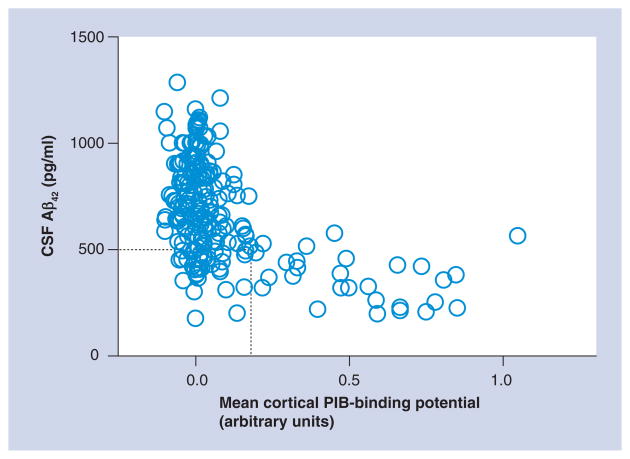
Figure 2. Levels of cerebrospinal fluid amyloid-β42 in cognitively normal individuals as a function of cortical amyloid load as assessed by the amyloid-binding agent Pittsburgh Compound B
The majority of individuals in this cohort (n = 164) exhibited low or no cortical PIB binding (PIB-binding potentials clustering around zero). However, a subset (n = 25) of individuals exhibited positive binding for PIB, similar in level and distribution to what is observed in subjects with dementia of the Alzheimer type (data not shown). All of the PIB-positive individuals had relatively low levels of CSF Aβ42, whereas PIB-negative individuals had high levels of CSF Aβ42, indicating that low CSF Aβ42 is an excellent marker of cortical amyloid. A subset of individuals exhibited low CSF Aβ42 in the absence of cortical PIB binding (within the dashed box). Longitudinal follow-up of these individuals will be required to determine whether they eventually become PIB-positive or if they represent a different subgroup (e.g., those with diffuse, PIB-negative, plaques or are just reflective of the low end of the normal CSF Aβ42 spectrum). Aβ: Amyloid-β; CSF: Cerebrospinal fluid; PIB: Pittsburgh Compound B. Adapted with permission from [84].
Figure 3
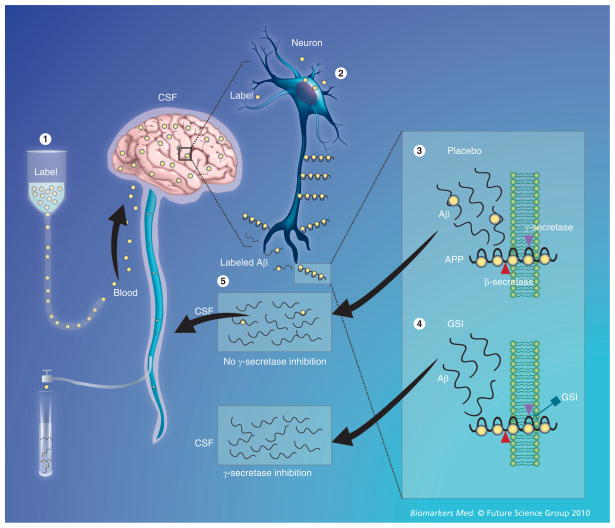
Figure 3. In vivo CNS stable isotope-labeled kinetics of Aβ production and the effect of its inhibition by a γ-secretase inhibitor. (1)
A stable isotope-labeled amino acid is infused into the bloodstream and is transported to the brain. (2) The labeled amino acid is incorporated into newly synthesized proteins (e.g., APP in neurons). (3) Labeled APP is cut by β- and γ-secretases to produce labeled Aβ, or in the presence of a GSI (4) labeled Aβ production is inhibited. (5) Labeled and unlabeled Aβ is transported and cleared through the CSF, which is in direct communication with the extracellular space of the brain, where sampling occurs over time to measure the production and clearance of Aβ. Aβ: Amyloid-β; APP: Amyloid precursor protein; CSF: Cerebrospinal fluid; GSI: γ-secretase inhibitor. Reproduced with permission from [85].

References

Bibliography

    1. Mirra S, Heyman A, McKeel D, et al. The consortium to establish a registry for Alzheimer’s disease (CERAD). Part II Standardization of the neuropathologic assessment of Alzheimer’s disease. Neurology. 1991;41:479–486. - PubMed
    1. Khachaturian Z. Diagnosis of Alzheimer’s disease. Arch Neurol. 1985;42:1097–1105. - PubMed
    1. Hyman B, Trojanowski J. Consensus recommendations for the postmortem diagnosis of Alzheimer disease from the National Institute on Aging and the Reagan Institute Working Group on Diagnostic Criteria for the Neuropathological Assessment of Alzheimer disease. J Neuropathol Exp Neurol. 1997;56:1095–1097. - PubMed
    1. Morris J. The clinical dementia rating (CDR). Current version and scoring rules. Neurology. 1993;43:2412–2414. - PubMed
    1. Petersen R, Smith G, Waring S, Ivnik R, Tabgalos E, Kokmen E. Mild cognitive impairment: clinical characterization and outcome. Arch Neurol. 1999;56:303–308. - PubMed

Websites

    1. Alzheimer’s Association. www.alz.org.
    1. Dominantly Inherited Alzheimer Network (DIAN) www.dian-info.org.

Publication types

MeSH terms