Review
doi: 10.1371/journal.ppat.1000816.
Expansion, maintenance, and memory in NK and T cells during viral infections: responding to pressures for defense and regulation
Affiliations
- PMID: 20361055
- PMCID: PMC2845660
- DOI: 10.1371/journal.ppat.1000816
Item in Clipboard
Review
Expansion, maintenance, and memory in NK and T cells during viral infections: responding to pressures for defense and regulation
PLoS Pathog.
.
No abstract available
Conflict of interest statement
The author has declared that no competing interests exist.
Figures
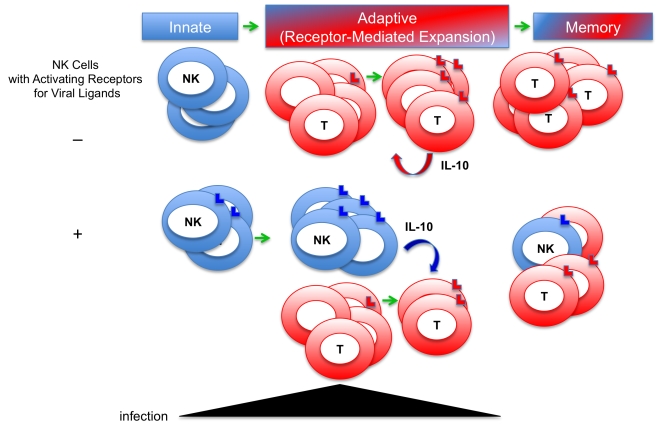
Innate immune responses were first appreciated for their role in early antimicrobial defense. Adaptive responses, including T cell responses, were understood to take longer to develop during first infections because of the need to expand antigen-specific cell subsets from low frequency populations, and to be important for heightened defense, i.e., memory, during secondary infections. The evidence of innate NK cell proliferation and memory has blurred the distinction. Expansion of NK and T cells is a result of stimulation through activating receptors recognizing virus-induced ligands. New evidence indicates that a role for activating receptor-driven proliferation of NK cells is to promote their maintenance during viral infections, and that under conditions of extended infections, the cells produce IL-10 to regulate T cell responses. T cells can also be induced to produce IL-10 to control immune responses. Both NK and T cells can act to protect from immune-mediated disease. These observations underscore the need for evolutionary pressure to protect both from infection and from immune responses to infections.
References
-
- Biron CA, Nguyen KB, Pien GC, Cousens LP, Salazar-Mather TP. Natural killer cells in antiviral defense: function and regulation by innate cytokines. Annu Rev Immunol. 1999;17:189–220. - PubMed
-
- Dokun AO, Kim S, Smith HR, Kang HS, Chu DT, et al. Specific and nonspecific NK cell activation during virus infection. Nat Immunol. 2001;2:951–956. - PubMed
-
- Nguyen KB, Salazar-Mather TP, Dalod MY, Van Deusen JB, Wei XQ, et al. Coordinated and distinct roles for IFN-alpha beta, IL-12, and IL-15 regulation of NK cell responses to viral infection. J Immunol. 2002;169:4279–4287. - PubMed
-
- O'Leary JG, Goodarzi M, Drayton DL, von Andrian UH. T cell- and B cell-independent adaptive immunity mediated by natural killer cells. Nat Immunol. 2006;7:507–516. - PubMed
Publication types
MeSH terms
Grants and funding
LinkOut - more resources
Full Text Sources
Medical