


The impact of functional status on life expectancy in older persons
- PMID: 20363833
- PMCID: PMC2884085
- DOI: 10.1093/gerona/glq029
The impact of functional status on life expectancy in older persons
Abstract
Background: Although life tables provide a basis for estimating remaining life by age, gender, and race, these tables do not consider clinical characteristics or functional status, which can lead to wide variations in remaining years. Inclusion of functional status may permit more precise prognostic estimates of life expectancy and proportion of time in various functional states.
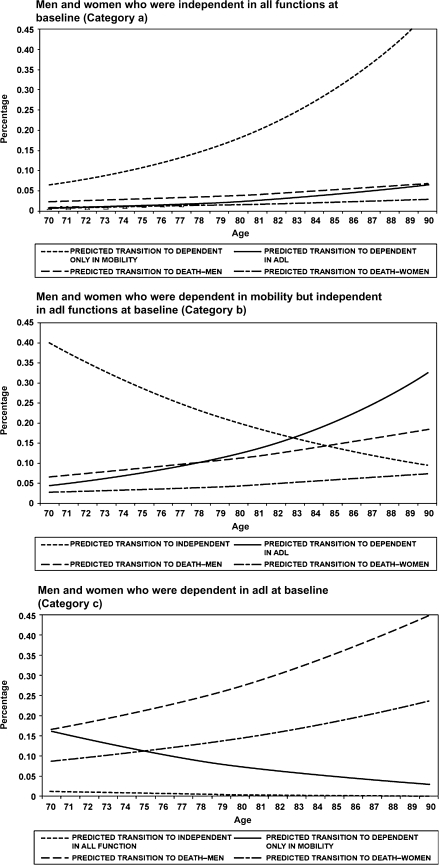
Methods: We used longitudinal data from the Established Populations for Epidemiologic Studies of the Elderly to determine transition probabilities between three functional states (independent in activities of daily living [ADL] and mobility, dependent in mobility but independent in ADL, and dependent in ADL) and death. These were used to estimate total life expectancy and life expectancy in each functional state.
Results: In general, the largest proportion of remaining life expectancy was spent in the persons' baseline functional status category. Persons younger than 80 years with dependencies, however, spend substantial proportions of their remaining years in a better functional status category, and mobility-disabled 70-year-old persons spend the greatest part of their life expectancy in the independent functional state. Functional status has a dramatic impact on life expectancy. For example, 75-year-old men and women without limitations have life expectancies 5 years longer than those with ADL limitation and more than 1 year longer than those limited in mobility. The life expectancy of an ADL-disabled 75-year-old is similar to that of an 85-year-old independent person; thus, the impact of the disability approximates being 10 years older with much more of the remaining life spent disabled.
Conclusions: Both ADL and mobility disability result in diminished survival and more of that survival period spent in disabled states.
Figures
References
-
- National Center for Health Statistics Health. United States, 2008 With Chartbook. Hyattsville, MD: 2009. http://www.cdc.gov/nchs/fastats/lifexpec.htm. Accessed July 9, 2009.
-
- Arias E. United States life tables, 2004. Natl Vital Stat Rep. 2007;56(9):1–39. - PubMed
-
- Ferrucci L, Guralnik JM, Baroni A, Tesi G, Antonini E, Marchionni N. Value of combined assessment of physical health and functional status in community-dwelling aged: a prospective study in Florence, Italy. J Gerontol. 1991;46(2):M52–M56. - PubMed
-
- Reuben DB, Rubenstein LV, Hirsch SH, Hays RD. The value of functional status as a predictor of mortality: results of a prospective study. Am J Med. 1992;93:663–669. - PubMed
-
- Bernard SL, Kincade JE, Konrad TR, et al. Predicting mortality from community surveys of older adults: the importance of self-rated functional ability. J Gerontol Soc Sci. 1997;52:S155–S163. - PubMed
